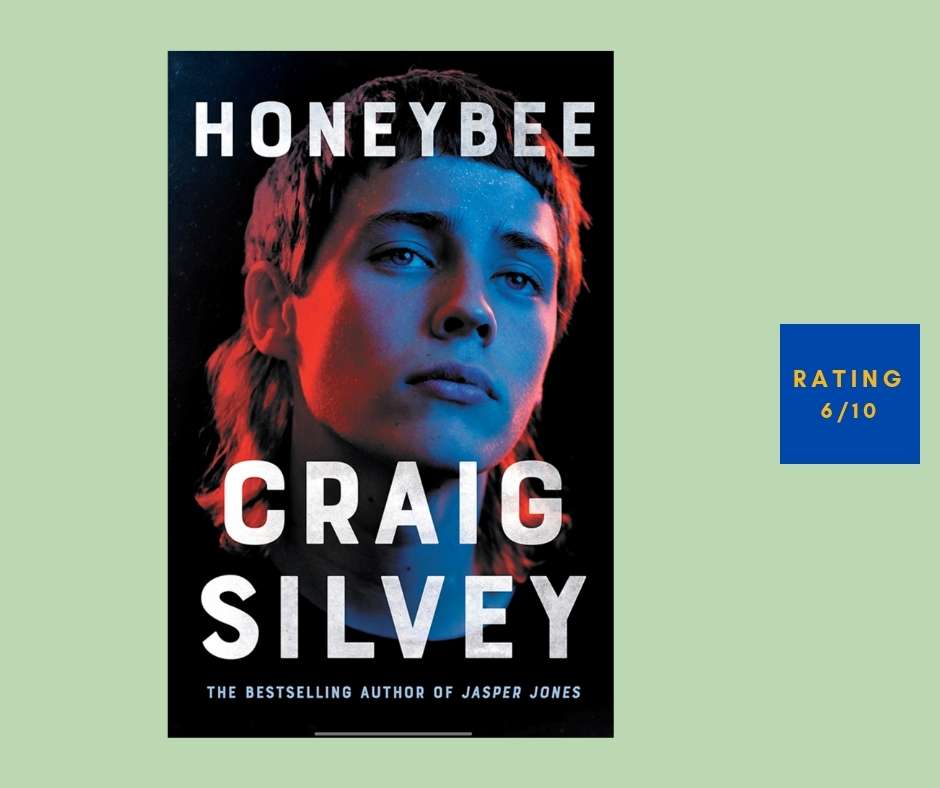
Craig Silvey’s bestselling debut, Jasper Jones, stormed the Australian literary scene and prospered overseas. A decade later, “Honeybee” is also a coming-of-age tale but boldly ventures into deep territory. The novel kicks off with teenager Sam Watson preparing to suicide off a bridge, only to be befriended by an older man with the same aim, and from there Honeybee rockets along as Sam attempts to navigate a tough world and his own transsexuality. He is a welcome hero, alternately frail and spirited, and the author shoots the plot in startling directions, but fundamentally the grand theme is love and acceptance. I found Honeybee to be wholly admirable but unaccountably flat, and the only factor I can attribute that to is the author’s style, a close-up, earnest, plain, Young-Adult-ish tenor that ultimately distanced me. So … don’t let me dissuade you from tackling this serious, worthy novel, for you may well take to Sam Walton’s in-the-moment voice. I certainly look forward to Silvey’s next work.
The Practice by Seth Godin [7/10]
Seth Godin is one of those How-To gurus you either adore (because you desperately need his advice) or despise (he can seem slick). His writing style, the endless aphorisms and cool stories, belies the acuity of his vision, and, whilst I have found most of his books to be useful, it is this one, “The Practice: Shipping Creative Work,” that has begun to shift my own writing productivity. Godin offers a holistic framework around concepts of daily practice, professionalism, giving, passion, individuality, and shipping (actually producing creative works). He spins yarn after yarn, slowly building up the case for a steady life of work that is never easy but contains its own rewards. A highly nuanced and effective set of tools for the creating, shipping creator.
The Lying Life of Adults by Elena Ferrante [7/10]
The searingly intense internal landscapes of Elena Ferrante’s books can divide readers. I know plenty of friends who struggle with her novels and, to tell the truth, I have to work at them, simply because I can get overwhelmed. “The Lying Life of Adults” is a quintessential Ferrante, covering the teen years of Giovanna as she quizzes her identity and her purpose and her sexuality, until she bursts into adulthood. Suffice it to say that the book’s title gets a good working over. And, as usual with this author, the city of Naples hovers as a seamy, vibrant, contradictory character in its own right. In The Lying Life of Adults, Ferrante digs further in on setting, sending Giovanna back and forth between her home in the refined upper heights of Naples and her in-laws’ suburbs in the sordid depths. The author maintain a hypnotic, hectic pace through Giovanna’s years. The prose is fervid and brutal simultaneously. And the frankness of the story never lets up. Summing up, if you adored the Neapolitan quartet, rush to snap this up; if you struggled back then, steel yourself and embrace The Lying Life of Adults for the sake of your appreciation of courageous, immersive modern literature.
A Letter to Layla by Ramona Koval [8/10]
A fine example of theme-led investigative and writing, noted broadcaster Ramona Koval’s third book, “A Letter to Layla,” wrestles with humankind’s deepest past and fleetest future. What can science tell us about Homo Sapien’s evolutionary origins and how does that prepare us for present-day existential challenges? What can speculative science offer along the same lines? Koval seats her travels, interviews, and reading alongside fascinated observation of her granddaughter Layla’s precocious development. The author plonks herself in the middle of the book, offering a beguiling writerly/travel/quest memoir to the reader, and that makes for much of the appeal of A Letter to Ramona, as she travels to Georgia (the republic), France, and U.S.A, and provides mini pen portraits of an eclectic bunch of archaeologists, paleontologists, and futurists. I enjoyed dwelling on her gently intelligent style while her mind unpacks her investigation’s conclusions. Highly recommended for general nonfiction readers.
The Law of Innocence by Michael Connelly [7/10]
Every one of Michael Connelly’s numerous novels delivers a satisfying brew of tantalizing plot, deftly drawn characters, and clean, robust writing. That said, recent outings have begun to fray under the baggage of his series’ growing complexity. His third in the Jack McEvoy series, Fair Warning, slightly underwhelmed me, so I came to “The Law of Innocence,” the sixth Mickey Haller book, with a buzz of trepidation. I need not have worried, for this is a typical Connelly humdinger, in part because super-smart, attitudinal street lawyer Haller is a triumph of a hero. This time a policeman finds a leaking body in his boot (his trademark Lincoln, from which he plies his trade), and wham, Haller is buried in jail awaiting what seems like a slam-dunk murder conviction. Haller’s quest to prove he has been framed is fiendishly complex, and the plot, replete with legalistic issues and courtroom machinations, rockets along. If I were to issue a caveat, namely that there are so many side characters involved in Haller’s life by now (including one Harry Bosch) that a whiff of TV sludginess can be sniffed a few times, Connelly’s sure hand at the tiller ensures the customary satisfying ride. If you’re a Mickey Haller fan, you’ll love The Law of Innocence. If not, why not?
Ex Libris by Michiko Kakutani [7/10]
Legendary New York Times book reviewer Michiko Kakutani offers, in “Ex Libris: 100+ Books to Read and Reread,” a generously curated cornucopia of reading. Kakutani’s breadth is stunning, ranging from classics and obscure documents, through school staples, through “top 10 of all times” listers, to trenchant modern nonfiction takes on America. Refreshingly, she has not attempted any form of balance or orientation, rather Ex Libris is a magpie-reader’s “the shit I read” A-Z dump, and I was captivated. Four Muhammad Ali books sit next door to an obscure Martin Amis memoir. William Faulkner’s As I Lay Dying slides into Elena Ferrante’s The Neapolitan Quartet. A zinging coverage of Elizabeth Kolbert’s The Sixth Extinction is followed by a Jhumpa Lahiri novel and then by two Jarod Lanier polemics. In contrast to her formal newspaper reviews, Kakutani’s treatment is convivial. She spends time telling us what each book is about. Often a book’s virtues are barely enumerated; all you need know is that she has chosen it and therefore is is worthy. The books I knew were reborn under her gaze, and the unfamiliar offerings … well, I’ve plucked a dozen out to try. I can roundly recommend Ex Libris for any passionate reader, indeed for anyone commencing a journey of reading passion.
2021 music listening so far
At this point in a year, I customarily provide my Top 10 albums thus far, but over the past six months, despite thinking I might have enjoyed some twenty musical offerings by now, my listening has been paltry. Eight albums, barely one a month!
I did hear amazing stuff. Virga I from the prodigious talent of Eluvium was the highlight, but it’s a niche taste, long-form ambience that reminded me of Klaus Schultz from the 70s! Matt Berninger’s Serpentine Prison ear-wormed me for weeks with its poetic, lilting songs. And who could resist the indie folk-pop magic of Swallowing the Sun by Steve Robinson? But none of the other five albums ranked over 7/10.
It’s not that I don’t long to be blown away by a diet of superb modern music. The problem has been long brewing and it is twofold. Firstly, background listening seems to annoy me during this phase of life and dedicated loungeroom listening is history. Secondly, I have not lucked upon an efficient, enjoyable means of garnering and triaging new rock music. The result is that listening is not part of my life in the way that reading and watching is, and, even more relevant, what I hear is mostly old-person shit that is, at best, tired.
No solution readily pops up. But I’m not ready to retire my ears (even though all my friends have done so) and I’ll attempt to address the issue over the coming months.
2021 Top 10 Movies/Series so far
The cinematic world remains chaotic. Non-streamed movies have been tough to launch inside a pandemic. I have the sense that the pinnacle of streaming series’ excellence has been and gone; much of the fare released has reverted to pap. But the streaming platforms’ competitive jungle ensures that the best of what is out there is stellar. I have experienced another superb half year of viewing. One movies, a documentary at that (The Dissident) received a perfect score of 10/10. The other nine ranked at 9/10, indicating that any one of them will amaze. Links below are to my reviews.
The Dissident—flawless, thrilling storytelling by Bryan Fogel, and this in aid of the true story of the Russian blogger chopped up in a Turkish embassy!
The Queen’s Gambit—cool and cerebral, a fine, visually arresting 7-parter about a female American chess champion.
Mrs. America—a triumphant acting role by Cate Blanchett, but this dense 9-episode series about seventies’ feminism never misses a beat.
Mank—a brooding, monochromatic film about the screenwriter behind Citizen Kane.
Upright—a splendid 8-short-episode tale of a road trip across Australia.
The Midnight Sky—George Clooney’s masterpiece, an elegiac dystopian sci-fi that entrances.
Call My Agent Season 4—no more, no more, and what a pity, this marvelous series goes out on a luscious, hilarious high.
Staged Season 2—Even more post-ironic and maniacal than the first season, this made-during-lockdown season of eight episodes, about the making of lockdown series, is hilarious.
City on a Hill Season 2—brilliant eight-parter, savage and heartfelt equally, about crime and race in Boston in the nineties
Greta Thunberg: A Year to Change the World—artfully and respectfully composed, an inspiring look at one year in the life of an inspiring person.
2021 Top 10 Books so far
At this stage last year, my lockdown-influenced reading tilted more towards nonfiction and the thriller/mystery genres than is customary. This year’s first half reading highlights are both of higher impact (all are rated 9/10 except The Premonition, which I gave a perfect 10/10 score, and one 8-rater) and spread out across the spectrum of categories. One rare occurrence – two books in a trilogy both hit my Top 10, signaling, of course, consistent excellence, but also an extremely rapid publication rate. The links below take you to my review.
The Premonition (10/10) by Michael Lewis—a riveting, illuminating tale of a group of analytical American officials and analysts who understand Covid-19 as soon as it hits their shores.
Garry Disher’s Consolation—the crown of top Australian crime fiction author rests on Disher’s head and this is one of his most propulsive and haunting.
The Cold Millions (8/10) by Jess Walter—a captivating, swaggering literary novel set in the American battle for unionism a century ago.
Mick Herron’s Slough House—buckle up for a brilliant ride with the seventh in the Jackson Lamb spy thriller series.
Untraceable by Sergei Lebedev—plucked from the headlines of Soviet nerve poisons, this literary thriller is just as much about the characters.
Charlie Newton’s Canaryville—no one pens a thriller as stylishly as this author and Canaryville is his incendiary, unputdownable pinnacle (so far).
A Man at Arms by Steven Pressfield—the writing guru can also write, and write brilliantly, with a raw, thrilling tale of early Christianity.
The Trials of Koli by M. R. Carey—the second instalment in this remarkable author’s Rampart science fiction trilogy, told in Koli’s unforgettable voice, unfolding a post-technology epic and riddle.
The Fall of Koli by M. R. Carey—the triumphant capstone to a trilogy of classic status.
Kim Stanley Robinson’s The Ministry for the Future—hard science fiction addressing near-term climate change, but stellar story-making as well.
Bridgerton Season 1 [6/10]
“Bridgerton,” a rollicking eight-episode adaptation of a best-selling historical romance novel (the first in a series, now nine strong, by Julia Quinn), does not match my reading circles at all. For one thing, it is set in the Regency period of British royal times (the early nineteenth century, a fact I had to establish), part of an extended period of British history of zero interest to me and, I would wager, zero relevance to the modern world. Second, it exudes romance genre of the steamier sub-genres, full of breathy declarations and bared arses. And third, by very definition, this tale of “wealth, lust, and betrayal … seen through the eyes of the powerful Bridgerton family,” as a blurb puts it, might be a yawn. Yet somehow, by adding clever mini forks in typically predictable romance plots, by injecting alterna-history through including a few black noble families, by souping up the music, by amping up the glitz and color, by working extra hard at all the romance tropes … by focusing on intelligent escapism, Bridgerton succeeds in freshening up what could have been Downton Abbey with nudity. For every scene that had me cringing at quasi-porn or silliness or affectation, I enjoyed another scene tinged with seriousness or mystery or coolness. Quite a surprise, this one.