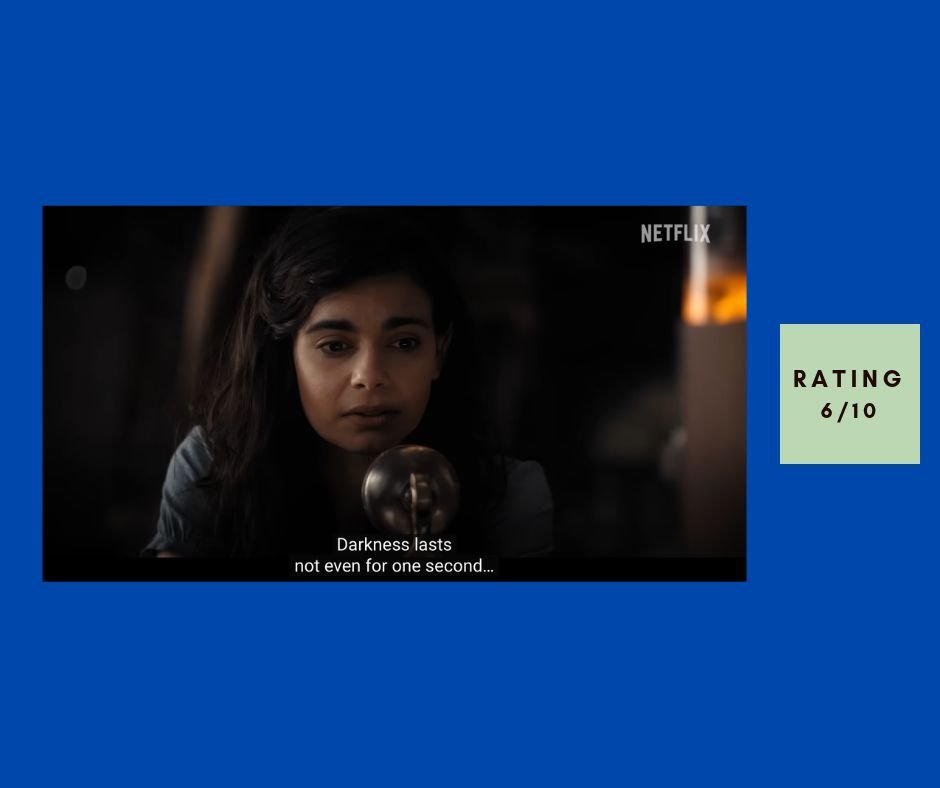
Much anticipated because of Anthony Doerr’s brilliant novel, All the Light We Cannot See, a four-part streamer series, commences with one of its many sweeping wartime set pieces, as Allied forces bomb a Nazi-occupied French village and we see a teenage girl broadcasting from an attic room. The girl fled Paris earlier with her father, a museum curator who rescued and hid a precious jewel, and now the father is gone. Enter a young German radio operator (played with intensity by Louis Hofmann), brilliant at his craft and repulsed by his Nazi overlords. Enter a reptilian Nazi jewel hunter (Lars Eidinger is the only actor to imbue the many Nazi villains with any malevolent heft and he does it with style). The three inexorably wend their way to confrontations, amidst numerous flashbacks filling out the tale. The underlying book embraced huge themes of inhumanity, hope, and redemption through culture, and it did so with grave grace. The film’s arc captures the book’s tale faithfully, and it brings war’s kaleidoscopic horrors to stunning life, but the script is pedestrian and many actors are miscast. The music, by stalwart James Newton Howard, is old school strings and is execrable. Overall, All the Light We Cannot See is passable lush entertainment but utterly fails to do the book justice.
2023 Top 10 Books
2023 was an odd reading year. Subject preoccupations biased me towards nonfiction books but I have to say that my fiction slate, while full of fine books, in the end offered few masterpieces. Not so the seven nonfiction books in the list. For once, I can’t really guarantee you, dear reader, ten must-reads, because you might well find my preoccupations irrelevant, but anyone adventurous will surely be rewarded after dipping into some of these ten.
The links below provide my reviews.
Jeff Goodell is the best climate change journalist/writer bar none. Heat: Life and Death on a Scorched Planet (10/10) covers what a heating world will do to us humans at the most elemental level: we’ll need to deal with hotter, much hotter, days and nights. A must-read.
Mick Herron’s The Secret Hours (10/10) takes a sideways step from his amazing Slow Horses/Jackson Lamb spy thriller series but I think it ascends even higher in the pantheon of this genre. Sublime.
Going Infinite: The Rise and Fall of a New Tycoon (10/10) is probably the most controversial of Michael Lewis’s many triumphant nonfiction books. I see it as a benchmark example of investigative writing.
Crook Manifesto (9/10) by Colson Whitehead—a follow-up to Harlem Shuffle, from a couple of years ago, this is both an engaging crime caper novel and deep, atmospheric historical fiction.
Return to Valetto (9/10) is Dominic Smith’s pinnacle novel so far, a beguiling, moving family saga set in Italy.
The Passion of Private White (9/10) is Don Watson’s moving and rigorous history of a heroic modern anthropologist in Arnhem Land.
The Earth Transformed: An Untold History by Peter Frankopan (9/10)—kaleidoscopic, scholarly, and almost lyrical in expression, this history of Earth and its human denizens, told with a climate change lens, will be read for decades.
You don’t need to be engrossed with marine matters to become riveted by Helen Czerski’s brilliantly structured and styled Blue Machine: How the Ocean Shapes Our World.
Lev Parikian is so upbeat, so informative! Taking Flight: The Evolutionary Story of Life on the Wing (9/10) is the only book on bird flight that gripped me from start to finish. I learned so much.
Brain surgeon Henry Marsh’s And Finally: Matters of Life Death (9/10) sees the stylish medical memoirist grapple with his own mortality.
2023 Top 10 Movies/Shows
I had firmly believed my diet of books trumped that of movies/shows, especially when examined over a full year, especially when considering the best of the best. Not this year. Although my reading included gems, my viewing teemed with excellent and indeed magnificent offerings. Any of the following would reward your attention.
Follow the links below to my reviews.
The adaptation of Hugh Howey’s wonderful dystopian sci-fi series that began with Wool is wondrously atmospheric, superbly acted, and utterly unpredictable from episode to episode. Ten-episode Silo (10/10) probably tops the year.
Season 2 of The Bear (10/10) rivals Silo in excellence. Just as frenetic, deeply characterized, and riveting as Season 1. If you love food, even if you only love movies, treat yourself to these ten episodes.
Succession Season 4 (10/10)—need I say anything at all?
This first season of Slow Horses was most welcome but the second season (10/10)—perfection, the spy thriller outing you must see! (And I’m currently partway through Season 3!)
An arthouse father-daughter drama of immense emotional heft, Scrapper (10/10) might be the best 2023 film you’ll typically never hear of.
Rachel Antony & Laurence Billiet’s hypnotic, scary, inspiring documentary about both Bob Brown, the legendary Greens politician, and the beauty of Tasmania’s forests, The Giants (10/10) was hands down the most impressive documentary of the year.
Blockbuster it might have been, but Christopher Nolan’s transfixing Oppenheimer (10/10) deserves all its praise.
A completely different film was feminist crime fiction drama Deadloch (10/10) by Kate McCartney & Kate McLennan. Funny, tense, and affecting.
To learn so much about creativity, intelligence, idealism, and persistence, you can’t go past Turn Every Page (9/10), which gently portrays master biographer Robert Caro and master editor Robert Gottlieb.
Season 2 of The Newsreader surpassed the superb first season and exemplifies Australian drama.
Miss Benson’s Beetle by Rachel Joyce [7/10]
Rachel Joyce, an immersive English novelist (author of The Unlikely Pilgrimage of Harold Fry, which I enjoyed in book and filmic form) does seem drawn to the same genus of character, the very ordinary citizen impelled by inchoate motivations to attempt hopeless adventures, and one is tempted to suggest she might become trapped by this fondness for a particular storyline. But Miss Benson’s Beetle works because it is a variation on that pattern. Margery Benson, a plump, dejected teacher in England in 1950, impulsively quits and “follows her dream,” stoked since childhood, to travel to Indonesia to be the first to find an exotic beetle. Her companion turns out to be a contrasting, pink-suited young woman of impulsive, expedient character, and the two of them, as they embark on an adventure neither is remotely equipped for, forge a most unlikely partnership. The author writes wonderfully evocative scenes, the storyline is full of twists and turns, and their remote island comes to life in these pages. One ancillary character feels clunky and, as with Harold Fry, mawkishness is not far below the surface, but overall, Miss Benson’s Beetle is a rambunctious girl’s own romp that is a fun, surprisingly affecting read.
The Lost Flowers of Alice Hart [8/10]
I have Holly Ringland’s novel The Lost Flowers of Alice Hart in my Audible audiobook library, gifted by Amazon as part of a membership, but I never began to listen. Now I don’t need to, in a sense, because a seven-episode series, The Lost Flowers of Alice Hart, pulses with foreboding and drama. Set in rural Australia, the tale begins with nine-year-old Alice scarred by a terrible fire consuming her parents and ending up on her grandmother’s flower farm (the film is scattered with flower arrangements and their hidden meanings), which doubles as a women’s refuge from domestic violence. The first episode, depicting the initial horrors, is brilliant, and indeed the first half of the series, based around the young Alice, is the better portion. Sparkling acting—Alyla Browne and Alycia Debnam-Carey as the young and adult Alice, Sigourney Weaver as the secretive Grandma, the hypnotic Charlie Vickers as the abusive father, and a number of supporting actors—form the core of the show’s emotional wallop, aided by Hania Rani’s wonderful film score. As I implied, the second half, witnessing Alice unpacking the secrets surrounding her life, sags a little, but the final payoff, in the final episode, is superb. Recommended.
The Killer by David Fincher [8/10]
Fans of “noir” will, I hazard a guess, have varying interpretations on what this specialized genre (as distinct from a general label indicating “hardboiled” or “tough”) strictly comprises but no one would doubt that David Fincher’s new, focussed film, The Killer, starring a perfectly cast Michael Fassbender, is as noir as it gets. Intimately fixated in the gaze and mind of a longtime professional assassin, full of voiceovers of his rules of life and conduct, from the opening scene when our killer is waiting for his mark to arrive in a Paris apartment, we are aware all normal constraints of morality are out the window. The assassin’s philosophy is plainly practical and void of humanity, and, as is customary for this genre, the fascination lies in observing such a sociopath operating, in using such a sociopath as a lens to explore notions of good and evil. The film’s plot conceit is simple and classical: after a botched job, killers come from our killer and our killer embarks on a patient, unstoppable vendetta. Fincher is superb with long action scenes, fascinating in their vulgar expression of killing modes, and Fassbender plays the part to perfection. The notion of a disintegrating personality, also de rigeur for noir, is played with, but without any real sense of plotting purposefulness, and the end of the film can feel inconclusive, but like all noir fans, I watched The Killer for the uneasy, troubling vibe (coupled with thriller-level antics) and found it to be riveting.
Birnam Wood by Eleanor Catton [7/10]
Who could fail to admire The Luminaries, the complex blockbuster that launched Eleanor Catton onto the world literary stage (and accorded her a Booker)? Yet it was a novel that sometimes failed to ignite in the reader’s mind (that was certainly the case for me), and something of the same echoes in Birnam Wood, her new, far more supple thriller about ecological activism and billionaire shenanigans. Set in an unspecified remote part of New Zealand, the novel follows three members of Birnam Wood, a fascinating guerilla gardening group that spies an opportunity in a wealthy man’s country land suddenly isolated by a landslide; the gentry owner of the land and his wife; and the most interesting character of all, an uber-competent, super-smart, manipulative billionaire (think Peter Thiel or Ray Dalio) with enigmatic plans of his own for the land. The “thriller” aspect of the novel is surprisingly humdrum but halfway through Birnam Wood, I was powerfully reminded of Tom Wolfe’s Bonfires of the Vanities, a wonderful portrayal of a time and place populated by deep characters and overlaid by a servicable plot. Birnam Wood is likewise a novelistic excursion into our troubled times, and a worthy read indeed.
Deadloch by Kate McCartney & Kate McLennan [9/10]
What a rollicking delight, rocking with madcap humor while also suffused with classic Coen-Brothers-style dread, is Deadloch! Beset with a headline label of “feminist noir comedy,” and roaring with sharp wit, we embark on eight jam-packed, tightly choreographed (in the best tradition of twisty, twisty murder mysteries) episodes. A visually stunning Tasmanian town is plunged into terror when male bodies are found with identical gruesome MOs, and the task of righting wrongs falls to steady-as-she-goes local policewoman Dulcie Collins (brilliantly played by Kate Box) and a crass, swearing, visiting hoon cop, Eddie Redcliffe from Darwin (portrayed completely over the top by Madeleine Sami in a way that also endears). A huge cast of eccentric characters swirls around Dulcie and Eddie as they seek a killer. The early slapstick tone darkens toward the end, without ever relinquishing a guffaw or a chuckle, and the crime plot is flawlessly executed, guaranteed to fool every watcher. Written by TV comedians Kate McCartney and Kate McLennan, Deadloch is a oncer, a mix of genre magic and feminist truth-talking and genius humor. A winner.
Bosch: Legacy Season 2 [9/10]
The cascade of Michael Connelly offerings—books and series—featuring either perennial Harry Bosch or newer Mickey Haller or Renee Ballard, can be hard to keep up with. What astounds me is how consistently excellent, within its chosen crime fiction genre, all the output is. Bosch: Legacy spins off from Bosch the driven homicide detective, now driven private investigator, and increasingly focuses on Maddie, Bosch’s daughter, a fresh cop in the LAPD. Madison Lintz flawlessly captures the young woman through initial travails, and into her early career, as she inevitably morphs into her father’s implacable, violence-soaked character. In Season 2, Maddie is kidnapped in a terrifying first scene and we spend a few episodes as Bosch endeavors to rescue her before it is too late. Blowback from Season 1, featuring two newish and engaging characters—super-lawyer Honey Chandler and hip hacker Mo Bassi—threatens Bosch, and a defence case plunges them all into the web spun by rogue cops (with Max Martini in particular playing a terrific part). Midway through this season, I wondered (as I often do) if the Bosch lineage is coming to a useful end, but then the final episodes steamed ahead, and I was left shaking my head in enjoyable amazement. Another fine series.
The Last Passenger by Will Dean [8/10]
English novelist Will Dean, now living in Sweden, revels in off-the-wall plots, and The Last Passenger will, I am certain, amaze you. When a blancmange British woman wakes after her first night on a luxury 1,000-passenger transatlantic cruise ship with her unexpected new boyfriend, she finds herself alone, steaming ahead on an unpiloted ship. Whether you can tolerate such a wild beginning will influence your enjoyment, but the author’s clever craft, mixing in-the-moment veracity with plot gyration after gyration, should speedily conquer you. The Last Passenger rockets along at warp speed, and a final out-there twist adds to a captivating one-sitting read.