Famed for his social realism, Ken Loach waxes uncharacteristically sentimental (with tons of unsentimental, profane scenes of racism as balance) in The Old Oak, a tale of the solid, kind owner of a traditional, creaky old pub in an ex-mining village in Britain, helping out a busload of Syrian refugees. The story seems simple but Loach deftly portrays hidden aspects of the participants in the drama in a way that maintains tension until the end. The music score by George Fenton is a marvel, oblique and dramatic. The key to the film is the acting, and the lead role by George Fenton is blindingly realistic. He is wonderfully supported by Ebla Mari as the key Syrian with the most English, and the large supporting cast never miss a step. The Old Oak is a searing portrait of betrayed Britons reacting to decades of neglect by lashing out with virulent racism, the only path out being the realization of common humanity. Not nearly as bleak as many a Loach feature, it is nonetheless savage and the positive emotional tone is unfurled with marvelous cinematic brevity and clarity. Highly recommended.
The End of Eden by Adam Welz [8/10]
South African writer/naturalist/conservationist Adam Welz has, with The End of Eden: Wild Nature in the Age of Climate Breakdown, done what many of us would dearly love to, namely traverse the globe seeking to imprint on our own psyches, but also on humanity’s conscience, the many, many ways in which our climate crisis is driving nature and wildlife toward extinction. Eschewing outrage, employing a measured tone and gentle specifics, the author delves into pockets of nature around the globe in which shifting seasons amidst vanishing wilderness are sending animals, birds, and plants into a spiral of doom. The Puerto Rican iguaca parrot, the incredible Red Knot, mooses in New England, hornbills in the Kalahari Desert, dolphins off the coast of Texas … the remorseless litany is laid out with a calmness that is in itself irredeemably tragic. A final chapter offers us the author’s more general view of the climate crisis and how it might be tackled, but by then his work is already done. We are bringing upon the Earth the sixth great extinction and Adam Welz is indeed documenting The End of Eden.
The Detective Up Late by Adrian McKinty [8/10]
We feared he would never return, DI Sean Duffy, a rare Catholic cop among Protestants in Belfast at the height of the Troubles, a canny policeman with a passion for justice and a love of culture and an ever-ready quip. After the sixth book in the series, 2017’s Police at the Station and They Don’t Look Friendly (the book titles all come from Tom Waits lyrics), the author went mainstream with back-to-back standalone thrillers that put Duffy in the shade. But a memorable character like Sean is hard to keep down, and The Detective Up Late is a scintillating return to our bookshelves. As the 1980s, fraught indeed for Duffy, move into 1990, our hero is partly moving to Scotland but what keeps him pushing in Ireland is the disappearance of a fifteen-year-old traveler girl. No one is interested, bar Duffy of course, and the book patiently builds up steam as he methodically and brilliantly dissects her final days in pursuit of a killer. The author is a superb, rhythmic stylist, the plot steamrolls on, and the window into Ireland is beguiling. The Detective Up Late is a cracker of a crime novel, sure to win awards.
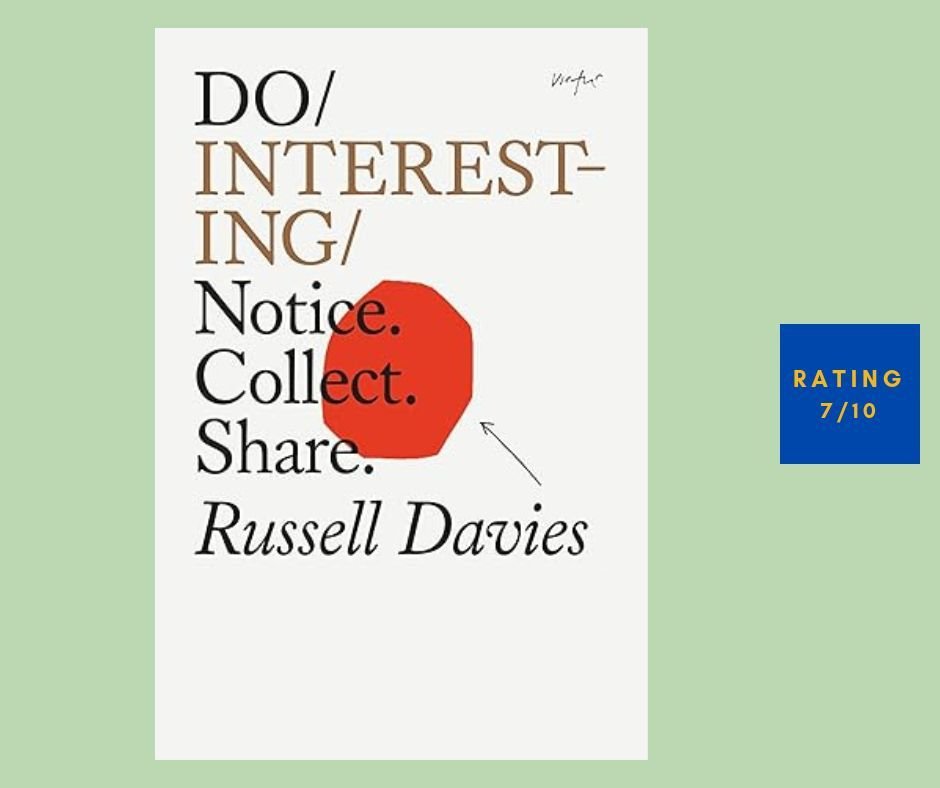
Do Interesting by Russell Davies [7/10]
I have observed a sub-sub-nonfiction genre, part of both Self-Help and Creativity, that tackles how be more “in” a consequently more intriguing world, a mixture of mindfulness and a range of hacks. Rob Walker’s The Art of Noticing: Rediscover What Really Matters to You proved to be a catalyst for my own “in the world” habits. Now multifacted writer/strategist Russell Davies freshens up the concept with his Do Interesting: Notice. Collect. Share. , in which we are exhorted to literally pick things/topics, often seemingly banal, to snatch from our senses, to then keep track of them through journaling or scrapbooking or whatever, and then to finally disseminate our observations/musings to others and the wider world. Do Interesting is usefully organized with snappy, numbered “Do” activities, and the writing is snappy and illuminating. If you feel as if the world is a blur around you, if nothing seems to interest you anymore, Do Interesting might form a valuable companion into a new mode of existence.
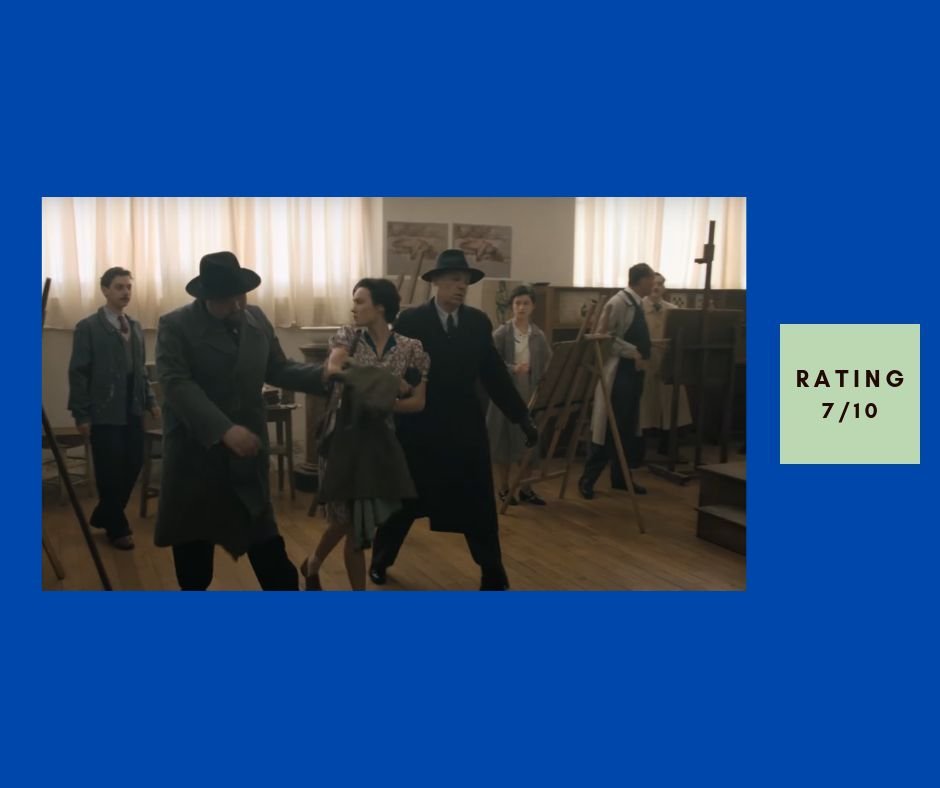
The Story of Annette Zelman [7/10]
Seemingly modest in ambition, The Story of Annette Zelman proves to be an intelligent, unabrasive addition to the cinematic holocaust library. Our heroine is a plucky upbeat twenty-year-old Jewish artist in occupied France during WWII. Based on the real Annette, with what seems like careful adherence to the actual chronology, we see her in 1942 Paris, energetically resisting the slowly turning screws of the Vichy government at the behest of the sinister Gestapo, falling in love, and then tumbling into the maw of the upcoming genocide. With less violence and more canny tension-building, splendid, non-grandstanding acting throughout, and sure-footed plotting, the movie builds a sense of horror toward what might be a predictable outcome but is saved from viewer dissatisfaction by some wonderful, inspired final scenes.
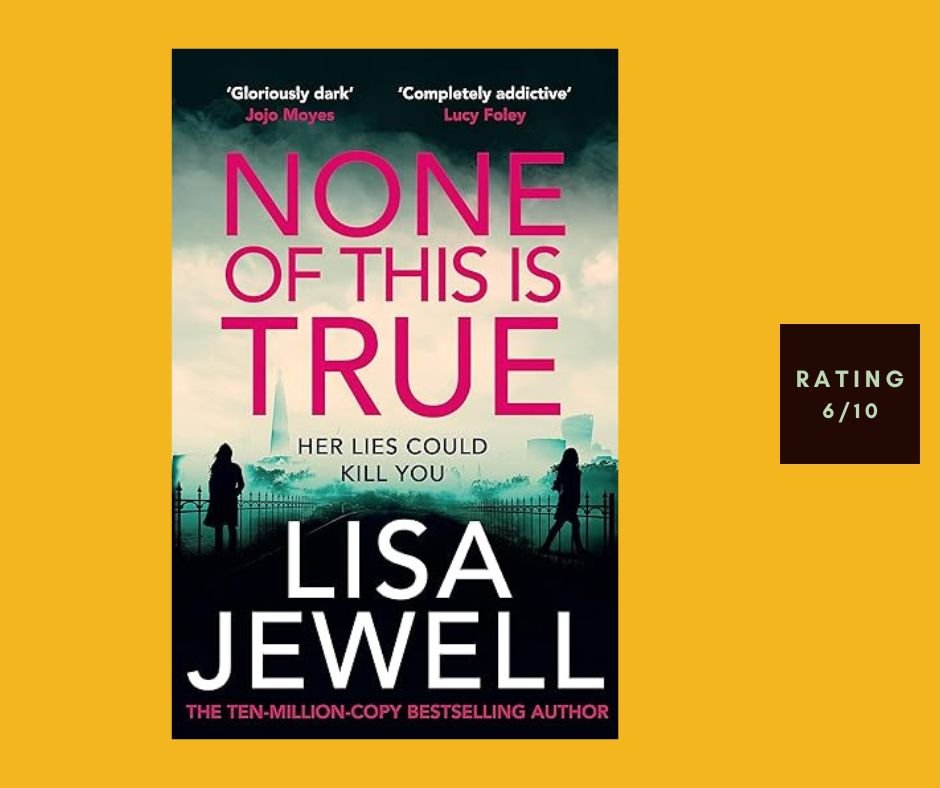
None of This Is True by Lisa Jewell [6/10]
Twenty novels under her belt, and, according to the front-cover blurb, a “ten-million-copy” bestselling author, Lisa Jewell is new to me. Her latest, None of This Is True, fizzes with plot inventiveness but will not entice me to read more from her. When a 45-year-old podcaster bumps into another woman born in the same hospital on the same day, she starts a new podcast, “Hi! I’m Your Birthday Twin!” (and Penguin, the publisher, has actually produced a four-episode podcast mirroring the book, which makes me cringe). The interviewee turns out to have a dark present and a dark past, and the author skillfully unravels all these murky strands as the darkness invades the podcaster’s own life. Written in the present tense, and cutting between both main characters, interposed with podcast and (weirdly) Netflix segments, sufficient tension is spun to make None of This Is True a quick meal. But, despite earnest interior explorations of both characters, the plot intricacies (familiar to anyone reading in the sub-genre launched, perhaps, by Harlan Coben) swamp any sense of reader identification, and the twisty, fierce climax leaves only an empty palate.
Resurrection Walk by Michael Connelly [7/10]
Michael Connelly’s made-up-but-realistic world of LA detectives and homicides has, like many long-running series, evolved into a complex tapestry. Resurrection Walk finds the reader walking in two shoes: the first-person, jaunty worldview of high-profile defense lawyer Mickey Haller, and the second-person, highly intense story following Harry Bosch, ex.-legendary, contrary homicide detective, now a private investigator with health problems. Cameo appearances grace us, from Maddie, Bosch’s policewoman daughter, and Renee Ballard, another homicide detective who has starred in a few Connelly novels. All of the above is a long-winded way of saying that Connelly’s “world” works, unlike those of many longstanding crime fiction superstars. In Resurrection Walk, a woman who has spent four years behind bars for murdering her husbanded manages to snare Haller’s attention. When he agrees to represent her and unleashes Bosch to check up on the woman’s indictment and trial, he unleashes a fraught sequence of events. The novel alternates between painstaking plod work and compelling, complex courtroom scenes; Connelly is that rare writer who excels with both. I read it in two plane hop immersions, the perfect book for the occasion.
Scrapper by Charlotte Regan [10/10]
The cinematic magic in Scrapper is why we watch at all. A debut indie film that embraces quirkiness and homespun verisimilitude, Charlotte Regan’s debut release shoves the viewer into the world of twelve-year-old Georgie living alone (and escaping the dreaded “social services” by persuading a friend to record conversational scraps as a mythical “Uncle Winston Churchill”) after the death of her mother. Life is bicycle stealing and domestic rigour amidst grief avoidance. Vaulting over her back fence comes Jason, her father who flitted to Spain before her birth, a jaunty laddish man not especially suited to assuming fatherly duties. The two clash and ebb, clash and ebb, while the viewer settles, via jittery cinematography and eclectic music and an excellent supporting cast, into a convincing absorption of a blue-collar British neighbourhood. Regan punctuates the earthy, dialogue-driven narrative with jarring surreal moments: talking-heads interviews with locals, a captioned spider conversation, visually recreated thoughts. All of this melds deliciously, resulting in a sense that we KNOW the two central characters, both (at least in my own case) vastly out of our own experience, and this knowing infuses visceral tension as the central question plays out: will the new father bring salvation or tragedy? I doubt I’ll find myself as invested in a 2023 movie as I was in Scrapper.
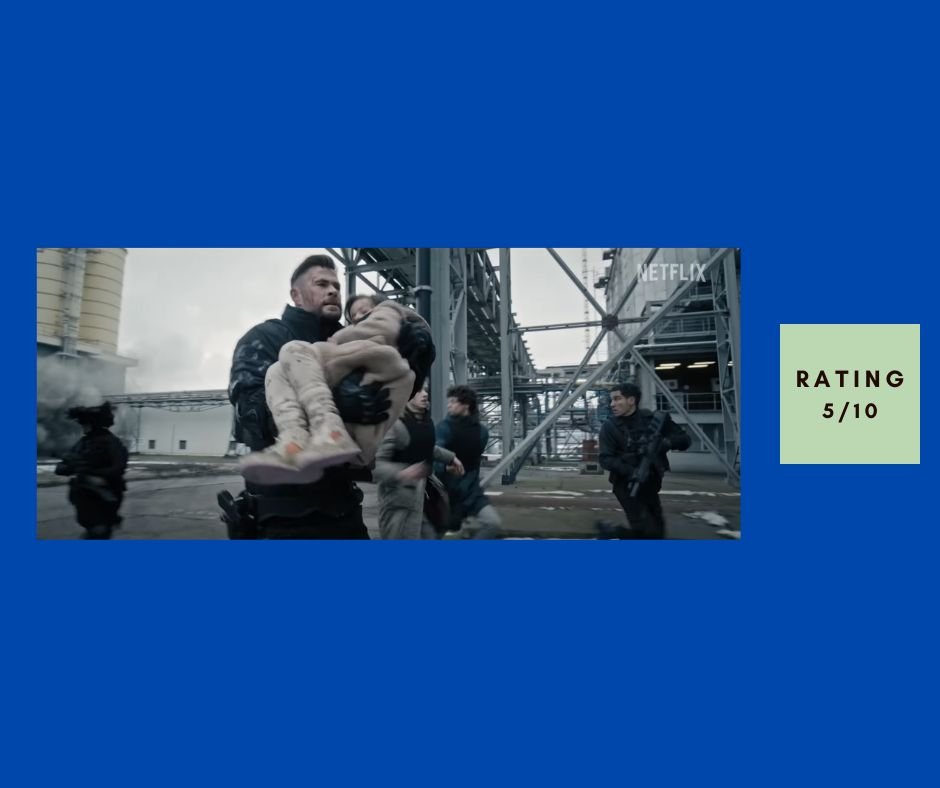
Extraction 2 [5/10]
I failed to watch the original Extraction but one recent evening, an urge came upon me to watch a dumbass action movie. They serve a purpose. And Chris Hemsworth comes across as at least slightly self-effacing. Hence Extraction 2, two hours and two minutes of an “extraction team” of specialists rescuing a woman from a Georgian prison and then battling a Georgian criminal overlord seeking revenge. The overarching “personal” storyline involves the Hemsworth hero recovering from the first film and regretting his neglectful-father past. We do not expect much from this type of John-Wick-style film and some of what we do expect is occasionally delivered this time: extended gore-video-game scenes, two of which are done well, one of which is plain stupid; a partially atmospheric bad guy; sweeping cinematics; a huge train crash; plenty of quips in dialogue that can sometimes hit the mark but more often seems overly flippant; tight tense scenes but also overblown dull action scenes. The acting is formulaic except for sparks of life from Hemsworth, clearly wrestling with a patchy script. All in all, Extraction 2 gets a pass grade but only just.
The Bee Sting by Paul Murray [7/10]
Much praised Irish novelist Paul Murray’s first three books whizzed past me but I am making amends. A third of the way through The Bee Sting, a voluptuous, multi-point-of-view modern saga of an Irish family in financial, spiritual, and emotional chaos, it struck me that I was reading a fresh take on Tim Winton’s Cloudstreet. Like that wonderment, The Bee Sting cycles around different characters, after a financial crash and amidst a clearly signalled climate crisis crash: teenage daughter Cassie, frantically caught up in the web of a glamorous friend; younger son PJ, anxious for stability and immersed in the online gaming world; mother Imelda, beautiful but unrefined, her sections told as a stream of consciousness befitting her oscillating mind; and, most centrally, father Dickie, heading for bankruptcy with his father’s business and wracked by secrets, a man of gentleness beset in his world. The author’s four different prose styles boil and bubble wonderfully and his interlaced plot is carefully woven. This is a novel to be read slowly, the mood oscillating between dread and clever humor. Admire the author’s virtuosic juggling of stories and witness the four souls fan apart and then seek to converge as the end approaches via frenetic character switching. I recommend The Bee Sting highly, predicting you will either swoon by the end or, like me, nod with admiration while deciding that the author’s climactic plotting took the characters beyond what the rest of this 596-page journey presaged.