Within a few pages of commencing Hanging the Devil, the sixth in a San Francisco crime fiction series featuring private investigator Cape Weathers, by Tim Maleeny, something about the confident style, the sassy dialogue, and the kinetic plotting reminded me of that grandmaster of the genre, Stuart M. Kaminsky. The comparison only goes so far—Maleeny maxes out on humor—but it remained apt for the rest of the evening it took me to rocket through this engaging, fascinating novel. Revolving around an eleven-year-old illegal immigrant girl from Hong Kong, who witnesses a daring art museum heist seemingly perpetrated by a ghost, Hanging the Devil sees our PI hero, Cape Weathers, and his crime solving partner, ninja-style Sally Mei, navigate the murky depths of the city’s Chinese and Russian crime gangs. Blithe inventiveness suffuses every page, all the characters joke through even the direst of situations, and the chapter-to-chapter jumps are a pleasure in themselves. Such a pleasure and one that will send me back to the earlier five books in the series!
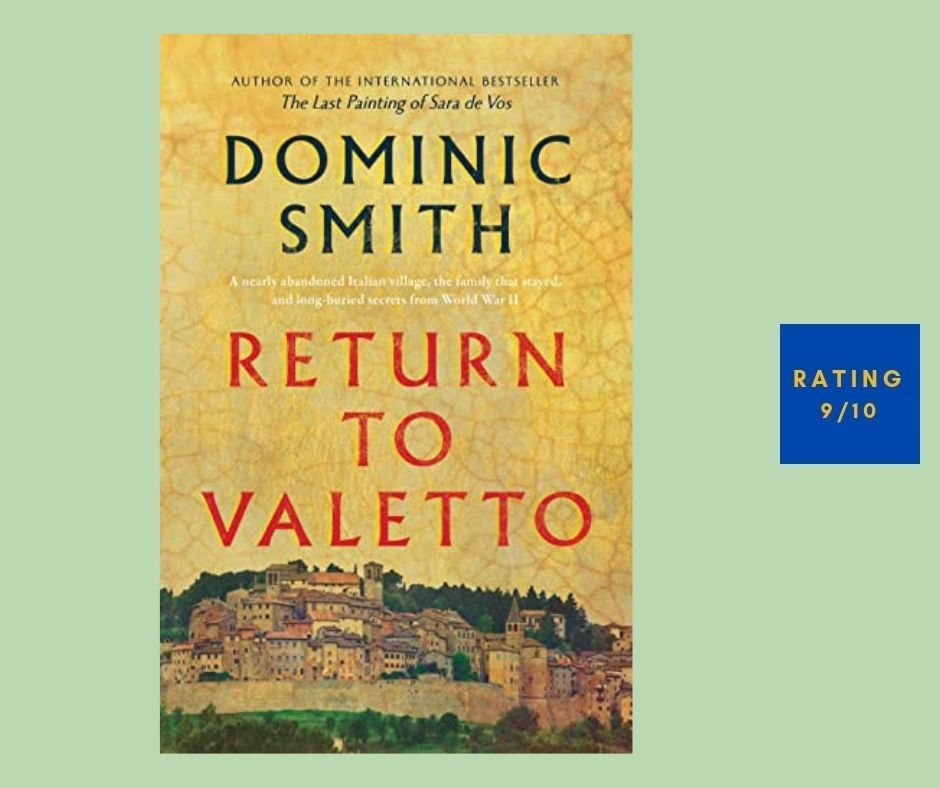
Return to Valetto by Dominic Smith [9/10]
Dominic Smith rose to fame with 2016’s The Last Painting of Sara de Vos, a novel I enjoyed but failed to bond with. Return to Valetto redresses the scales, for this is a reading bounty that feels like an old-fashioned novel from my childhood (I was going to say it is redolent of Somerset Maugham, but my memory of his works is so vague by now that such a statement would be spuriously specific). The story is assembled quickly but from then on, the pace is measured. There is one plot revelation or twist (no surprise really) but no final surprises. A large cast of characters is allowed to insinuate itself into the readers’ mind through scene after perfect scene. The setting, the ten-person near-abandoned village of (imaginary) Valetto in Umbria, is vividly brought to life, with food in particular part of most scenes. The protagonist, an academic who has lost his mother and his wife, travels to Valetto to live in his mother’s bequeathal, a cottage amongst his aunts’ and near-centenarian grandmother’s abodes, only to find a woman squatting in his cottage, with a claim of ownership reaching back into the terrors of fascist wartime Italy. The author exhibits a masterful control of the returnee’s perspective, from which the entire novel is told (no character switches, no flashbacks); only slowly do we realize his flaws. A final climax takes half the novel to get there and is worth the wait. Amongst my 2023 reading, Return to Valetto is an unexpected gem.
A Haunting in Venice [3/10]
Kenneth Branagh has begun to desecrate the memory of Agatha Christie. I yawned through his cinematic rendition of Murder on the Orient Express, skipped Death on the Nile due to awful online feedback, and only went to A Haunting in Venice because a movie club mandated it. I wish I had called in sick. Branagh himself displays no enthusiasm for his lead role of Hercule Poirot and the other actors, even such usually reliable performers as Michelle Yeoh and Jamie Doran, are limp in the grip of a clunky script. Venice as a setting is wasted, with most of the 103 minutes spent immersed in a gloomy storm, and the music is a weak reed. The Christie plot is perfectly serviceable, with a fine climactic twist, but is swamped by the mediocrity of its telling. Woeful.
Shayda by Noora Niasari [7/10]
Shayda offers a tense, credible, timely drama about an Iranian woman, with her six-year-old daughter, hiding in an Australian women’s shelter from her abusive Iranian husband, who has the relentless goal of taking the girl with him when he returns to Iran. Written and directed by Australian/Iranian Noora Niasari, the film kicks off in suspense mode, with the protagonist peering out of the shelter’s windows whenever a car approaches, and from then on, the tension is palpable. Niasari’s narrative control successfully melds the escalating plot and sweet mother-daughter moments, although I felt that some of the celebratory scenes played out too long. Zar Amir Ebrahim is flawless in the lead role and Osamah Sami plays the creepy, religious husband to a tee. Shayda is a well crafted, tense, and germane film.
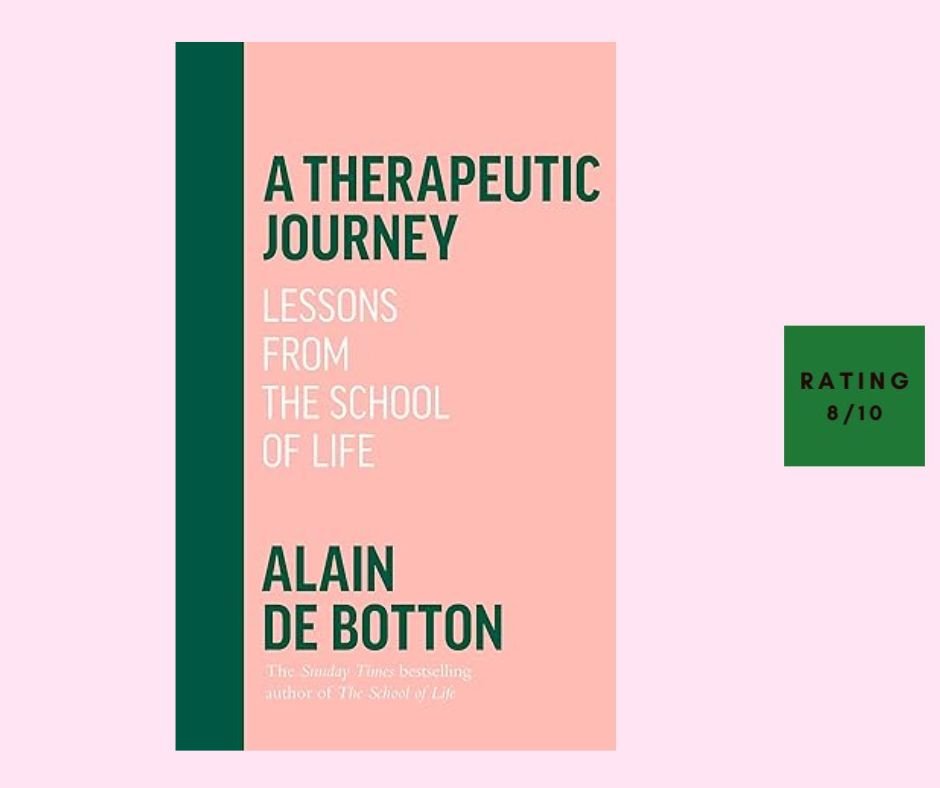
A Therapeutic Journey by Alain de Botton [8/10]
What a healing, eloquent book A Therapeutic Journey: Lessons from The School of Life is! I have not read Alain de Botton for years and have tended to view his School of Life as undoubtedly helpful but also as an upper middle-class self-help clinic. Yet something of this book reeled me in and I suspect it was because I experienced existential anxiety a couple of years ago. Perhaps A Therapeutic Journey best suits not those afflicted with serious mental conditions but those hovering on the edge of serious damage. Be that as it may, the book is a treat, moving from the issues confronting those in despair, to a suite of pictures/photographs offering existential or mental health vantage points, to a sweeping, rousing collection of ideas around the rubric of “hope.” The author writes in soft, compassionate prose that is a pleasure to read, and a wonderful sense of novelty pervades the entire book; this is not typical of how-to tomes. Personally, I found A Therapeutic Journey to be indeed “therapy in the reading,” and anyone anxious or gloomy should seek it out.
Only Murders in the Building Season 3 [8/10]
A comedic cozy-style murder mystery series (10 shortish episodes per season) set in an upscale Manhattan hotel and based around three residents solving the crime while podcasting about it … well, it shouldn’t work. That Only Murders in the Building succeeds, and wonderfully so, is due to the comic genius of Martin Short (playing an overweening Broadway producer) and Steve Martin (portraying an ex-TV-gumshoe-star actor). Both of them improvise on a dime and everything that comes out of their mouths is either intelligent or funny (sometimes uproariously so) or both. Selena Gomez is a perfect foil as a drifting young woman who does much of the legwork. Season 1 had the added benefit of introducing the show’s conceit and I fell in love with it (see my review). Season 2 was even better, with a wonderfully twisty plot and Martin Short at his peak (see my review). In Season 3, Short finally has a play in production, when its cranky lead male ends up dead, the body of course being found in the Arconia apartments. A shapeshifting (and in many ways irrelevant) plot allows the three stars full rein, with added oomph from a season-long contribution by Meryl Streep and a cameo from Matthew Broderick. Wicked, jazzy, cheerful, and smart … Season 3 keeps up the quality with barely a sense of a declining franchise.
100 Ways to Change Your Life by Liz Moody [7/10]
Podcasters/influencers/how-to gurus such as Liz Moody, forever offering “hacks” to punters unwilling to change at a fundamental level, annoy me, but the tragedy is that I am drawn to them, time and time again, and occasionally, just occasionally, I snatch a pearl or two of wisdom. At best something about their very approach or style penetrates my cynicism, to great effect. 100 Ways to Change Your Life: The Science of Leveling Up Health, Happiness, Relationships & Success, which offers a self-explanatory menu of ideas, is a cut above most such how-to books, primarily due to the author’s engaging style and her sheer energy. Some of her suggestions helpfully reinforce practices of my own, such as her “fresh start” idea; maximizing the amount of nutrients per bite, and, separately, eating thirty types of plants per week, both in keeping with my current extreme Whole Foods Plant Based diet; and eliminating sources of decision fatigue. She addresses establishing boundaries, something I’m pondering with one of my relationships. I read with interest about the hack of taking a cold shower; about “vision and action boards”; and about a “breathwork practice.” How to “overcome procrastination” is treated blithely, and a number of offerings, such as “amping up your charisma,” are plain silly, but my “silly” might not be yours. Overall, 100 Ways to Change Your Life is worth a look.
Forever Strong by Gabrielle Lyons [4/10]
Like many, I am fascinated by the fast-emerging field of functional medicine, according to which doctors assess each patient individually based on recent knowledge of health, genetics, and our plague of modern health ills. Dr Lyons has an impressive pedigree and in Forever Strong: A New, Science-Based Strategy for Aging Well refreshingly addresses the seemingly recent realization that exercise, but specifically muscle mass, profoundly impacts everything from brain function to heart/stroke/cancer risk. Her vigorous championing of the crucial role of weight lifting (it doesn’t have to be “pumping iron”) is most welcome, and I enjoyed much of the book. However, on the question of diet, she goes against all my (admittedly relatively amateurish) understanding of the role of protein in optimizing one’s diet, effectively recommending protein be accorded the central plank of diet and prescribing twice the level of protein all my reading suggests. A decent chunk of the book, setting out how to micro-manage nutrients, exasperated me no end. So, my recommendation? If you are new to the centrality of exercise/muscle to a healthy life, or if you (like many) think protein is more important than (whole food) carbs, then Forever Strong might be a pertinent and engaging read. Otherwise, there are better diet/health/exercise primers around.
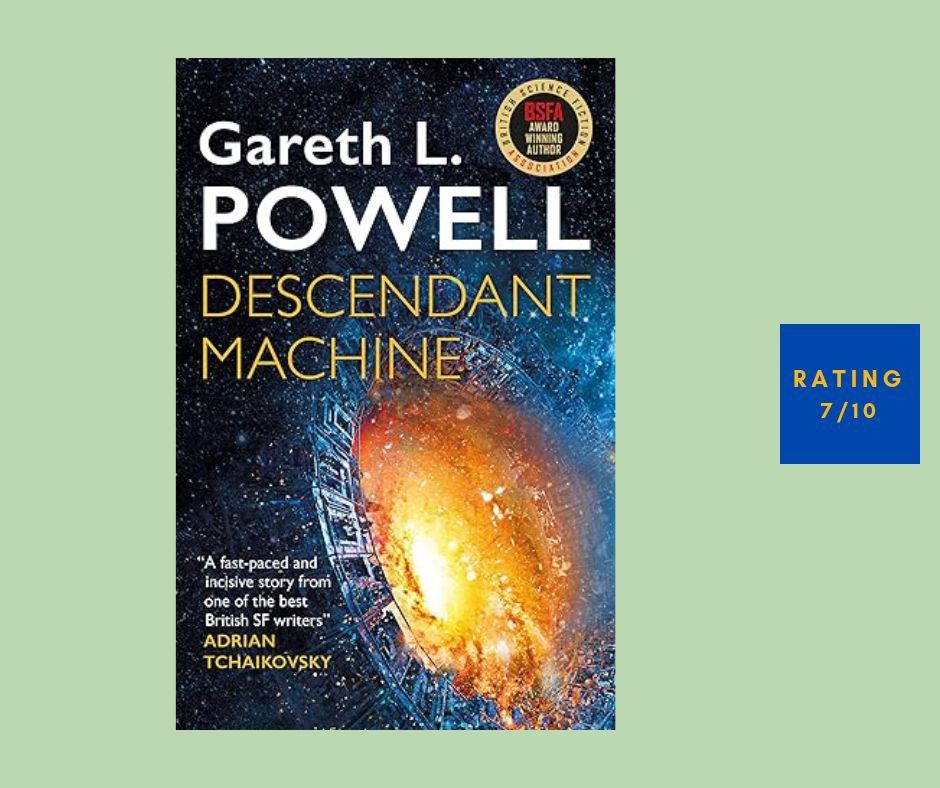
Descendant Machine by Gareth L. Powell [7/10]
Gareth Powell is one of the seemingly many well-regarded science fiction authors I have never read or even come across. The British author has penned ten books before Descendant Machine. Powell ingeniously builds, amongst scenes of escalating adventure, a wondrous world of mega-spaceships traveling through space with humanity’s post-Earth denizens aboard, connected by an instantaneous travel capability. The novel’s heroes are a sentient AI scout ship and her human navigator (in this world, trans-space travel needs ship and navigator mentally linked in a symbiotic relationship) who investigate another alien (but nearly human) world abutting a strange, huge Mechanism of mysterious origin and design. The author writes smoothly and stylishly, with credible, flawed characters, and the story builds up under excellent narrative control. Without plot spoilers, I found the tail end of the book, including its climax, enjoyable but excessively imaginative, but overall Descendant Machine was a sprightly, fascinating read. I hope there is more to come (this is the second in a series without continuity of characters).
Irreverent [7/10]
Showrunner (and dominant writer) Paddy Macrae came up with a wonderful idea for the 10-episode Irreverent. When a Chicago gangster, on the run with a suitcase of cash, reaches Australia, fate lands him in the role of a pastor in a remote northern Queensland seaside town called Clump, replete with quintessential Aussie characters. Colin Donnell is pitch perfect as the fake reverend, cynical yet edging toward caring, whip smart, full of barbed humor. The supporting cast is excellent, especially Tegan Simpson as the local misfit girl, living in the church, dreaming of getting to Paris. The early episodes ham up the slapstick of the situation but gradually, in a beautifully controlled manner, a serious edge enters many of the scenes, overlaid by dramatic tension as the reverend’s Chicago past catches up with him. The mood of individual episodes can vary but the overall narrative of Irreverent is warm, comedic, and smart. Well worth watching.