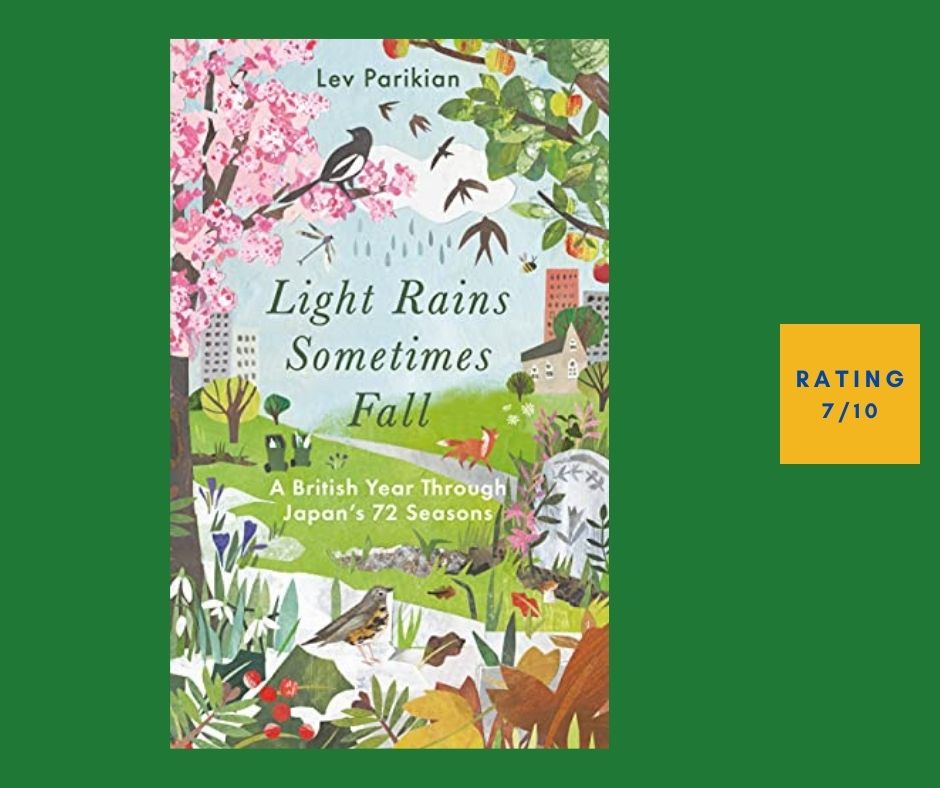
“Light Rains Sometimes Fall: A British Year Through Japan’s 72 Seasons” is the latest quirky, rewarding outing of British conductor and nature chronicler Lev Parikian. Framing a year as six dozen traditional Japanese “seasons” of around five days, with each chapter listing the Japanese traditional phrases associated with each “season,” the author describes a year of exploring his own British town turf: the cemetery, the streets, the parks, his own garden. And of course his project fitted perfectly into the pandemic-locked-down world we faced over 2020 and into 2021. Parikian is a devout birder, and superb at describing birds and their sounds and habits, but he’s also an endlessly curious naturalist, beginning journeys of learning about butterflies, plants, wasps, you name it. His effortless style marries lyricism, intelligence, humor and adept pacing. Listen: “But without getting too ‘the stars are God’s daisy chain’ about it, all I can say is that after five minutes of simply standing still in the presence of this bird, I feel better. Would I go so far as to say it sparks joy? I would.” And: “Yes, light rains do sometimes fall, as do heavy ones. And then there are the occasional torrential downpours, the kind that feel like some sort of endurance test.” I strongly recommend Light Rains Sometimes Fall; if any book can persuade you to see more closely, this is it.
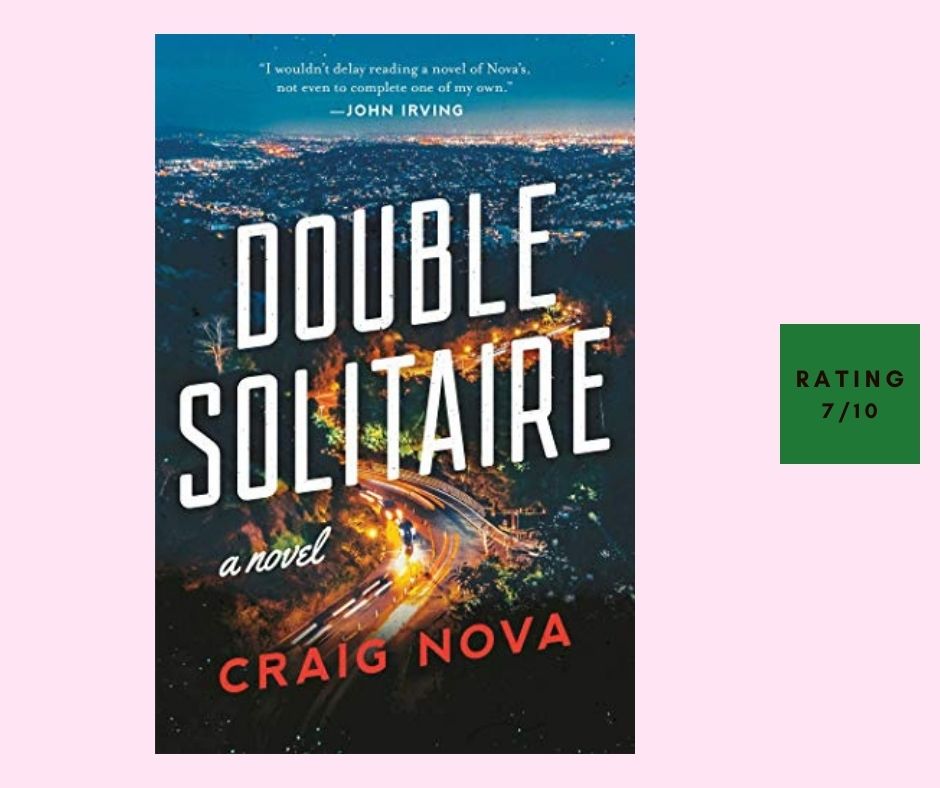
Double Solitaire by Craig Nova [7/10]
Craig Nova is one of the many novelists I’ve often heard praise for but have never gotten around to read. Based on “Double Solitaire,” I have missed out on an immersive stylist of depth. In this genre-style outing, we meet Quinn Farrell, a Los Angeles fixer, someone who cleans up other people’s messes. And in LA, there are more messes than tidiness. Farrell is a wonderful hero, whip smart, easy in his own shoes, but ambivalent about life in the face of his profession. A famous actor produces one morass, then another, and Farrell does what needs to be done, but realizes a greater evil may lurk outside his strict domain. And a neighbour who works in a hospital with terminally ill patients penetrates Farrell’s carapace, the threat of intimacy pushing him to act. The weird but instantly movie-familiar locales occupy center stage as a character, and Nova is a surefooted plotter, but the core strength of this sharp noir novel is the memorably evoked inner life of Farrell. Recommended to read in one sitting, an absorbed sitting.
Mission Economy by Mariana Mazzucato [5/10]
British economics professor Mariana Mazzucato wants to restore the place and import and seriousness of government in shaping countries, in direct opposition to the neo-liberal, post-Reagan notion of governments scooting into the shadows. “Mission Economy: A Moonshot Guide to Changing Capitalism” is an academic idea for everypeople like me, a narrative contrasting what the United States could once achieve, with the moonshot (and indeed the atomic bomb), and our current world’s obeisance to private sector capitalism. Not only should governments return to an active role in shaping a nation’s structure and funding, Mazzucato offers principles for how such a restored role should ensure good value and stewardship. Outside my usual interests, I found the writing to be coherent but the overall plotline a trifle mundane. However, in the Covid-19 era of governments opening up purse strings to avoid meltdown, Mission Economy is sure to find fascinated readers.
Civil Resistance by Erica Chenoweth [8/10]
Erica Chenoweth, political scientist and possibly the world’s preeminent expert on what I call nonviolent direct action, is famous within Extinction Rebellion for having first espoused the 3.5% notion: that an activist movement needs to fully and solidly mobilize that percentage of a population to achieve change. Chenoweth has written much, including books, on the subject. Now “Civil Resistance: What Everyone Needs to Know” is a consummate, wise, compendious everyperson treatment of this vital topic, suitable for both the experienced activist and anyone anxious to right wrongs and unsure whether to start a war or organize a protest. Chenoweth’s patient account, backed by as much research as has been done (she is at pains always to point out that research can be helpful but social change is ultra complicated and each case is unique), forms a history, a primer, a reflection, a from-the-headlines analysis (including, for example, how governments now fear civil resistance the most and actively fight it with fake news and deliberate provocation), and a toolkit. In my youth I read Gene Sharpe, the first systematic synthesizer of nonviolence’s history, and I’ve been an activist (an active activist, that is) twice in my life, so I am no neophyte, but I was spellbound by the usefulness and generosity of Civil Resistance. A must-read for anyone longing for a better world.
The Godmother [8/10]
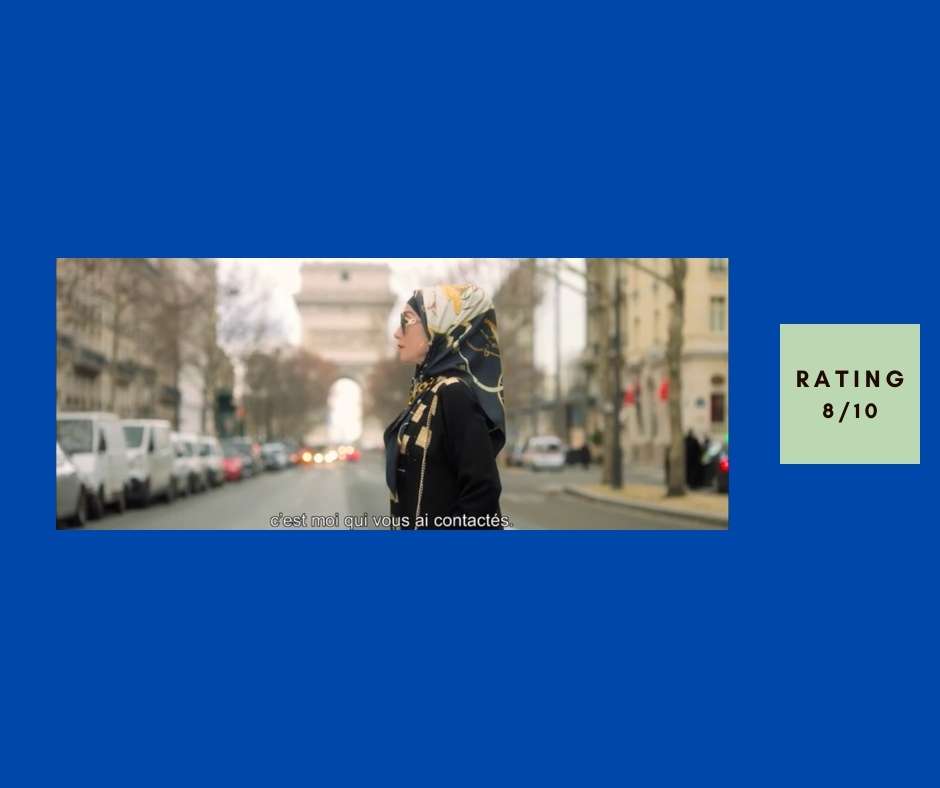
Hannelore Cayre’s pithy, packed crime thriller was a most unusual, delightful lockdown read. A tale of a Paris-based translator of Arabic drug dealer wire taps who crosses to the other side, it was mordant yet exciting. Because much of the pleasure of the novel lies in the hero’s inner thoughts (including much about the business of dealing drugs), I feared that the new movie version of “The Godmother” would flop, but my worries were misplaced. Cayre is credited as scriptwriter along with director Jean-Paul Salomé, and the script, while working harder on visual comedy and drama, and less on back story, retains the sharp, dark character of the book. Isabell Huppert is supremely confident and empathetic as “Mama Weed” (the French title), and the tautly choreographed actions scenes, one after the other, are filmed with great flair. The Godmother turns out to be an exuberant, French-infused caper film and is a hoot to watch.
Ms Represented by Annabel Crabb [8/10]
What a refreshing “of the moment” series from veteran political journalist Annabel Crabb! The four episodes of “Ms Represented” examine the history of female parliamentarians and senators in Australia, from the early days when a single woman might swim amongst the sharks, through the awakening decades when handfuls of women got elected, through the glory days of our first female Prime Minister, up to the present day. Crabb has a natural affinity with her many interviewees, so that the tale is told through the eyes of a panoply of female politicians from all political parties, buttressed by her sure narrative and wonderful historical footage. The series takes no prisoners, slamming the pervasive sexism over the past century, a sexism that still reigns supreme in the corridors of Canberra. The various interviewees are all a delight, and the fact that Crabb is able to get some of them to ham up in telling the story is a credit to the rapport she achieved. Steady direction and surefooted scripting ensures smooth, immersive viewing. In the end, I was left with a joyful sense of hard-won progress tempered by the realisation that Australian politics remains blokey and primitive. Ms Represented is a perky, intelligent blast of immediate history.
The Triumph of Evil by Charles Petrie & Spike Zephaniah Stephenson [8/10]
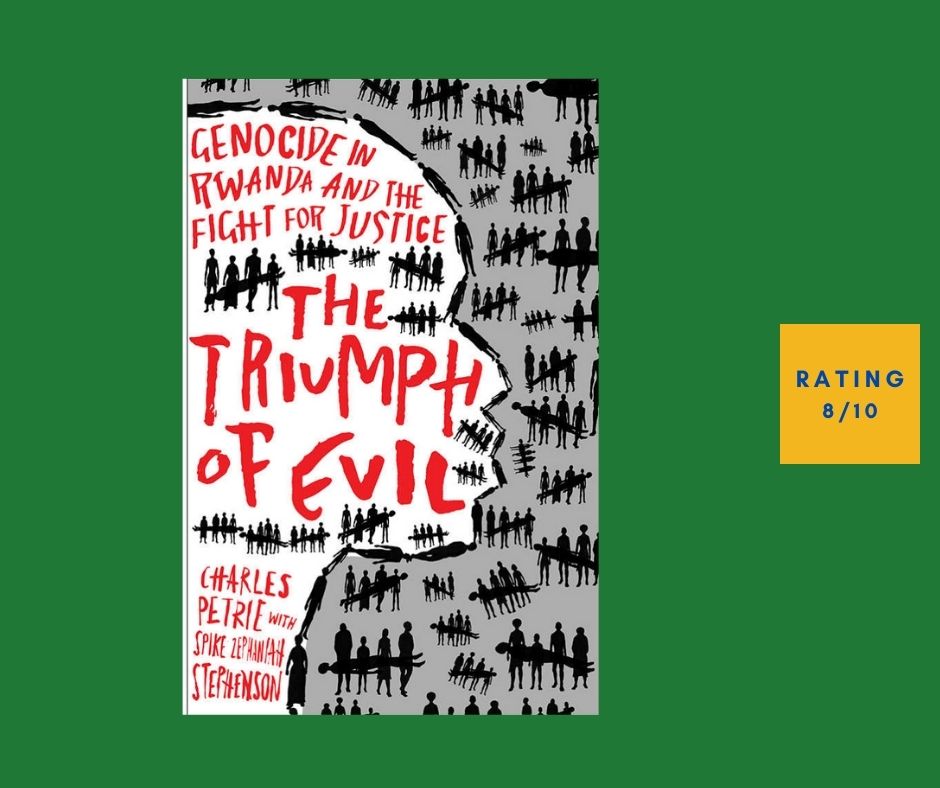
United Nations diplomat Charles Petrie operated in the hellholes of the world for two decades, and in “The Triumph of Evll: Genocide in Rwanda and the Fight for Justice,” he jettisons his learnt reticence to pursue an evildoer he came across during the unbelievably appalling Rwandan genocide in 1994. A UN officer led the killings of numerous people, including UN friends of Petrie, but has remained free despite years of pursuit. Petrie’s crowd-funded book is a modern-day page turner, as he describes, painstakingly and often lyrically, the twists and turns of his diplomatic career, all the while attempting to keep the wheels of justice turning. He admits to failure, and one of his confessions is heartbreaking. What makes The Triumph of Evil so remarkable is the beautiful illustrated drawings of Spike Zephaniah Stephenson, especially a long visual narrative of the unspeakable events of 1994. The Triumph of Evil springs from the heart and is a work of bracing, solemn majesty. May Petrie’s campaign one day win!
Thin Ice [6/10]
“Thin Ice” offers so much: a setup (an Arctic Council meets in Greenland to sign a climate-emergency treaty) snatched from our headlines; eye-candy scenery amidst the grandeur of Greenland’s vast spaces and its town with colored houses; the promise of intrigue involving different countries, different languages; and ice-and-snow action scenes wonderfully staged? So why does the Swedish eight-part series periodically falter, risking viewer withdrawal. Whilst much of the direction is tight and slick, the frequent hotel scenes can occasionally seem clunky. As well, although the acting is serviceable (notables including Bianca Kronlöf and Angunnguaq Larsen), two key actors remain unconvincing throughout. And although plot switchbacks are de rigeur for such thrillers, the plot complexity of Thin Ice is torrid enough to raise eyebrows. Overall, entertaining and scenic but not outstanding.
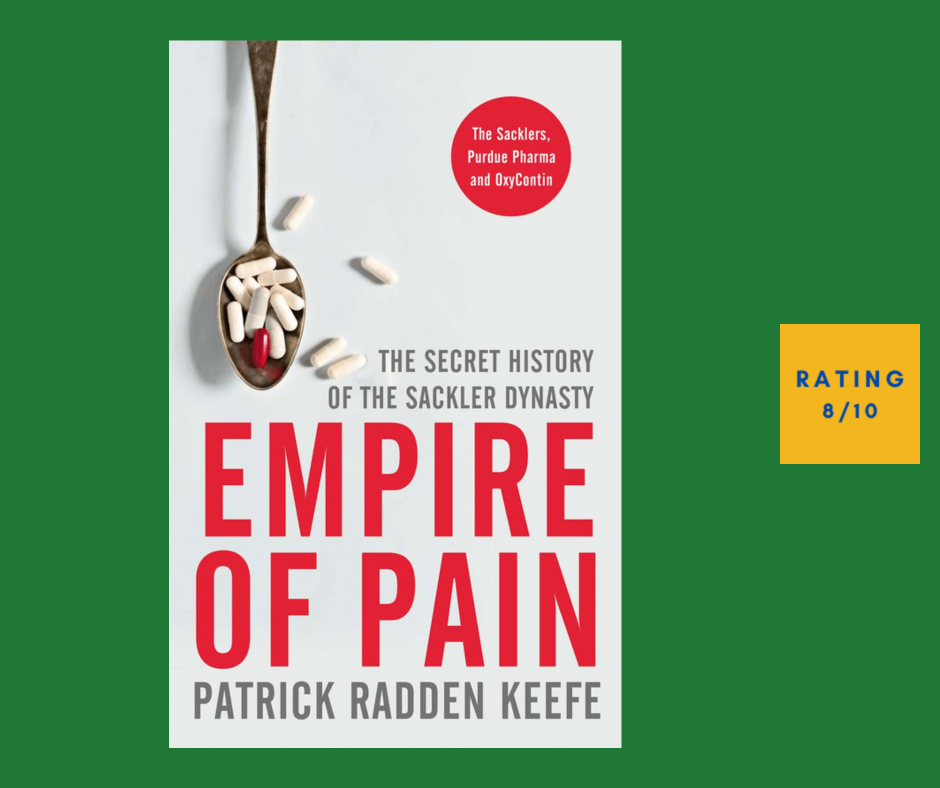
Empire of Pain by Patrick Radden Keefe [8/10]
“Empire of Pain: The Secret History of the Sackler Dynasty” is an expose of evil that will stand the test of time as a classic. Patrick Radden Keefe is a consummate investigator and precise, rhythmic chronicler, and what a subject he has chosen to tackle. The Sackler family started and pursued the OxyContin opioid crisis that has engulfed large slabs of the United States and killed a half million people. The author follows the Sacklers from humble origins in the early 20th Century, through years of obscure but wealth-gathering pharmaceutical company building, through the years of fanning the greed-fuelled ascent to billionaire status, through the years of compulsive opportunistic philanthropy, through the twisted treacherous theatricality of a large, voracious family, to our current era of justice sought. This is no easy tale to tell, with its complexity and deeply disguised corruption, but the author exhibits masterful control and cogency. Empire of Pain should arouse rousing outrage and motivate sweeping change. Brilliant.
No One Is Talking About This by Patricia Lockwood [9/10]
“No One Is Talking About This” immediately thrusts the reader into the world of a social media “influencer,” an unidentified woman fully immersed in what she calls the “portal.” In a manner reminiscent of Joseph Heller’s wonderful Something Happened, the first half of the novel riffs and riffs on our hero’s bizarre yet instantly recognizable life, more an online life than a real one, and then, with the impact of a lightning bolt, switches to a new existence rendered real by a tragic event. Nothing in the first fascinating pages prepares the reader for the wrenching tale that then ensues, and when the dust settles, the final uneasy juxtaposition between Trumpian, quotidian existence and the internet world a click away is unforgettable. Patricia Lockwood is a superb, poetic stylist with an unerring eye for both the banalities and the profundities of the modern world. No One Is Talking About This postures as experimental fiction, and readers need to be patient, but, please, stick with it, for I predict this novel will remain a mainstay for years to come.