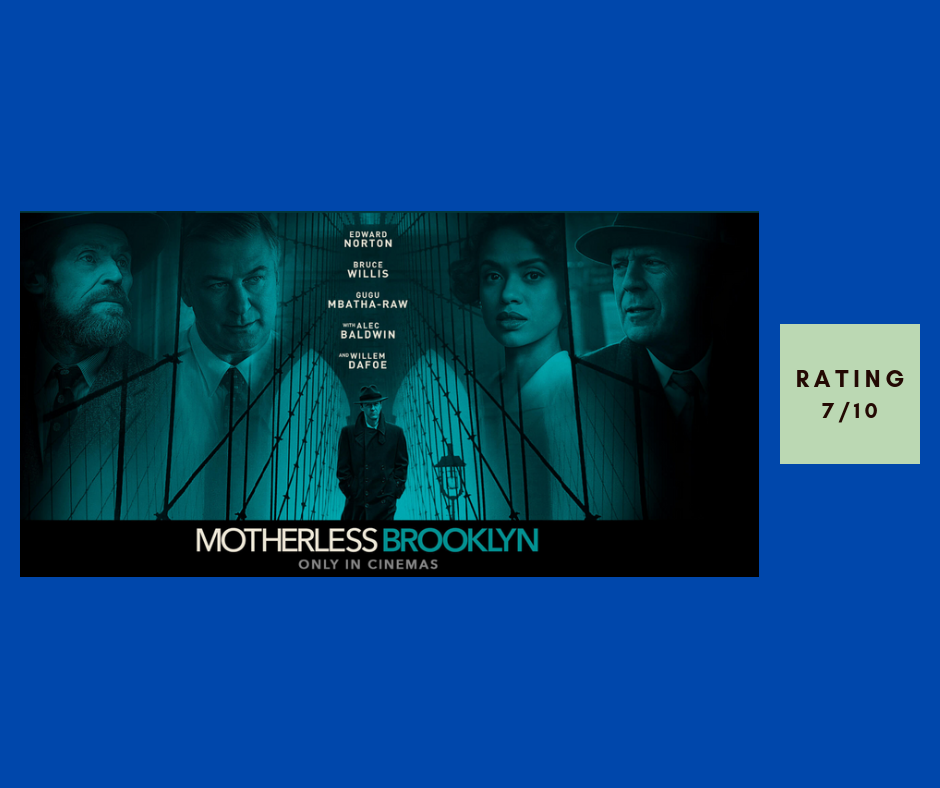
Motherless Brooklyn [7/10]

Motherless Brooklyn review

Besotted with Jonathan Lethem’s brilliant, immersive novel of the same name, I hung out for Ed Norton’s passion project, “Motherless Brooklyn.” But I missed it just before lockdown and have only recently caught up. Norton wrote the screenplay, directed, and stars as Lionel, a member of the Minna gang, a private eye outfit in the 1950s. Lionel has Tourette’s Syndrome and is assailed by tics and obsessions. When his boss (played with genuine assurance by Bruce Willis) is gunned down, Lionel searches for justice. In fact, justice is the central theme: justice for Frank Minna, justice for underprivileged tenants in an era of repossession. The novel was always going to be a tough adaptation because the book’s central triumph is Lionel’s frenetic, outlandish voice, but Norton strives valiantly and does a passable job. Norton’s atmospherics, including the music, are superb, and some of the supporting actors shine. But I’m glad I knew the plot; its intricacies, so lovingly traced in the novel with its air of doom, struggle to receive air in the movie. And some of the actors, especially Alec Baldwin in the key “sinister overlord” role, are off key. Overall, Motherless Brooklyn is an absorbing feast for eye and ear and mind, but falls short of magnificence.

The Truth by Hirokazu Koreeda [6/10]

It’s hard to imagine more different filmic worlds than that of Hirokazu Koreeda’s brilliant “Shoplifters,” a naturalistic, dark tale of Japanese poverty, and that of “The Truth,” his latest outing. His first film outside his home country, it is set in the opulent, refined world of Paris filmmaking. It is a simple, subtle set piece for Catherine Deneuve, who plays Fabienne, a movie diva approaching the end of her career, and Juliette Binoche, who plays Lumir, Fabienne’s observant, shrewd daughter. Fabienne is publishing her memoirs, none too truthful, and trying to emote in a new movie (a sci-fi film that sets up another subplot), and Lumir is in town to pursue the truth. Truthfulness and artifice form the thematic backbone of the film, and Koreeda’s snappy script circles them intriguingly. “The Truth” is bathed in atmospherics and the dialogue is first-rate. Binoche holds down her role commandingly and Ethan Hawke is one of a number of intelligent supports, but, to my mind, Deneuve over-eggs her haughty role without eliciting enough credibility. Add to that a smartly nuanced, but mild storyline, and “The Truth” ends up as a confection, not a triumph.

Baseless by Nicholson Baker [9/10]

Nicholson Baker Baseless review

The latest from brilliant, freewheeling Nicholson Baker, “Baseless: My Search for Secrets in the Ruins of the Freedom of Information Act” is a triumph, albeit one that is, I presume, of interest only to a limited audience. Nearly a decade ago, Baker had begun researching the hypothesis that the United States had used chemical weapons during the Korean War, as part of a program to add those weapons to its Cold War arsenal. When Baker began requesting identifiable documents under the FOIA, he initiated years of painstaking, often fruitless archival work, research that spun off into stupefyingly complex rabbit holes. Finally, unable to write a conventional history, he chose to run two-months-plus of personal journals describing his work and what he has learned, at the same time providing his personal context. As a mix of memoir, history, and polemic, Baseless is utterly original, yet it might have ended up a structureless mess were it not for the author’s consummate narration, elucidation, and literary skills. You might have guessed already that I’m one of his target audience. As a somewhat amateur historian with limited archival digging experience, I was bewitched from start to damning finish. Alternatively forensic and declaiming, Baseless might well be the most bewitching book you read this clamorous year.

V2 by Robert Harris [7/10]

Robert Harris V2 review

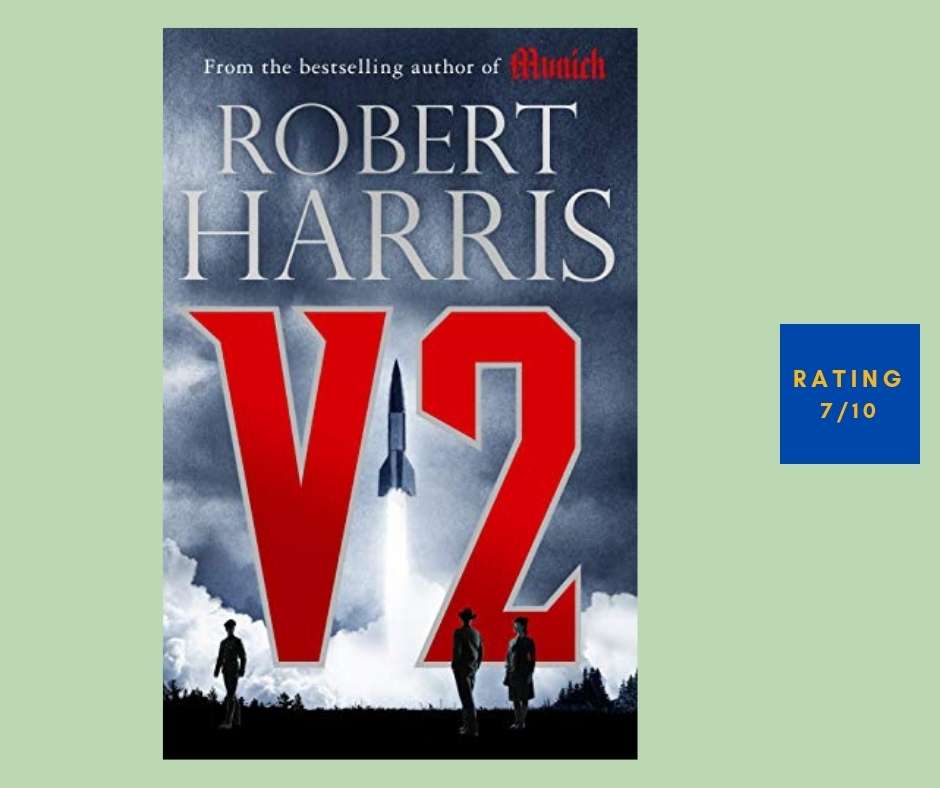
Robert Harris is congenitally unable to write anything that is not immersive entertainment, be it contemporary or historical, and in “V2,” he returns (after a detour into the 15 century with The Second Sleep, see my review here) to World War II. As Hitler rushes to pound London with Werhner von Braun’s revolutionary V2 ballistic missile, the war’s outcome seems to be in the balance. As he usually does, Harris immersively plonks us in the skins of two opposing souls, a brilliant, jaded German rocket engineer supervising launches from the Dutch coast, while an enterprising WAAF English woman rushes to Belgium to join a ragtag team attempting to triangulate the V2 launch sites. Of all of Harrris’s sophisticated cleanly written novels, V2 reminded me most of his Pompeii. As in that historical novel, we know the outcome of V2 but the strength of narration and tone sweeps us forward in excited thrall. Simply splendid.

The Thursday Murder Club by Richard Osman [6/10]

Richard Osman The Thursday Murder Club review

A sophisticated cozy mystery that should satisfy most genre followers, “The Thursday Murder Club” follows a disparate quartet of long-in-the-tooth retirees in a bucolic English retirement village who assemble weekly to tackle, of all things, cold and not-so-cold murder cases. When murder takes place in the here and now, the four of them stumble, bumble, and sweep towards solving the case and the predictable growing mayhem. Throw in two quirky police, throw in a huge cast of quaint village residents, and The Thursday Mystery Club is a swirling, affectionate read. Osman keeps up a fast pace and is a deft stylist, adopting an intelligent, deft style redolent with dialogue and humor. Mysteries in this sub-genre can be best served short, so by the end I was ready for the end, but if you sigh with pleasure at rereading Christie, this could well be something you bask in.

Folklore by Taylor Swift [7/10]

Taylor Swift Folklore review

A Covid-19 iso album with a sharp twist in style has brought megastar Taylor Swift to my attention for the first time. With simple arrangements pegged on piano and gentle guitar, souped up a bit by The National’s Aaron Dresser, “Folklore” is an unexpectedly sweet album worlds away from saccharine pop and C&W. Swift’s breathy, winsome voice suits the measured melodies, and her lyrics speak of hopes and loves and various stories. A swaying, chugging combination of voice and lyric and indie-genteel accompaniment, Folklore sits easily on the turntable (to use a term). There are no classic tracks, but that’s not the point. Amongst a very even, healthy roster of songs, I noted the gossamer-voiced old-love song “Seven”; the rickety, bass-infused “Cardigan” (“when you are young, they assume you know nothing”); and the fine “Exile,” featuring Bon Iver’s scratchy croon over a bucolic piano figure and faraway strings. Enjoyable and not diva at all.

Writers & Lovers by Lily King [7/10]

Lily King Writers & Lovers review

A rambunctious, intelligent novel about a budding novelist and her lovers and her craft, “Writers & Lovers” is one of those books that can leave general readers cold, but anyone flirting with creativity should enjoy it greatly. A Boston refugee from love and her mother’s death, Casey flails at her restaurant job while writing and falling in love and, in general, leaping at life. Lily King is a gorgeous stylist and every page is chock full of prose delights and humor. Maybe the plot, as mechanistically assessed, is old, but the treatment is fresh and lovely, and I enjoyed the read. Writers and Lovers is a treat for lovers of sparkling literary fiction.

Shuggie Bain by Douglas Stuart [8/10]

Douglas Stuart Shuggie Bain review

Shuggie Bain” is a scorching tour de force, a coming-of-age novel centered on a Scottish boy awash in the ruins of his pretty, refined mother’s alcoholism. In the early 80s, Shuggie grows up amidst the descent into poverty of his family: wayward taxi driver Shug, who abandons them; Agnes, forced from Glasgow into the dire hell of a mining town and descending into the bottle; spirited sister Catherine; and beleagured brother Leek. It’s the youngest, Shuggie, the most sensitive and imaginative of them all, who comes to love his mother deepest and longest, and the novel is the author’s keening paean to that devotion and love. In lush yet devastating prose, the novel sweeps us onward through a grim, grim saga that somehow lifts us up, lifts us up just as I recall Cormac McCarthy’s The Road doing all those years ago. Shuggie Bain is a bleak journey but it is among the most powerful books I have read this year.

Devolution by Max Brooks [7/10]

Max Brooks Devolution review

Horror is a genre that rarely works for me (that is, the fright factor remains low) but “Devolution” is a wonderful exception, and if you enjoy placing yourself in the hands of a masterful scaremeister, I can heartily recommend it. What is surprising is that Devolution reprises a staple horror trope, that of Bigfoot, the huge, apelike creature roaming mountainous areas. The novel also trots out a classical conceit, the discovered journals of a victim, in this case, a woman who settles with her husband in a modern, communitarian village deep in the Pacific Northwest of the United States. When a volcanic eruption leaves them landlocked and out of communication with civilization, the dozen or so villagers find themselves confronted a growing menace. Brooks assembles a wonderfully diverse, astutely observed group of utopians, and the classic horror novel trajectory is buttressed with post-event interviews and observations and news items. The writing, hewing to the core character’s journal, is alive and rich. Devolution is a hoot to read, intelligent as can be, and yes, I felt the hairs stand up on the back of my neck.

Salt Wars by Michael F. Jacobson [7/10]

Michael F. Jacobson Salt Wars review

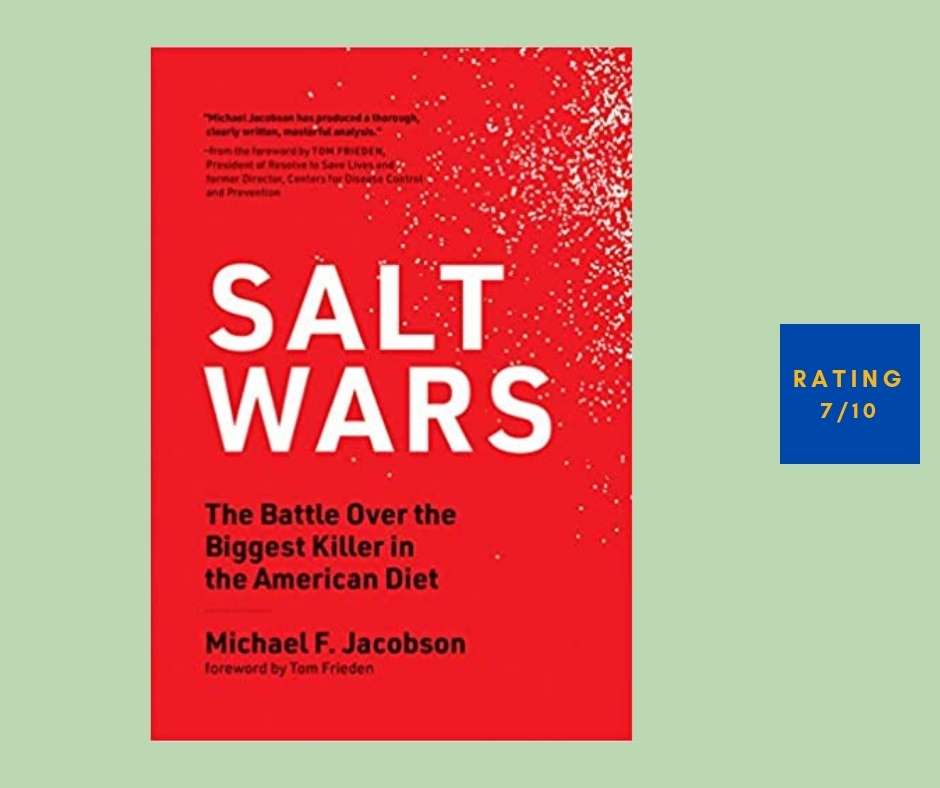
A fascinating book on a subject far from our everyday thoughts, “Salt Wars: The Battle Over the Biggest Killer in the American Diet” is the masterful magnum opus of Michael Jacobson, who for four decades has been fighting the good fight on this issue at The Center for Science in the Public Interest. Jacobson is a gently forceful, erudite, rational observer and participant who has seen it all. It won’t surprise you to hear from me that the book’s storyline is simple: too much salt is deadly (leading, via hypertension and other paths, to heart attack and stroke and much else), and we eat far too much, yet the food industry, working from the tobaccos/climate change playbook, has deftly and determinedly managed to forestall any major public policy attention to the issue. Jacobson assembles the evidence, dissects it, and then tells the sad (to me) story. He is scrupulously fair, noting in detail that applying science to this subject has been tough (but not more than tough) and that gaining traction against our insidious longing for salt, present as a ubiquitous, invisible force, can seem almost impossible. At the end of the book, the author provides invaluable advice for us to tackle our own salt excesses, all the while reminding us that this (like climate change) is not a matter of individual freedom but one of governmental dietary care. Salt Wars is a must-read for concerned individuals and politically active souls.