Colum McCann cannot write a stodgy paragraph and his latest offering, “Everything in this Country Must,” showcases his subtle, freighted prose. The author is a master at revealing without explicating, and here, over the course of a novella and short story, he portrays aspects of the Irish Troubles with sensitivity and grace. In the title novella, a teenage girl becomes enmeshed in the dramatic rescue of her Catholic father’s horse by boisterous, unthinking British solders. The two short stories also feature teenagers, one in exile with his mother while an uncle endures a hunger strike, the other helping his mother build poles for a Republican protest march while his crippled father sleeps. To my mind, the author is better suited to novels, as these shorter works cover little narrative ground and can underwhelm, but as always, the pleasure is in the lyricism.
The Insider by Matthew Richardson [7/10]
Spy fiction frustrates. Crowded with enthusiastic pretenders to the throne of Le Carre and Deighton, the genre rarely fulfils hopes for a genuinely rewarding plot coupled to uncliched characters (that is, spies who leap off the pages as real). All of this is preface to congratulating “The Insider” as a “classic” twisty Soviets-versus-Brits mole-in-the-middle adventure that weighs more than its plot. The author’s brilliant asset is Solomon Vine, a doughty, insomniac former spy recalled upon the murder of a London-based Russian oligarch who, known only to four top bureaucrats, had been a British asset. Can Vine track down the mole before national disaster? In framing the book’s central question as I have just done, I’m signaling that the plot is a fervid race against time from the Jason Bourne playbook, which would ordinarily turn a book cartoonish, but The Insider never feels less than solid, embodied in the figure of Vine, a natural spy gripped by love of intrigue. With a rollercoaster ending, The Insider snafu’d an evening of my life, and I can thoroughly recommend it.
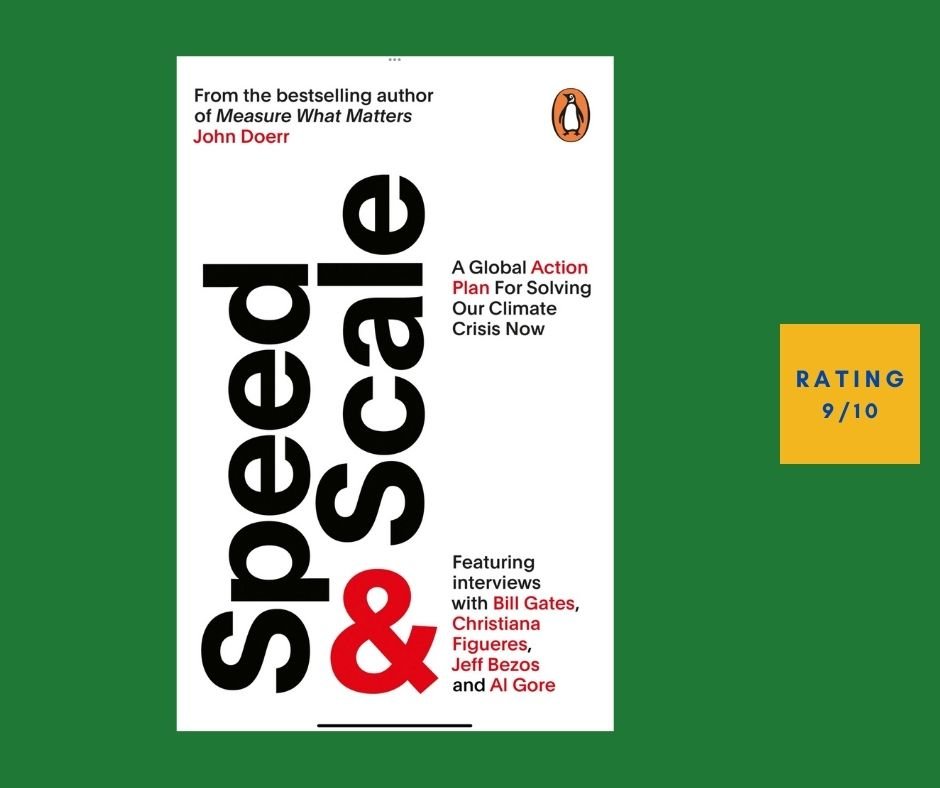
Speed & Scale by John Doerr [9/10]
Prescriptions for the global climate crisis can inspire but they rarely impress with precision, so John Doerr’s “Speed & Scale: A Global Action Plan for Solving Our Climate Crisis Now” is a timely, brilliantly conceived and superbly written treat. Doerr, who helms Kleiner Perkins, one of the world’s most successful venture capital firms, is one of my kind of folks, a paragon of planning and monitoring. His underpinning OKR methodology, the acryonym standing for Objectives tied to measurable Key Results, might seem better suited to a widget startup, but in Speed & Scale he manages to embrace the entire challenge of zeroing 59 gigawatts of carbon emissions by 2050, and to break it up into sectors and ancillary targets, in a way that even I, a climate action neophyte, could follow. Indeed the book offers wonderful coherence and understandability. I feared that Doerr would, like Bill Gates recently, focus excessively on the role of innovation, but he is balanced throughout, covering quite aptly the political actions needed to shut down all fossil fuel burning, the advocacy to motivate the huge changes required, and global equity, as well as, of course, the key roles of investment and invention. Speed & Scale is a must-read for every climate emergency activist keen for an action blueprint.
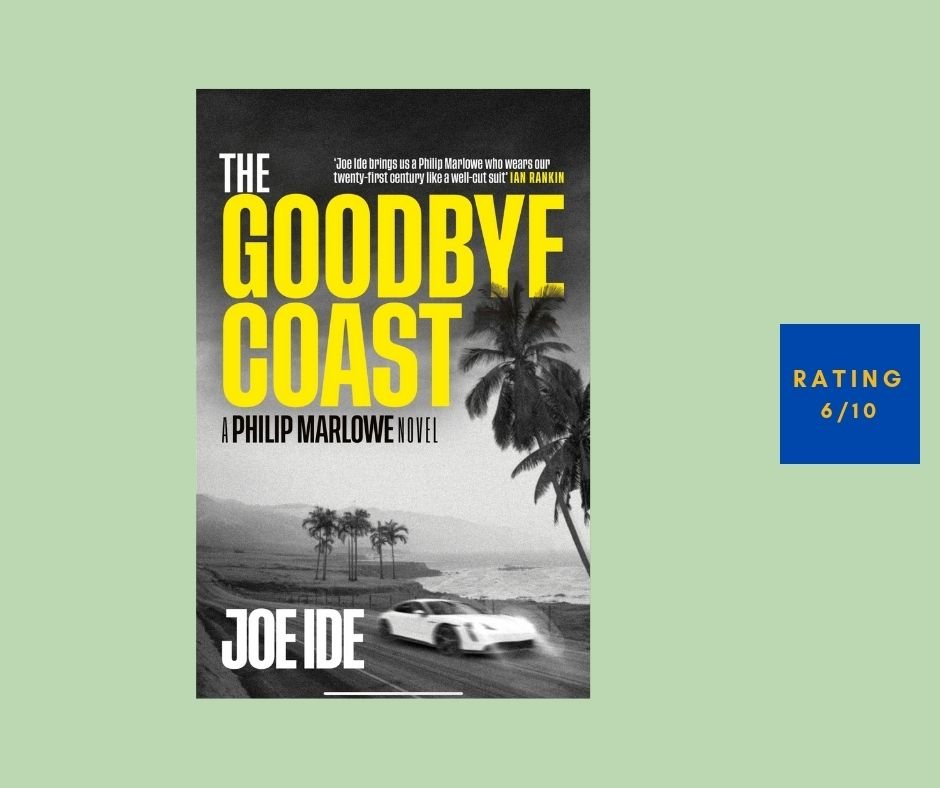
The Goodbye Coast by Joe Ide [6/10]
Only bold souls tread on the graves of noir icons like Raymond Chandler, but Joe Ide is one such adventurer. Ide is one of my favorite crime fiction authors, his five-book-strong Isaiah Quintable (aka IQ) series being full of gems. Now, in “The Goodbye Coast,” he transplants Chandler’s flinty, wise-cracking PI, Philip Marlowe, into the Los Angeles of today. In this reincarnation of sorts, Marlowe is a redoubtable PI, full of inner strength, operating as a hugely busy investigator alongside his alcoholic cop father. The novel’s detective puzzle involves a success-addled starlet, whose producer husband was recently murdered, seeking their runaway daughter. Joe Ide loves writing freakish scumbag crooks and soon the roster of suspects is a tornado of violence around Marlowe, who battles on according to his own code of practice, one that is not, unsurprisingly, unlike that of Chandler’s Marlowe.
Not everything in The Goodbye Coast worked for me. Marlowe Mark II struck me as nothing like the original, just a pale shadow really, and the byzantine plot is often dull. And the denouement, while Chandlerish, feels forced. The author’s writing style is nothing like Chandler’s nor indeed like his own regular style, and the prose can feel clunky. That said, the action scenes are unfurled with typical Ide aplomb and the L.A. atmospherics are wonderful. Overall, a mixed bag that nonetheless entertains.
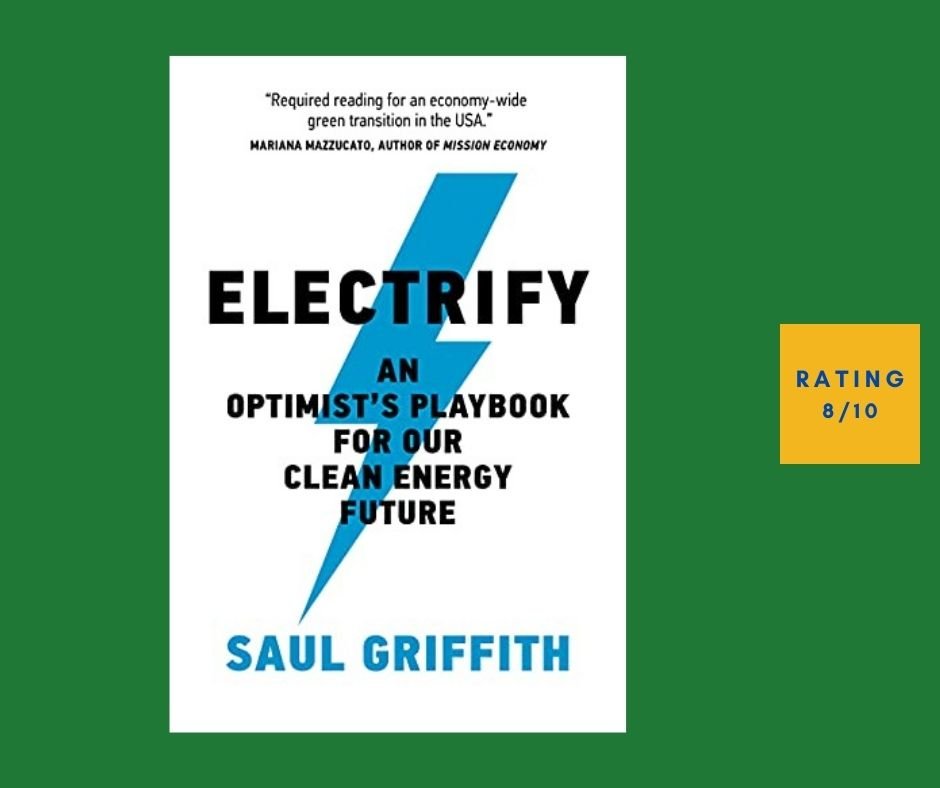
Electrify by Saul Griffith [8/10]
No doubt you read climate crisis books compulsively, like I do. Nothing is more important in our lives, so nothing is more important to read, right? “Electrify: An Optimist’s Playbook for Our Clean Energy Future” stands out from the pack as a completely practical one-solution blueprint. Focusing on America, the author, an engaging entrepreneur and inventor, prescribes Manhattan-Project-level policy decisions: switch electricity to solar, wind, and (with some hesitation on his part) nuclear; switch petrol-fueled cars to electric vehicles; switch home heating to reverse-cycle air-conditioning (he calls it heat pumps); fund innovation but only for the tail of the problem (industry, air travel, food); transform the electricity sector to allow households and businesses to freely exchange juice with utilities; and provide cheap government loans to get over the financing hump. Griffith has analyzed extensive U.S. energy usage data, coming up with amazing ideas, for example that about half the energy used in America is employed to extract and move fossil fuels, so that the national transformation required is much less than envisaged. He is scathing (rightfully so) on climate-washing notions like carbon capture and hydrogen. All up, Electrify is an exhilarating jolt of positivism that everyone should read.
Misericorde by Tiny Little Houses [8/10]
Melbourne band Tiny Little Houses burst onto the scene with the distinctive semi-sneering vocals of frontman Caleb Karvountsis declaiming on the Pixies-like stunning track “Garbage Bin” off the band’s debut album. It was a stunning debut. Three years on, “Misericorde” is less bile, more storytelling, but the band’s derivative-yet-distinctive lo-fi mix of fuzz and catchy melody has arced up a notch. Maybe you need to remember 90s indie to immediately fall in love with Misericorde but even if you need some time with the songs, eventually their pull will work magic. Not one of the thirteen tracks is filler, each deserving rotation. Highlights include “Richard Cory” with its stunning lyric describing how he “one calm summer night put a bullet through his head”; the album’s closer, the majestic “Holy Water”; and spiky “Car Crash.” If Tiny Little Houses keep progressing like this, the next release will be a classic.
Belfast by Kenneth Branagh [10/10]
Kenneth Branagh eschews both savagery and soppiness in “Belfast,” his highly stylized but emotionally weighty story of a Belfast family torn by pressures to leave the city as the Troubles take off in 1969. Shot in a warm black and white monochrome laced with occasional colors, and galvanized by Van Morrison songs, the film cuts to the essence of the times without ever using cliches. The acting is splendid throughout: Jamie Doran as the slightly roguish yet heroic father; Catriona Bailfe as the passionate mother; Judi Dench as the wrinkled grandmother; Ciaran Hinds as wise Pops; and, most important of all, Jude Hill as nine-year-old Buddy, around whom the movie swirls. The family’s house is a core location beautifully presented, being as it is in a mixed-denomination street that has the feel of a stage set. Branagh’s script is relentless as the violence between equally reprehensible British overlord thugs and Unionist hardmen ratchets up, and he relishes grand scenes such as the opening one of burning Catholic homes and, later, a looting riot. Throughout, Branagh returns again and again to the core question facing the family: how can they leave this charismatic city but what is the price of staying? One part a coming-of-age story, one part a love song to Belfast, and one part a retrospective of the unique Troubles, Belfast is a cinematic triumph that left this reviewer in tears.
Intimacies by Katie Kitamura [6/10]
“Intimacies,” an intriguing spare novel that never wastes a word, chronicles the days of an interpreter at the International Court in The Hague, her refuge after floating years. Here she becomes enmeshed in a loathsome yet fascinating interpretation assignment, translating for a charismatic yet sinister former president accused of genocide. Outside the court, a love affair seems to be suspended and a friendship invites hidden knowledge. The setting and milieu of the court of international justice is portrayed with a detached clinical eye that renders it fascinating, and the author’s open, running style suits the claustrophobic character-centered atmosphere. So, yes, there is much to admire during the reading of Intimacies, but the final impact is dampened by a mild plot that rouses tension but only partially delivers. An enjoyable read that could have aimed for more.
The Long Game by Simon Rowell [6/10]
Garry Disher is not the only mystery writer tackling the Mornington Peninsula, a bayside neck of land near Melbourne. Simon Rowell’s second puzzler, “The Long Game, ” starring Detective Sergeant Zoe Mayer, may not quite match the master’s peerless plotting and characterization, but it’s a rewarding, fast-paced read. The novel’s opener sees a surfer killed with a knife in his chest, and the case soon seems routine, but DS Mayer’s attentive digging soon unearths subtle oddities about the case. Before long, she (and her trusty dog) is on the trail of a devilishly clever opponent. The author’s prose is polished and well-controlled, and the varied locales of the beach are convincingly evoked. The climactic twist, although not telegraphed, might be guessable, but by the end of The Long Game, the tension has ratcheted up enough to provide a fitting ending in any case. Recommended.
The Dark Hours by Michael Connelly [6/10]
Superstar crime fiction writers invariably slide downwards. Even the redoubtable James Lee Burke, for so long my favorite writer in any genre, became a self pastiche. Michael Connelly has always been the exception, his nearly two dozen Harry Bosch novels all perfectly plotted, suffused with characterization, and stylishly penned. Throw in the marvelous Mickey Haller books and it is no wonder that I always snap up the annual (or more frequent!) Connelly treat. “The Dark Hours” is the fourth outing for Renee Ballard, a Los Angeles detective of relentless activity and purpose, seemingly without higher ambitions, who is smart and expedient. The presence of Bosch as her partner/mentor enhanced the previous two Ballard outings. In The Dark Hours, Ballard takes on a New Years Eve killing of mystifying opaqueness while tracking two savage rapists. The author’s command of plot is as masterful as ever, making for an easy armchair read, but for the first time, I found myself thinking, “too much plot, where are the humans?” If you’re a Connelly fan, snap up The Dark Hours. If you’re a general crimmy fan, go back and read the Bosch classics.