A Sam Mendes film is always worth waiting for, and “Empire of Light” is a minor gem. It revolves around a gorgeous movie theater in a southern England coastal town, sumptuously filmed by Roger Deakins, Olivia Colman is unforgettable as a forty-something manager in the cinema, possessing a hidden flaw, who falls badly for a young black usher, wonderfully acted by Micheal Ward. Other delightful cast members include Toby Jones as the projectionist and Colin Firth in an uncharacteristic sleazy role as the manager. The film starts gently enough, but with a pulse clearly going somewhere, and a revelatory mid-movie plot twist tumbles the viewere into an entirely different film, one of intense pathos. Wonderfully evocative scenes of the times (the early 80s) round out a terrific viewing experience that lingers. Empire of Light presents itself as too mild to be significant but its carefully wrought undercurrents make for a fine film.
Invention and Innovation by Vaclav Smil [8/10]
Super-technology-analyst Vaclav Smil has the wonderful capacity and ability to burrow into details and yet scan from the highest possible heights. His “analyses” are either weaponized (anti-renewable folks loved him but now he’s smashing nuclear power!) or derided as myopically extrapolating from the past. I see him as a marvelous provocateur to be read and absorbed and then carefully digested. “Invention and Innovation: A Brief History of Hype and Failure” is his latest no-holds-barred mixture of historical adventure and bristling polemics. Decrying what he sees as a current fad for overestimating the pace of innovation, Smil starts by recounting the histories of three “inventions that turned from welcome to undesirable”: leaded gasoline, DDT, and chlorofluorocarbons. Then he unfolds the histories of “three inventions that were to dominate – but do not”: airships, nuclear fission, and supersonic flight. Then, three “inventions that we keep waiting for”: travel in a (near) vacuum, nitrogen-fixing cereals, and controlled nuclear fusion. Each mini history is a tour de force of unpacking data analytically, cogently, and authoritatively. Smil’s final chapter is his now-familiar rant that decarbonization targets and hopes are hopelessly ambitious, at least based on any history.
Some of Smil’s recent prolific output has seemed to flirt with excessive emotionalism. Make no mistake, Invention and Innovation is at heart a diatribe, a familiar one, but the historical underpinnings are a pleasure to absorb and his unexpurgated opinions certainly add to our current debates about the future. Recommended.
Hinge Points by Siegfried S. Hecker [8/10]
So much has been written about the weird, dysfunctional manner in which North Korea, an isolated, totalitarian country, has armed itself with nuclear weapons, a slow, steady, seemingly unstoppable process over three quarters of a century. A test of the global nonproliferation regime that has seen that structure fail, North Korea’s nuclear arming has fascinated scholars and participants. Now we have the definitive account, by superbly credentialled American physicist, Siegfried Hecker. Not only is his technical experience, at Los Alamos Laboratory and elsewhere, been first rate, he visited North Korea, at their invitation, over 2004-2010, and dealt with both diplomatic and technological negotiations. “Hinge Points: An Inside Look at North Korea’s Nuclear Program” is his account of his jaw-dropping experiences, related in a fluid, commanding style, but also his analysis of what he calls “hinge points,” moments of missed opportunity to ratchet back the nuclearization. It is no surprise to anyone with any perspective of the last three decades of the North Korean debacle (for that is what it was) to hear that the most recent Republican administrations were blind and incompetent on this issue, but both President Clinton and President Obama come in for reasoned criticism. Hinge Points is THE go-to analysis and account of this story and was, for this reader, a delight to read.
The Candle and the Flame by Robert Forster [9/10]
Albums from the wonderfully droll, poetic, and oddly radical Robert Forster sound at first to be amateurish but then speedily morph into ear candy. So too “The Candle and the Flame,” his first album since 2019’s Inferno. Produced at home and roping in family and friends as needed, Forster delivers nine delightful, low-key but muscular songs anchored by his trademark semi-conversational voice. The album kicks off with a brilliant curio, a furiously strummed riff over which Forster spits (singing to his wife who came down with ovarian cancer), “she’s a fighter, fighting for good,” before “Tender Years,” a gorgeous love song. “There’s a Reason to Live” offers homespun philosophy over an unforgettable, lilting melody, while the closer, “When I Was a Young Man,” is a lovely, poetic reflection on the past. Overall, The Candle and the Flame is a brilliant package that cuts through the ephemerality of much modern music.
Avocado Anxiety by Louise Gray [6/10]
Nowadays writing about food is much more complicated that a couple of decades ago, to the extent that there is a new sub-genre that examines the role of the food system in the climate crisis, the extinction crisis, and escalating global inequity. “Avocado Anxiety: and Other Stories About Where Your Food Comes From” is a mash-up of food history, carbon footprint discussions, food decision-making, English history, and emotionally charged recipes, ending up with a sense of overreach. Food writer/journalist Louise Gray relates the tales of a dozen fruits and vegetables as they have featured in the lives and history of Great Britain, and each of the stories is an engaging essay written with punch and flair. I learned plenty about bananas, avocados, and more. The author weighs in on the evolving debate about food miles: is it better to buy only local produce even if driving to a farmer’s market catalyzes greater emissions than air-freighted supermarket produce one can walk to? And so on and so on. I enjoyed her candor in admitting that often a decision on what and how to buy ends up being arbitrary or simplistic. In the end, Avocado Anxiety was an intriguing read that perhaps shrank from boldness and advice, advice this reader undoubtedly needs.
Knowing the Score by Janine Hosking [5/10]
Possibly best suited to opera afficionados, “Knowing the Score” relates the story of the trailblazing Simone Young, who travels from Manly Beach to the wide male-dominated world of opera and classical music, and conquers them all, reaching the top of the profession. The documentary hinges on her return to conduct at the newly renovated Sydney Opera House, an occasion intensified by an earlier tenure at Opera Australia when she had been sacked. The hero is a modestly charismatic figure, the filming involves some imaginative graphics, the direction is steady, but I felt insufficient dramatization was invoked, dramatization that was there in the underlying story but not amped up. Truth be told, the operatic milieu is not for this reviewer, perhaps coloring my impressions, so Knowing the Score, with its grand theme of our over-slow passage to gender equality, might well appeal to many.
Glass Onion by Rian Johnson [6/10]
The movie that turned Rian Johnson into one of the star turn writer/directors, Knives Out, was an exuberant, star-filled Agatha Christie homage that simply worked. Even the oddity of Daniel Craig hamming it up as a southern American gentleman Poirot-clone somehow succeeded. The sequel, “Glass Onion,” transports the twisty puzzle to a Greek island, to a tale of a tech billionaire (Ed Norton) entertaining his murderous supplicants in a locked-room setting. In essence, the plot setup is the same as in Knives Out and the locale is even more atmospheric, so this viewer came to the viewing primed for delicious plot twists and belly laughs from a cast of established stars. Unfortunately, the acting performances are routine, with clear blame placed on Ed Norton, who transmits no charisma at all. What attempts at humor are made quickly fizzle out. And the unrolling of the plot offers the viewer complexity without depth. As light entertainment, Glass Onion whiles away a couple of hours, but the earlier magic is gone.
Upgrade by Blake Crouch [8/10]
A breathless sci-fi thriller with smarts and a little depth, “Upgrade” takes place in a mildly dystopic world a bit in the future. A gene criminal policeman, son of a famous scientist who accidentally wreaked havoc and then suicided, takes place in a routine snare mission and then, after an explosion, begins to witness his body and mind altering, the “upgrade” of the title. Family dynamics come into play as our hero battles to deal with his genetic evolution. The author controls the plot well, pens stylishly, and keeps the reader guessing. Upgrade is classy post-Christmas entertainment for those who like intriguing near-future sci-fi.
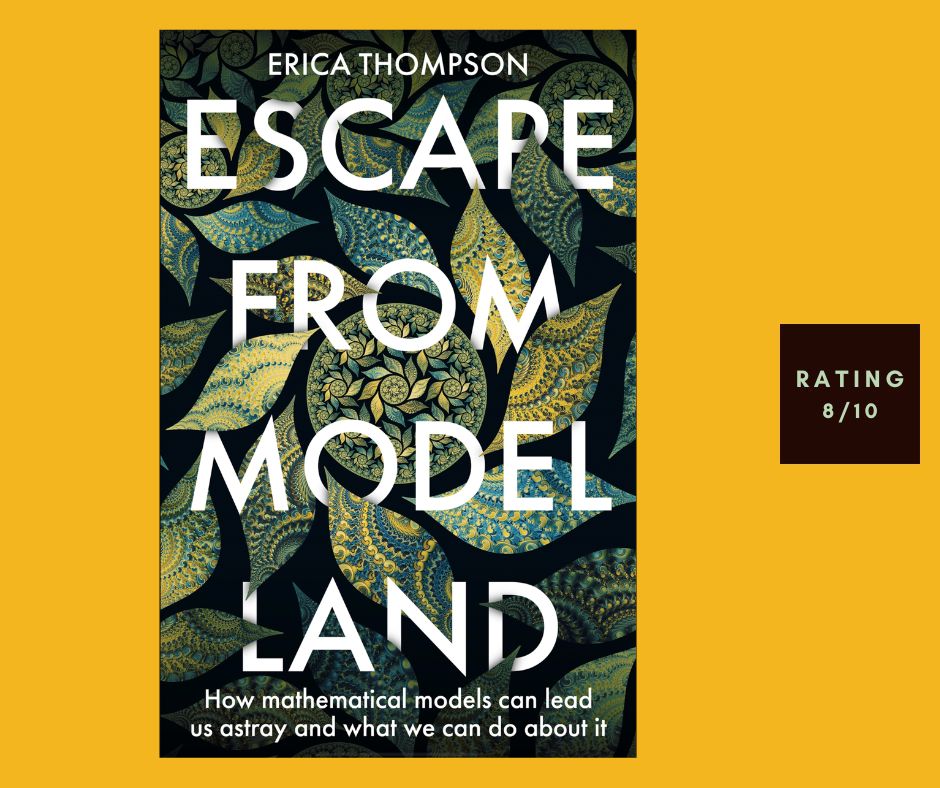
Escape from Model Land by Erica Thompson [8/10]
As an ex-actuary who employed models, albeit highly specialized ones, in my working life, the much more ambitious climate change models that underpin the IPCC’s stellar, critical work fascinate me. Yet as someone who understands the pitfalls of models, just how useful those models are in practice has been an open question for me. Now Erica Thompson, an experienced modeler/data scientist, has tackled that very issue (among many others) with “Escape from Model Land: How Mathematical Models Can Lead Us Astray and What We Can Do About It.” There is no dumbing down here, with the author digging deeply into general and specific models from the outset, so, dear reader, have your wits about you. But any savvy interlocutor should be able to sink into a superb, sprightly narrative that traverses fields from historical beginnings to recent Covid-19 models, while spending considerable time on humungous climate models. Anyone confronting the dodgy “climate change won’t have any material impact on humanity’s economies” models knows how distortions can arise. The many pitfalls of models, from hubris arising from having an elegant model, through data deficiencies, to poor explication at the other end, are covered elegantly and thoroughly. The ongoing value of models, even in the face of downsides, is also stressed, and the author makes suggestions on how to evaluate and use models. In this age of mega issues facing us, Escape from Model Land is marvelous, essential reading.
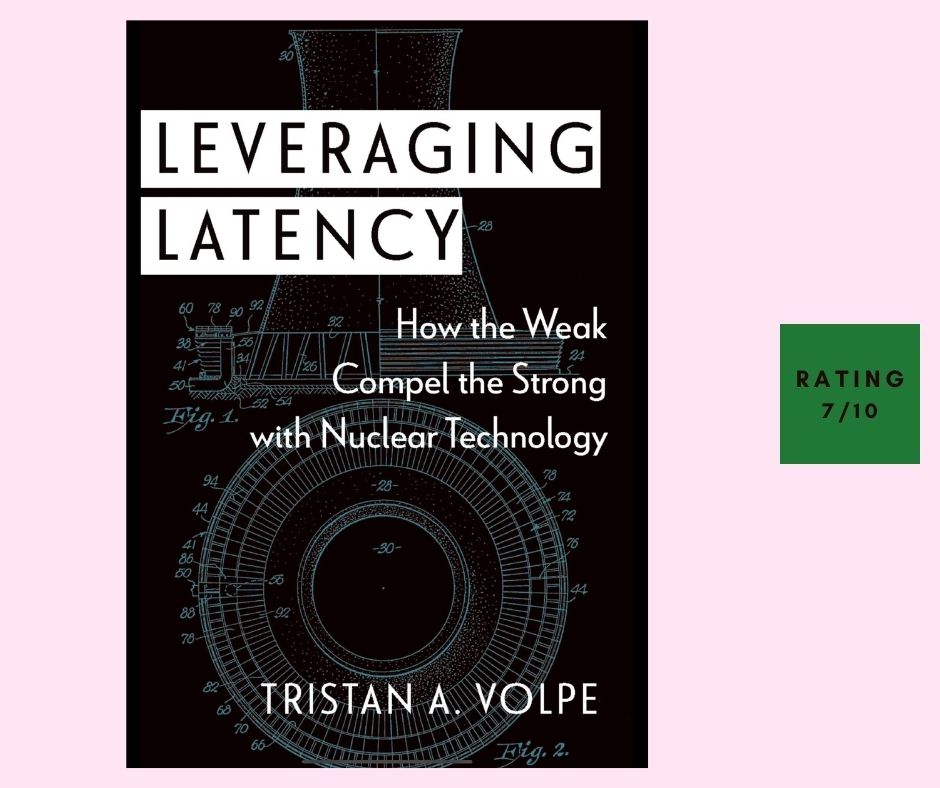
Leveraging Latency by Tristan A. Volpe [7/10]
Very much for nuclear proliferation wonks—sporting historical data, employing a methodology, and testing a hypothesis—”Leveraging Latency: How the Weak Compel the Strong with Nuclear Technology” may also appeal to post-WWII-history buffs, simply because it is so appealingly executed. The author, a historian at an American naval school, exhibits full control of his narrative and writes in a perky, clear style that makes for sweet reading. His argument, that potential nuclear proliferators can sometimes strike advantageous bargains with large national powers but only at a certain “Goldilocks” sweet point, is most persuasive. At a time when an academic or semi-academic treatise on nuclear proliferation seems to be born every six months, Leveraging Latency shines out.