A pitch-black yet comedic revenge tale for women would not normally even come up on my radar but my wife was entranced by Bad Sisters, persuaded me, and rewatched it with me. Co-written by wonderful Irish actor Sharon Horgan, it dramatises the efforts of five close sisters to get rid of one of their husbands. The narrative switches between their bumbling killing attempts and a later investigation by two insurance adjusters (wonderfully played by Bryan Gleeson and Daryl McCormack). The script zings and the direction of the ten episodes is perfectly controlled and paced, with atmospheric cinematography in the Irish seaside country. Horgan herself is stellar as the sister elder, but the other four sisters are brilliantly portrayed by Eve Hewson, Sarah Greene, Anne-Marie Duff, and Eva Birthistle. Dark and hilarious and super-smart, Bad Sisters is a wonderful hybrid thriller.
Small Mercies by Dennis Lehane [9/10]
Dennis Lehane is a superb writer of both thrillers and mystery novels, but over the last decade or longer, has shifted into the screenplay world, to fine effect. His forays into fiction have impressed but not astounded and it took me a long time to get round to reading his latest, Small Mercies, simply because I feared dropping him from my panoply of favorite authors. My concern was misplaced. Small Mercies is a return to top form, both a jagged, violent revenge/justice thriller and an in-depth, character-based dissection of inner Boston in the mid 70s. The plot is simplicity itself—a downtrodden single mother, searching for her missing teenage daughter, begins to encroach on the activities of the neighborhood’s ruling Irish gang—but the chapter-by-chapter unfolding of the truth is anything but simplistic, twisting unexpectedly and often shockingly. All this amidst oppressive heat and the turmoil of a school desegregation push… The author pulls no punches and, showcasing Lehane’s superb plotting skills, the climax is both revelatory and inevitable. The author is a flowing stylist with a real ear for dialogue, and the pages of the book seem to turn themselves. Welcome back, Dennis Lehane!
How to Blow up a Pipeline by Daniel Goldhaber [8/10]
How to Blow up a Pipeline is not for everyone but it was written for me, given that I had read, absorbed, and partially appreciated Andreas Malm’s 2021 theoretical eco-terrorist debate book, How to Blow Up a Pipeline: Learning to Fight in a World on Fire. Malm’s book is supremely academic; he argues that climate change is so globally existential, and so dependent upon immorality on the part of, notably, fossil fuel companies, that property destruction might be morally defensible or even necessary, if only to rally a more reasonable activist polity. Now, in this film, director and co-writer Daniel Goldhaber has created an old-fashioned heist caper in which a dozen or so direct-action activists, barely known to each other, plot to explode a hefty Texan pipe. The plot is surprisingly clever, cinching up the tension while shuffling through the combatants’ back-stories, and reserving a couple of minor plot twists to the end. The intricacies of assembling and deploying an amateur explosive are lovingly caressed by the camera, and the disparate characters are well cast and played and unfolded. How to Blow up a Pipeline is not for those with utter disdain for the central premise, but if you can entertain flexibility concerning the good guys and the bad guys, it is a tense, intriguing hour and a half.
Gods & Assassins by Frank Kennedy [8/10]
Gods & Assassins is a detour in Frank Kennedy’s panoramic Collectorate space opera story, told over a few long series. Whereas the main game is a vast tale encompassing worlds galore, in Gods & Assassins, released in the form of five short novels picturesquely titled Red Dust, Silver Skin, Blue Heart, Black Star, and White Sunset, the focus narrows to Royal, a barbarous, immortal once-God, now scrabbling a living on a shit-bucket planet. Over the five books, Royal (and his even more bloodthirsty collaborator, Moon) begins carving out a criminal enterprise that spreads from a town to a planet to a collection of planets. Aided by an ancient intelligence he allies with, Royal assembles an organization lovingly described by the author. Like his main series, this one oozes atmosphere, in this case Royal’s bloodthirstiness (this read is not for the faint-hearted), is packed with set-piece action sequences that work wonderfully, fizzes with lively dialogue, and is underlaid by complex politics. In essence, Gods & Assassins is a 1,000-plus-page novel that will energize any lover of space science fiction.
The Internet Con by Cory Doctorow [9/10]
Cory Doctorow is a firecracker novelist, nonfiction writer, and activist, one who has consistently explored alternative publication and marketing strategies. The Internet Con: How To Seize the Means of Computation was a Kickstarter campaign, one that was instantly alluring to me, and I received an audiobook when the funding phase inevitably succeeded. The book is a distillation of Doctorow’s decades of analysis of and activism against the Internet titans such as Facebook, Google, and Apple. His is (literally in my case) a beautifully expressive, but also elegantly educational, voice on the situation we find ourselves in, in which a handful of large monopolistic and oligopolistic players rule, greedily using us ordinary citizens for profit motives. What is needed, Doctorow persuasively claims, is to bring the tech giants to heel using antitrust legislation that compels what he calls interoperability, that is, the freedom for anyone to exit the major services for smaller new ones whilst still retaining access to one’s own data and connections to existing social media connections. The environment in which antitrust is being fought is rife with complexity, not least the perils of privacy loss, bad actor activity, and terrorist inroads. Doctorow weaves a sprightly path through all this. As he notes, the path ahead is long and needs both civic leaders and detailed technical expertise. Overall, The Internet Con is startlingly powerful, at once a digestible read, a comprehensive status report, and a precise action plan.
Going Infinite by Michael Lewis [10/10]
On October 3, when Sam Bankman-Fried, once vying to be the multi-billionaire ruler of the crypto world, faced the judge on his first day in court, Michael Lewis released his extraordinary close-up part-biography, Going Infinite: The Rise and Fall of a New Tycoon. This book has generated scads of hostility since its release, especially during Lewis’s book tour of interviews, and any reader can examine this high-profile case at length and decide whether Lewis in some way wrote a hagiography, but let me tell you, Going Infinite is not a judgement on crypto or indeed on Bankman-Fried’s guilt. It is a high-spirited, closely observed, rollicking tale of Lewis’s fortuitous year spent with the crypto magnate in America, Hong Kong, and the Bahamas, a year of unparalleled access and so a precious window into a most different human being. An “ethical altruist” (that’s a technical term) with zero empathy and a wide-ranging, analytical mind, Bankman-Fried is, in a storytelling sense, an “amazing character,” and Lewis’s account is his narrative of the man’s pinnacle and fall. As ever, Lewis is a consummate stylist, combining a light-touch prose style and wonderful technical elucidation with gritty mud-digging journalistic skills. Going Infinite is a farce or a tragedy or a triumph, you take your pick, but above all, it is exhilaratingly enjoyable to read. One sitting is all it takes to marvel at a true story too wild for fiction.
So Late in the Day by Claire Keegan [7/10]
Claire Keegan must present a marketing dilemma for her publisher. She writes short: after short story collections (Antarctica and Walk the Blue Fields) in 1999 and 2007, there came Foster (2010, 128 pages) and Small Things Like These (2021, 83 pages). The latter two novellas were brilliant, written in a restrained, lyrical style and dealing with emotionally deep topics. I snapped up So Late in the Day as soon as it came out, eager to sink into another life-changing, novella-length wonderment, only to find … a short story. A charged story, to be sure, covering the reflections of a man ruing his recent love life while skirting on the edges of recognizing his own deeply imbued misogyny, but no more than a short story. Wonderfully written, gently choreographed, full of tender evisceration … yet … yet just a short story, not even close to the length of a novella. Summing up, if you are a real fan, like I am, by all means pay US$4 for an ebook version of So Late in the Day, but for anyone else, wait for it to emerge in a collection of shorts, as it should have been in the first place.
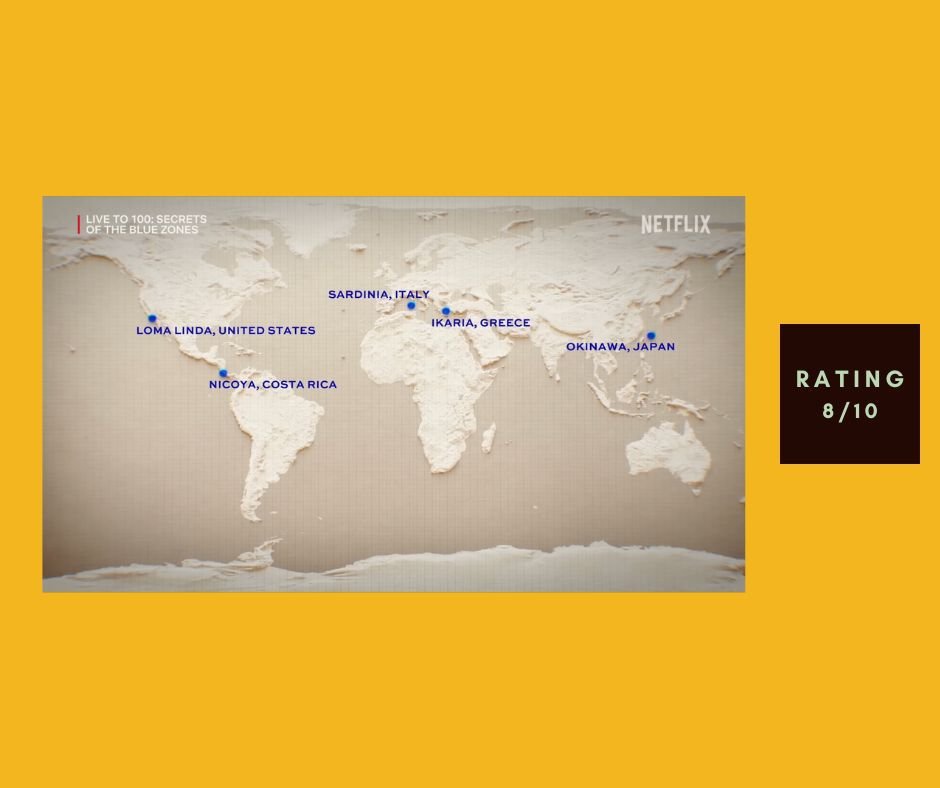
Live to 100: Secrets of the Blue Zones by Dan Buettner [8/10]
Ex-adventurer Dan Buettner has been relating his investigations into the startling nature of the world’s Blue Zones (pockets where the number of centenarians reaching age 100 is astronomically high) for years, via National Geographic and books, but also through community-based advocacy. Now he has his four-episode Netflix moment with Live to 100: Secrets of the Blue Zones. There might have been a temptation to grandstand or to over proselytize, and, frankly, I approached the series with a sense of dread. Instead Buettner comes across as humble and earnest, as he once again travels to Japan, Italy, the United States, Greece, Costa Rica, and (at the end, in campaign mode) Singapore. Each of the five Blue Zones is mined for insights gathered through interviewing and following a truly inspirational cast of very old people. The direction of the series by Clay Jeter cannot be faulted; every scene makes sense, every commitment of a viewer’s time is fascinating. The notion of Blue Zones and what it means for a healthy, long-lived life might not be as simple as portrayed on Netflix and I have seen the words “Blue Zone” wielded in favor of very different dietary regimes, but Buettner’s insistence on holistic life choices and ensuring the right enfolding environment rings true. Live to 100 offers no magic bullets for the unhealthy among us, indeed it will daunt many, but the hope is that the abiding eye candy of dozens of beaming, fit, and active wrinklies should open our eyes.
Red Queen by Juan Gomez-Jurado [8/10]
A much-hyped thriller that the marketing blurbs suggest is startlingly propulsive, Red Queen turns out to be a throwback to the serial-killer books that bloomed like fungi for a decade after the success of Silence of the Lambs. This comment is not meant to be criticism; instead, the way it hews to a classic trope, combined with the author’s confident, immersive style, ensures a classic sleep-derived read. No plot spoilers here: we have a preternaturally talented killer-hunter, paired up with a shambling, “average” cop, racing to track down a diabolically clever and evil monster before he kills again. Ably translated from Spanish and benefitting from a Madrid setting, Red Queen ducks in and out of the two main characters’ viewpoints, plus those of the potential next villain, the killer, and a handful of minor characters. Clues are laid carefully and pacing is cinched tightly, so that the tension around the climax is fierce. If the ending is slightly baroque, that too, is in line with this most enjoyable thriller’s ancestors.
Past Lives by Celine Song [6/10]
Movie trailers can prove to be utterly unrepresentative but the taster for Past Lives, the latest from South Korean-Canadian writer/director Celine Song, turns out to be accurate. Nora and Hae Sung are close childhood friends in Seoul until Nora’s family emigrates to Toronto, and two decades later Nora is married to fellow-writer Arthur, living a New York life, when dissatisfied Hae Sung, pining for his memories, finally comes to the big Apple. Will the South Korean notion of in-yun, the interlacing of lives through generations of incarnation, result in Nora and Hae Sung embracing true love? Writing the central plotline in the way I just have, with just that intonation, will alert you that for this viewer, a gentle plot, played out with intense camera focus on faces, partly captivated but partly slid by. The actors are magnificent—Greta Lee as Nora and Ted Yoo as Hae Sung, but especially John Magaro as Arthur, managing to convey in a glance what many actors take an entire film to convey)—and both the cinematography and music dwell sublimely, but throughout the stakes seem low and the emotions dialed down. Certainly, watch Past Lives for a sweet immigrant love story, but I wish it had aspired for more.