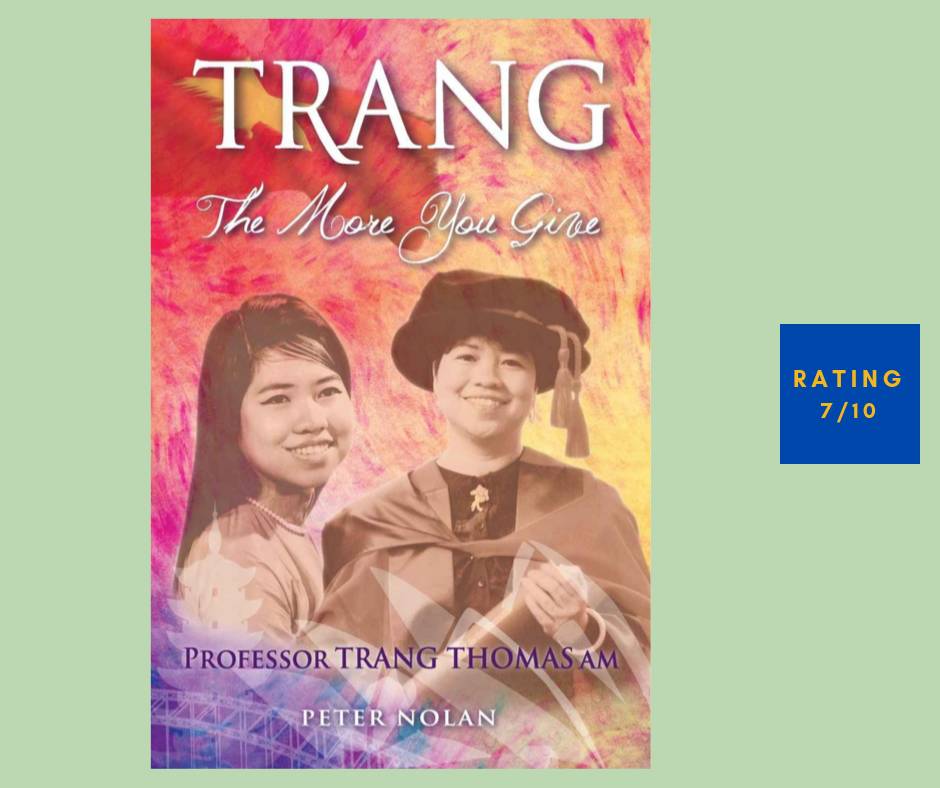
Trang by Peter Nolan [7/10]

Peter Nolan Trang review

Trang: The More You Give” is an unassuming biography of the sort that shouts “fascinating person I’ve known,” normally only of interest to those who actually are friends of the subject. And I do know Trang Thomas, the Vietnamese-born Australian covered in this book, though my acquaintanceship is recent and not especially deep. But appearances deceive, a cliché that applies equally to this bio and to Professor Trang Thomas herself, because this book is an engrossing tour through both a life and her times. Most unexpectedly, the gentle, intelligent academic I thought I knew was in fact a trailblazer through my era. A pioneering psychology academic, Trang was way ahead of the curve in Australia, tackling issues of aging and multiculturalism long before they became mainstream. She headed up government commissions, served on landmark boards, and was called to duty by a revolving roster of senior politicians. Consistently, she stood up unswervingly for the principles of multicultural richness and equality, as well as feminism, that are close to my heart. The number of times she was accorded a “first” (first woman, first Asian, etc., etc.) amazed me. Of course an interesting life often a boring book makes, but Peter Nolan, in his second book, is a smooth, logical writer with strong narrative control. In short, “Trang” is a superbly crafted biography that should be read by all Australians.

Dolphine by Mega Bog [6/10]

Mega Bog Dolphine review

Mega Bog is eclectic, subversive, playful Erin Birgy and “Dolphine” is her fifth flitting release. Talk about all over the shop! Songs leap from bouncy folk to glistening jazz to jagged guitar-led pop. Sounding life a refugee from the early 70s prog-folk interface, Mega Bog is, nonetheless, a cohesive marriage of pop trippery and avant music flourishes, and I thoroughly enjoy letting it wash over me while working. Standout tracks include the wonderful, rolling, pulsing title track of yearning, the short duet “Spit in the eye of the fire king,” and the shapely musical odyssey of “Fwee again.” Much recommended, this musical outflowing.

Everything Under by Daisy Johnson [6/10]

Daisy Johnson Everything Under review

Saturated with portent and gloom, and lurking in and around Oxfordshire river folk country, “Everything Under” is a most unusual novel, a gothic tale blended with modern transgressiveness and family schisms. Gretel, a humdrum lexicographer, tracks down the mother who walked out a decade and a half earlier, and then Daisy Johnson deftly (but deliberately obscurely, the strands are indeed murky) ducks in and out of the past with tales of transgender waifs and role models, and generational ills. Johnson pens evocative, mystery-saturated prose that grips from scene to scene, but to this reader, the overall narrative glides with little laid-out purpose. By the time of the climax, I found myself both engrossed and over it, so my judgement is this: a memorable novel that offers no easy closure.

The Anthropocene Reviewed by John Green Season 2018 [7/10]

The Anthropocene Reviewed review

The Anthropocene Reviewed” is neither book nor film nor album but deserves a review because in a real sense, this podcast is a book, an elegant, intelligent collection of essays wrought by a fine writer. Listening to the podcast, you can almost see John Green reading out the words, each episode immaculately conveyed. The conceit is that in each episode he rates, out of five, like a movie reviewer, a couple of aspects of humans in the Anthropocene Era in which humanity is remaking the planet Earth. Green intermingles the profound recollection underlying “Googling strangers” with an environmental reflection on lawn grass in “Kentucky Bluegrass” and quirkiness such as in “Piggly Wiggly.” Wise, humorous, and literary.

Money Heist Season 3 Episode 1 [8/10]

Money Heist Part 3 review

Money Heist Season 3” represents a bet on plotting imagination, for who could possibly match the sheer exuberance of the underlying plot of the first two seasons, the takeover of the Spanish mint? Episode 1, then, is a test: can it make the cut or will it straightaway fizzle? Well, the news is good. We kick off the action with snippets of the triumphant band at their various celebratory hideaways in nooks and crannies of the world, then bang: Rio (still played superbly by Miguel Herran), after a lapse of judgment, falls into the hands of the thuggish cops, and Tokio (another wow from Ursula Corbero) tracks down the Professor, played with incandescent cool by Alvaro Morte, for help. Soon enough, the band of thieves is reunited, with some new, interesting-looking thieves, and assembled for another grand coup attempt back in Spain. The first episode is all setup but it’s done with great verve, narrative flair (dodging back in time as needs be) and humor. There’s no reason to suppose the next seven episodes won’t be any less spectacular and intelligent than the earlier seasons.

The Boys Episode 1 [7/10]

The Boys review

2019, for me, is a year of extravagant entertainment, the kind of intelligent, exciting shit that takes you away from life but also deepens. So it’s been Bosch and other dark mystery/thriller series, and it’s been the sci-fi of Legion and The Umbrella Academy and so on. Do I need more of such exuberant escapism? Well, I’ve begun “The Boys,” a supremely odd superhero comic-based series that pits corrupt superiors against a ragtag bunch of citizen vigilantes. It begins with young Hughie (played wonderfully by Jack Quaid) gutted by a death caused by Vought Corporation (the one with all the vaunted superheroes) and falling in with mysterious, rough-as-guts Billy Butcher (what a surprisingly fine turn by Karl Urban!). In the meantime Annie, a wannabe Vought superhero, is anointed as Starlight and begins to understand what she’s really gotten into. Over the course of a slightly surreal, uncertainly paced first episode, we glimpse how Hughie, Billy, and Annie might range against the baddies led by super-superhero Homelander, portrayed by frosty precision by Antony Starr. The first episode is at once compelling and irritating, but by the closing, brutal scene, it’s clear the viewer is in for a ride. Will that journey satisfy? Let’s watch on, viewers…

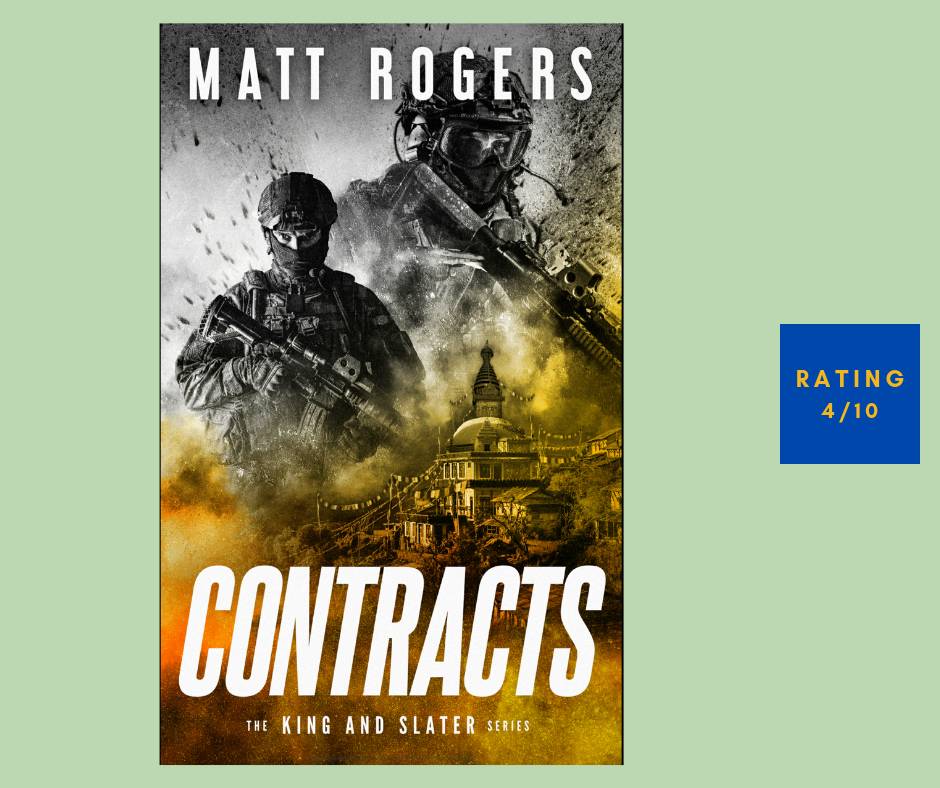
Contracts by Matt Rogers [4/10]

Matt Rogers Contracts review

Melbourne thriller writer Matt Rogers follows the tradition of Matthew Reilly with combat-centered action tales, and “Contracts” is a solid, if unassuming story set on the standard route to Everest. The second of a new series combining previously separate heroes, Jason King and Matt Slater (one is bigger, one is faster), the story revolves around the kidnapping of an American teenage girl, daughter of a senior secret service official. Battle after battle ensues, with the perils of high altitude sickness a further obstacle. Rogers choreographs the violence well but for me, little made the two nigh-superheroes stand out above the scrum of many similar Ethan Hunts in a crowded marketplace. Entertaining, nonetheless.

Bosch Season 5 Episodes 6 to 10 [9/10]

Bosch Season 5 review

Oh bliss is mine! The seamless closing half to the fifth season of police procedural “Bosch,” based on the peerless novels by Michael Connelly, vanishes in a blur of tension and satisfaction. It’s rare to find yourself thinking you know the characters in a television series as well as you achieve with novels, but I caught myself doing just that over the past couple of days. Whatever mental picture I’d accumulated over the decades of reading about Harry (born, of course, Hieronymous) Bosch are now fully subsumed by my images of intense, volatile, jaw-thrusting, super-smart Titus Welliver. I’d rated Episode 1 as 8/10 and the next four episodes as 9/10, so there’s no surprise with my assessment this time round, but let me tell you, such consistency is rare. The twin plot strands of “pill mill” murders and machinations of a serial killer from Bosch’s past, roll inexorably to fraught climaxes, and just as much pleasure can be found in the myriad other subplots, from daughter Maddie’s internship to Jerry’s neighborhood killing investigation to old-timer Troy’s retirement to police chief Irving’s ascent … all these and more, all splendidly portrayed, result in a wholly satisfying tapestry. And let me repeat again my accolades for the sure-handed direction, the wonderful dialogue, the Los Angeles-centric cinematography, and the edgy music. Indeed bliss is.

Deserve to Die by Miranda Rijks [5/10]

Miranda Rijks Deserve to Die review

The cunning interloper … an entire thriller sub-genre has developed around the idea of someone worming their way into the lives of innocents, with deadly aims. Perhaps Killing Eve’s Villanelle is the ultimate example (except she infiltrates with ease again and again and again). “Deserve to Die” is an entertaining entrant into this field, with gorgeous Tamara entering the world of designer Dom and his author wife Stacey and their two children. Miranda Rijks writes with great confidence, her dialogue especially admirable, and the mechanics of Tamara’s misdeeds are plotted with finesse. The characters are credible if a trifle shallow, so that “Deserve to Die” makes for a fine one-sitting read that underplays the implicit tension. A satisfying meal without being a wonderful night out.

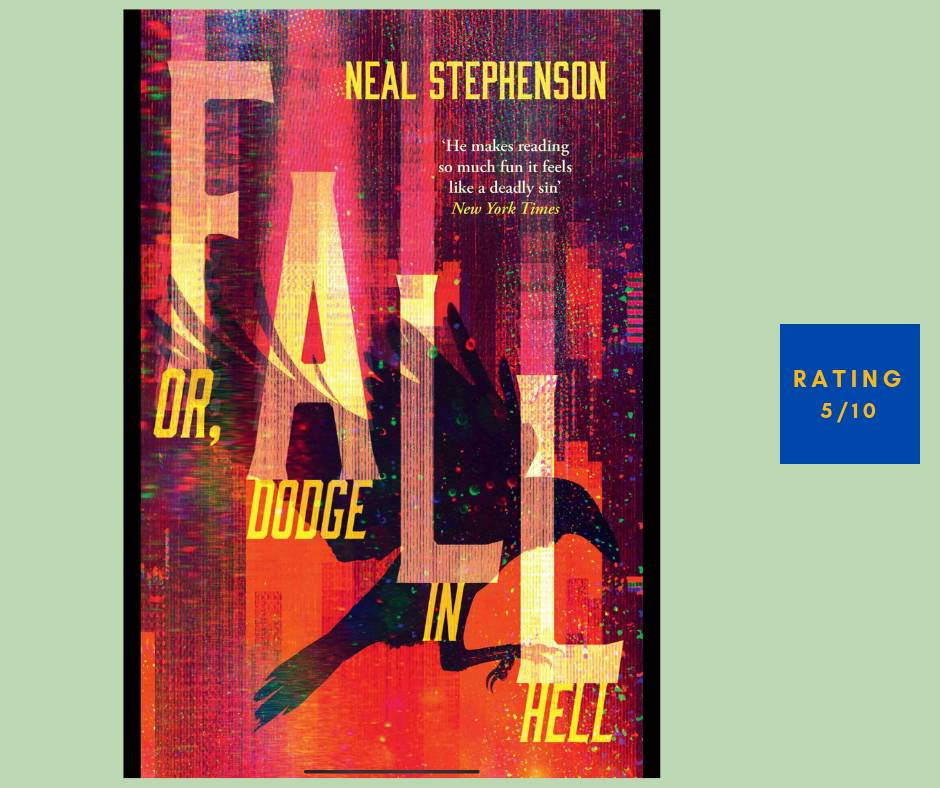
Fall: or, Dodge in Hell by Neal Stephenson [5/10]

Neal Stephenson Fall or Dodge in Hell review

The wondrous, hard-sci-fi worlds of Neal Stephenson crown him as the king of futurism. No one can match his entertaining, minutely imagined unravelling of fascinating futures. In “Fall: or, Dodge in Hell,” Dodge Forthrast, the super-smart, super-rich games developer at the heart of near-future techno-thriller “Reamde,” dies and is accorded a second existence in virtual reality. Stephenson, of course, delves into the very notions of cryonics and virtual reality with depth that is in itself fascinating, and he is a brilliant plotter who also gets under the skin of his numerous characters. This is a typical hefty book (nearly 900 pages) that mostly intrigues and entrances. If you love to witness a fantasy world – in this case the virtuality reality Bitworld in which Dodge emerges – unfurl in kaleidoscopic cacophony, this book will delight. And Stephenson loves to puzzle out the thematic possibilities of his futures. But for all the pleasures of “Fall: or, Dodge in Hell,” two aspects detract. Once upon a time, back with “Snowcrash,” Stephenson wrote with exuberant style. No longer: his late-career discursive style, while never shallow, is now almost pedestrian. And Bitworld, I’m sorry to say, quickly becomes numbingly tedious. No one is like Neal Stephenson and for that reason alone, I commend this book to readers, but there’s a world of pity in me that he doesn’t curb his excesses and focus more on the on-page experience.