Season 1 of “Ted Lasso” was a delicious confection, ideal during a pandemic. Season 2 begins in the same vein, with Richmond FC relegated and drawing match after match. Each of the many main characters morphs and bends pleasurably at the hands of yet another sinuous, intelligent plot, and the acting is just as damned spectacular. Anyone who has missed the scatty, geeky, conversational riffing of Jason Sudeikis in the role of Ted has missed something wonderful. This time round, Brendan Hunt stretches out in his brilliant Coach Beard role, including a surreal episode devoted to him. But Season 2 is not just Season 1 reprised. Partway into the season, Ted lurches off the ground with anxiety, and mental health issues crop up throughout. And a gradual darkening of the character of Nate adds another dimension. All up, the twelve episode of this season are sterling, even if the surprise factor of the first season cannot be regained. Highly recommended.
The Guilty [7/10]
There is a distinct, clever movie genre in which a single character in one place handles a thriller crisis; think Phone Booth or the recent Oxygen. As with Oxygen, this claustrophobic new movie starring Jake Gyllenhaal, ”The Guilty,” provides edge-of-the-seat entertainment but struggles to chime deeply. Gyllenhaal plays a Los Angeles cop in a police call center. We know he has been demoted to this desk job due to some infraction and part of the pleasure of the film is paying attention to clues as to his predicament. He is portrayed as a moral, caring policeman, and when a caller turns out to be a kidnapped woman speaking in code, pretending to be talking to her daughter, he becomes increasingly frenetic to save her. The overall plot is serviceable, and the atmospherics in the claustrophobic emergency center are well portrayed, but Gyllenhaal is the movie’s core, and he gives a stellar performance. Overall, this genre is so tough to turn into gold, but The Guilty provides a tense, enjoyable filmic experience.
Lights Out by Thomas Gryta & Ted Mann [7/10]
During my business career, a kind-of role model was Jack Welch, who took the mammoth electricity equipment manufacturer General Electric into far flung fields, seemingly with impeccable judgment, while instilling a ruthless, rational business culture that never failed. How I failed to spot the turnaround I do not know, but “Lights Out: Pride, Delusion, and the Fall of General Electric” is a brilliant journalistic expose of GE’s plunge in value in the hands of Welch’s successor, the sales-oriented Jeff Immelt. The authors unerringly commence with the dilemmas faced by Immelt’s hapless replacement, John Flannery, the man charged with revealing GE’s predicament to the markets, with horrifying value effect. Then the account backtracks to the glory days of Welch, before forensically and vividly cataloguing Immelt’s flailing mistakes. The writing is slick, the many anecdotes beef up the tale, and the plot is unfolded with surehanded expertise. A revealing and entertaining corporate fable, Lights Out should be read by enterprising business managers from any industry.
The Starling [5/10]
A mixed bag, this one. On the one hand, the first half of “The Starling” sets up a dramatically rewarding narrative of a married couple whose baby dies, plunging the husband into institutionalised depression and the wife into stoic activity, their stalled dynamic disrupted by a protective bird and a wise veterinarian. Notably, Melissa McCarthy is pitch-perfect as the wife, Chris O’Dowd captivates as the husband, and Kevin Kline is perfect for the role of the sage. For half the film, the plot and pacing are masterful and the film grips. But the second half fails to match the first, descending into cliche and sentimentality. Overall, The Starling is an entertaining ninety minutes that should have been so much more.
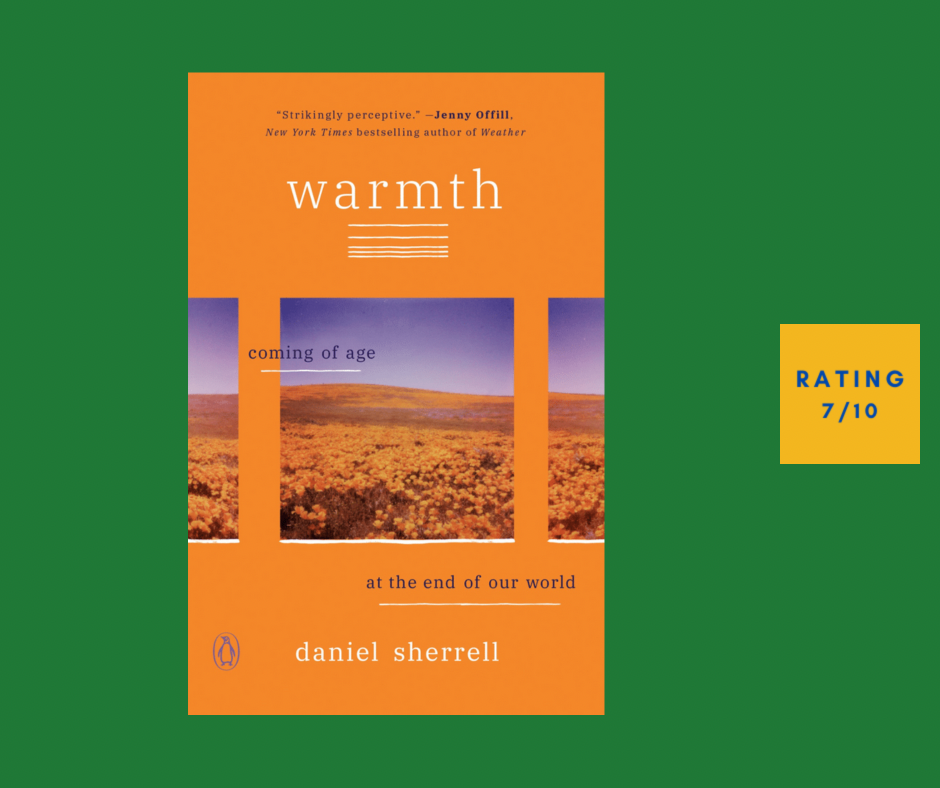
Warmth by Daniel Sherrell [7/10]
Most climate change writing is by “adults,” us older folks who poisoned the well in the first place, so how refreshing it is to 20s-something activist Daniel Sherrell’s meditations on the subject, “Warmth: Coming of Age at the End of Our World.” Sherrell is a captivating stylist with a wide-ranging mind, with a capacity to think more deeply about the subject than most of us (and indeed some of his reflections dug a little too deep for me). Structured as a letter to a potential child, the book ranges back and forth through time, and weaves in tales of his activism and his pursuit of understanding, including a wonderfully evoked outback “journey” with indigenous folks in Broome, Australia. Especially noticeable is his rage against my generation, mostly against the immoral denialists and obstructionists, but also a general contempt. I understand and appreciate this, and I found the read to be a fast-flowing and bracing one. Warmth is highly recommended for those of you exploring the gap between doomism and gung-ho activism.
Dead Ground by M. W. Craven [8/10]
“Dead Ground” is the fourth outing for a sparkling mystery series featuring serial killer hunters Detective Sergeant Washington Poe and his analyst, Tilley Bradshaw. He is bluff, unstoppable, and intuitive, while she is super-geeky and nigh socially inept. The novel opens with a riveting scene featuring vault bandits wearing James-Bond-actor masks and quickly moves to a baseball bat murder in a Cardiff brothel. Poe and Bradshaw become swept up into MI5’s domain, and the case (the cases?) grows ever more baffling. The author proceeds in short, sprightly chapters featuring pitch-perfect dialogue, with wonderful control of pacing. A classic mystery plot with unforeseen twists pins the reader to her seat. But the feature that distinguishes this series from the many mystery offerings I read is the hilarious, yet emotionally true rapport between Poe and Tilley. Dead Ground begs to be read in a single sitting and is one of 2021’s bumper mysteries.
The Devil’s Advocate by Steve Cavanagh [5/10]
Eddie Flynn is a fine hero for Steve Cavanagh’s six-strong legal thriller series: both an ex-con-artist and a lawyer for underdogs, he is determined and smart. ”The Devil’s Advocate” has a sensationalistic plot that roars into action from page one: a relentless “death row” prosecutor in rural Alabama, a young man accused of a grotesque murder, a defense attorney gone missing, and Flynn drafted in to save the day against impossible odds. The author is a sprightly stylist who piles on the action, buttressing it with vigorous characterisation and wonderful dialogue. I thoroughly enjoyed the first five Flynn outings and The Devil’s Advocate is just as much a roller-coaster ride as they were, but this time round, the expertly wrought pacing is unwound slightly by cartoonish villains, an overly complex web of characters supporting Flynn, and a twist that had me shaking my head in disbelief. If, like me, you’re a fan, stick with this fun outing, but if you are new to Eddie Flynn, tackle the first few books.
Falling by T. J. Newman [7/10]
Airplane thrillers—thrillers set on planes, not thrillers meant to be read on planes—need a cracking plot and flawless execution, and “Falling” possesses both. Debut novelist T. J. Newman’s premise, that of a pilot told to crash a commercial flight to save his family, sets off a fast plotline controlled superbly, and the escalating tension kept this reader glued to his seat. The author is a robust stylist and the airplane milieu is evoked splendidly. My only minor qualm was a strand of patriotic sentimentalism that kept rising to the surface needlessly, but this quibble was swept aside by the pleasure of the read. Falling is a scorching read and an ideal present for your non-reading grand-niece or brother-in-law.
The Star Builders by Arthur Turrell [5/10]
British physicist Arthur Terrell is the first to acknowledge the chronic label faced by nuclear fusion, that it is perennially the next big thing on the energy front, without getting any closer to fruition. But he, like the fusion pioneers he interviews at length in ”The Star Builders: Nuclear Fusion and the Race to Power the Planet,” is dazzled by this energy source’s progress over the decades, but especially recently. According to his research, the dauntingly difficult task of building a star in a physical structure has advanced by orders of magnitude. Having read about nuclear fusion in the 1950s, when it was first heralded with great fanfare, I have some knowledge but I was glad to learn more, and Terrell is a smooth enough writer. If he is not a riveting stylist, if he bounces too often between enthusiasm and scepticism, if the non-technical explanations of what is plainly a highly technical field still left me somewhat baffled … well, perhaps my eventual lack of engagement exposed a flaw in my mind or attitudes, but in the end, I found The Star Builders to be a diverting read that fell short of compelling.
Aisles by Angel Olsen [7/10]
One of the most compelling, intelligent musical artists gracing our ears is Angel Olsen. An EP of six songs, comprising 80s songs she recalls from supermarket aisles, “Aisles” is a tasty pandemic-times diversion, a woozy concoction. Olsen’s voice, as always, is hypnotic and emotional, her delivery flawless, and she is not afraid to subvert each song’s original treatment. Standouts are faithful but atmospheric rendition of Alphaville’s “Forever Young”; a gauzy, funereal version of Laura Branigan’s “Gloria”; and a lilting go at Billy Idol’s “Eyes Without a Face.” Look, Aisles is not the next Angel Olsen, the one we’re longing for, but anything she sings is instant ear candy, and Aisles is a loveable diversion.