Death in Dalvik by Michael Ridpath [7/10]

Michael Ridpath Death in Dalvik review

After reading Michael Ridpath’s wonderful thrillers set in the financial world, a quarter century ago, I lost track of him until I chanced upon the engaging Launch Code (my review) and then last year’s The Diplomat’s Wife (my review). Now comes “Death in Dalvik,” Book 6 in his Magnus series about an Icelandic murder detective who goes to America and returns as man of hybrid cultures. Entering a series after missing five books can make life tricky but I need not have feared. From the get-go, I knew was in able hands. Magnus is instantly likeable, instantly seen as dogged, intelligent, and moral. The most amazing feature of this outing is that Death in Dalvik, presciently, is all about bitcoins and cryptocurrency, and reaches into the heart of the massive meltdown of all cryptocurrencies unfolding right now. When a nineteen-year-old student from a coastal Icelandic village is gifted a few bitcoin, she in turn passes bitcoin to her mother to save the family farm, and her mother infects the area with cryptocurrency mania. When the mother is savagely murdered. Inspector Magnus Jonson seeks his murderer even as a local cryptocurrency crisis rocks the community. Ridpath is a smooth, adept stylist who brings the strange beauty of Iceland alive. A great strength is a gradual and skillful introduction to the arcane world of cryptocurrencies. The plot rockets along. Death in Dalvik is impressive, reminding me that I must find a beach on which to devour the earlier books.

Dead Rich by G.W. Shaw [8/10]

G W Shaw Dead Rich review

William Shaw, an English writer and journalist, has written series mysteries and a standalone, none of which I have read, regrettably it now turns out. For “Dead Rich,” a propulsive, old-style adventure story cum thriller, written as G.W. Shaw, is an energetic, superbly crafted treat. Commencing on one of those superyachts owned by Russian oligarchs (a wonderful prescient twist, given recent real-world events), and mostly taking place at sea, a terrain evocatively described, it’s a tale centered around a personable, drifting ex-DJ-star and the ship’s second-in-charge, a capable, loner woman. The plot launches from a defenestration death in London to a battle against what seems like a crew of sea pirates, in the company of the oligarch and his family, and races nonstop, never growing tired or failing to find a new twist. The author’s prose is delightfully supple, always sharp and never slow. Before setting off with Dead Rich, make sure you have a few hours ahead of you, for this is one of the few books in 2022 so far that cannot be put down. Call me old but I was reminded of Alastair Maclean!

Living the 1.5 Degree Lifestyle by Lloyd Alter [5/10]

Lloyd Alter Living the 1.5 Degree Lifestyle review

Living the 1.5 Degree Lifestyle: Why Individual Climate Action Matters More than Ever” is a rambling, intriguing investigation into the notion of adopting a carbon footprint in line with +1.5C, ranging over the many complexities of measurement, allocation, and achievability. An architect by trade and a teacher in sustainable design and a prolific carbon crisis writer, Canadian Lloyd Alter does not really offer a neophyte a prescription on how to fulfil the book’s title, but rather he addresses the relatively educated concerned citizen with a far-ranging discussion into issues such as personal versus collective action; embodied carbon; the subtleties of aiming for a low-carbon living/commuting environment; and the now-long debated notion, explored by many designers, of sufficiency as preferable to either fully electrified or rendered efficient via technology. In the end, Living the 1.5 Degree Lifestyle settled nothing in my muddled thinking on the subject, but I recommend it to anyone commencing detailed exploration.

Once Twice Melody by Beach House [7/10]

Beach House Once Twice Melody review

Beach House, a Baltimore duo, might sound superficially frothy but repeated listens have always revealed sweet, sweet combinations of dream-pop or synth or folk-pop arrangements overlaid by Victoria LeGrand’s slithering, invasive, sweet vocals. “Once Twice Melody” is at once a grand creation—eighteen tracks, three years in the making, released in four tranches—and a blur of Beach-House-y bubbliness. Unlike a couple of earlier albums with clear killer tracks, here there is a unity of sound and purpose, both creepily soothing and numbing. Once Twice Melody is the perfect post-pandemic floater. Standout tracks include the chugging sugar of “New Romance,” with its Tangerine-Dream-like rondo background; the stately, swirling closer, “Modern Love Stories”; and the inviting ooze of “Another Go Around.”

A History of Dreams by Jane Rawson [8/10]

Jane Rawson The History of Dreams review

Australian author Jane Rawson’s third novel, “A History of Dreams,” is unlike any I have read in the past few years. Set in Adelaide in the 1930s, but with the twist of a counterfactual history in the last years of the decade, the novel follows four young women into adulthood amidst that era’s chauvinism, misogyny, and toxic nationalism, all of these traits ramped up as World War II approaches and arrives. Margaret, intelligent older sister of daring Esther, together with their revolutionary friend Phyllis, become trained to be a specific cabal of witches, working with dreams, their trainer being flamboyant Communist Audrey. For the first third of the novel, we come to know the women through their spirited interactions whilst kicking against their various patriarchal families, and this section seems almost quaint, like a modern rendition of a 19th century novel, but the mood quickly darkens, turning the read into a harrowing journey. The author is remarkably adept at juggling between the various viewpoints, using techniques that feel almost experimental, but the result is a fast-deepening identification with all four wonderfully drawn characters. The setting of provincial, pre-modern Adelaide is savagely drawn, so that A History of Dreams became to me a feminist parable of times then and right now. By the time I reached the unsettled climax in the middle of the War, I was swept away and I shed a tear over the final scene. In some obscure way, I think of this outstanding novel in the same way that I do Amor Towles’ splendid The Lincoln Highway, as a multi-character adventure set in interesting times, memorable and true.

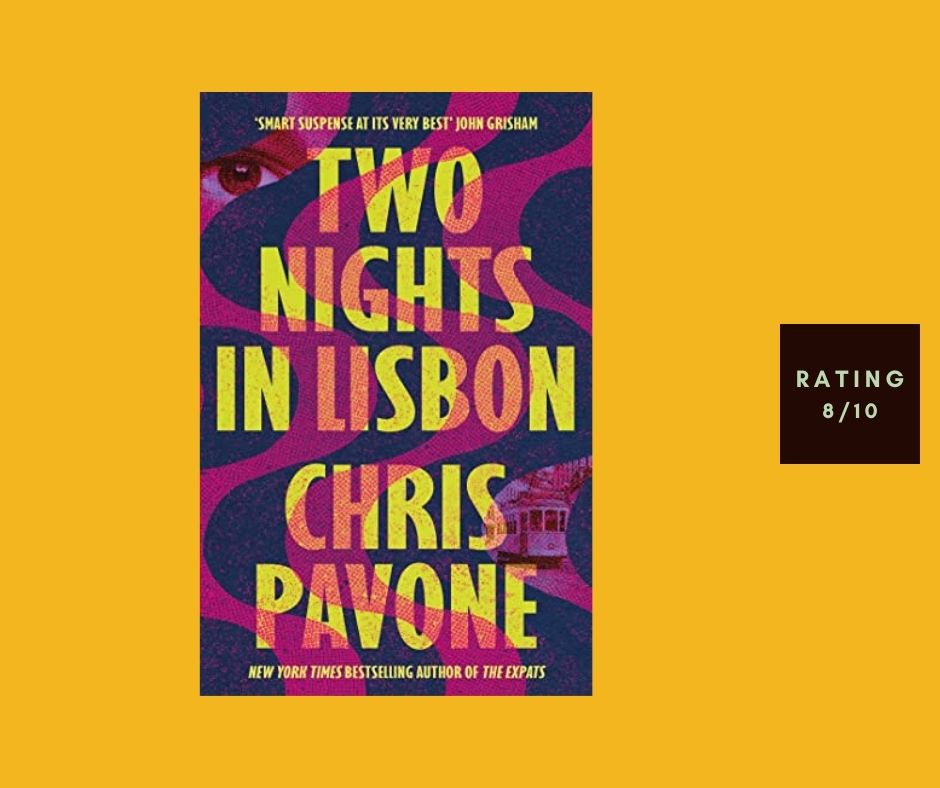
Two Nights in Lisbon by Chris Pavone [8/10]

Chris Pavone Two Nights in Lisbon review

An unusually twisty thriller that weirdly reminded me of twisty movies like The Usual Suspects, “Two Nights in Lisbon” kicks off with an American woman waking in Lisbon to find her husband has vanished. When she frantically, and initially fruitlessly, tries to get local police and the U.S. embassy to help, she kicks off a marvelously orchestrated jigsaw puzzle of people involved in the pursuit. No spoilers but even a seasoned clue spotter like me had to scramble to make sense of it all. The author’s seamless, rather quirky style immerses the reader in the woman’s feverish mind, plus the subplots of more than a dozen other participants, in a way that surges toward the conclusion, one that works like a charm. For some reason I had never heard of Chris Pavone until Two Nights in Lisbon; now I shall hunt up his other four thrillers and devour them.

I Came All This Way to Meet You by Jami Attenberg [8/10]

Jami Attenberg I Came All This Way to Meet You review

For writers, wannabe writers, creatives, and anyone striving for meaning, “I Came All This Way to Meet You: Writing Myself Home” is an oblique yet frank unwinding of the writing life of an author who took years to claw herself into a respected body of work. As Jami Attenberg describes it, she was largely ignored until succeeding with an unlike smash hit, The Middlesteins, in 2012. This memoir, structured as a gradually advancing set of progress essays, describes a life of constant moving, constant near poverty, and constant writing, always writing. Very much in the school of “I write because I am driven to do it,” the memoir encapsulates a cavalcade of hardship, tribulation, and loneliness, much of it self imposed by a contrary free soul. The skeleton narrative is subtle and there is little direct information about her novels, but the storyline, of “writing myself home,” as she puts it, is powerful indeed, and at the end of I Came All This Way to Meet You, a palpable spirit of achievement and release emerges. My read took a fortnight and I dwelt on many sections, basking in the inner thoughts and emotions of an artist braver and stronger than me. If you need a creative boost, this could be a 2022 highlight.

This Is the Voice by John Colapinto [7/10]

John Colapinto This Is the Voice review

New Yorker journo John Calapinto tackles a much neglected aspect of our human nature, our melodious voice, in “This Is the Voice.” The book is a revelation, explaining how the intricate collection of skin flaps and sinews in our throats can express a near infinity of ideas and emotions, how our voice is instantly recognisable, how demagogues employ it to sway millions. Using precise yet soulful language, the author explains how the voice confounds the Chomskyian theory of innate language, how the voice might well be the evolutionary lynchpin of our ascent to the pinnacle of the animal kingdom, how the voice’s complexities are only now being understood. His tale of his own voice, wrecked by minor physical damage after belting out songs in a band, is a clever frame for the book. A wonderful, entertaining work of revelation, This Is the Voice might be just the fascinating 2022 read you need.

Station Eleven [10/10]

Station Eleven review

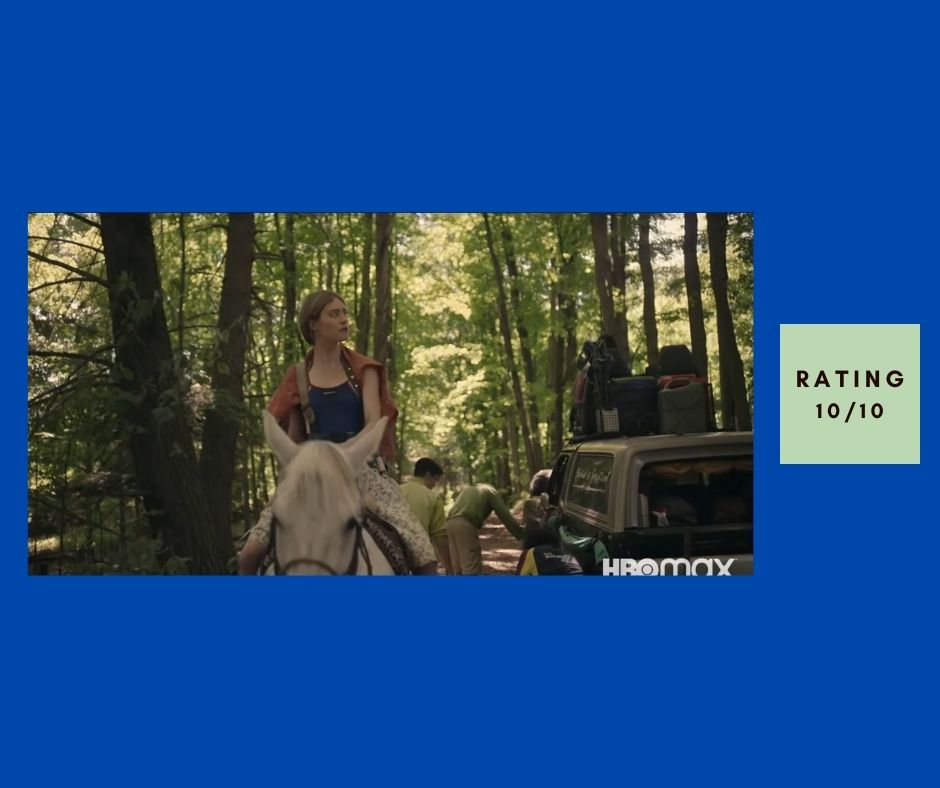
Over ten faultless episodes, “Station Eleven” plunges the trembling viewer into a dystopian story both ravaging and inspiring. I wish I had read the much-praised novel (by Emily St. John Mandel) first but now, I’m not sure I can, so fine is the onscreen tale. A complex narrative with many moving parts, Station Eleven drops us into a world in which nine tenths of the world’s population is killed by a pandemic flu (yes, this scenario was posited half a decade before the Coronavirus) and gradually reveals the storylines of a dozen characters at the time of the ravaging and twenty years later. The storylines gradually (oh so patiently) interweave amidst the travails of a post-apocalyptic travelling Shakespearian troupe. Not a single actor is miscast or anything less than perfect on set, but particular mentions go to Matilda Lawler, breathtaking as the younger version of key character Kirsten; Mackenzie Davis as the grown-up version; Himesh Patel as one of two saintly brothers; David Wilmot as an egotistical actor-survivor; and Daniel Zovatto, beyond sinister and complex as “The Prophet.” Throughout the challenging click-click-click of the story strands making themselves known, runs the mysterious comic book Station Eleven and its ethereal astronaut savior. Dystopian books and films often over-portray; in Station Eleven, the horror of the times emerges obliquely and with devastating impact. Yet throughout the tragedies, grand and quotidian, runs a slender thread of hope, built around the notions of story and art and redemption. Outstanding filmic experience of 2022 so far … Station Eleven must be watched.

Slow Horses Season 1 [8/10]

Slow Horses Season 1 review

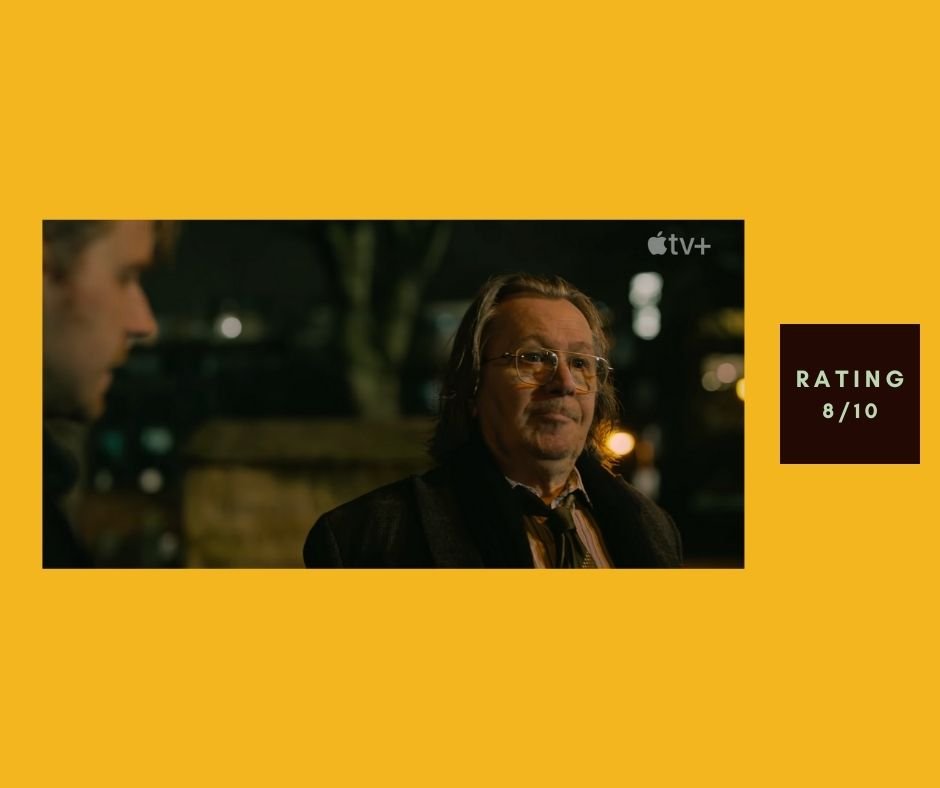
Mick Herron’s Slough House/Jackson Lamb series, soon to be eight books strong, is justly praised both as a stylistic breath of fresh air in the often turgid genre of spy fiction and for its propulsive, complex, tricky plots. “Slow Horses” brings the series’ first book, of the same name, to the streaming stage and I, along with many others, wondered if the screen version could do justice to the print version. My heart need not have fluttered. The six-episode first season not only hews close to the book (something purists always yearn for) but nails the key criteria of acting, script, direction, and pacing. The most important actor, of course, is Gary Oldman. He transports himself into the skin of the repulsive, farting, ontime-super-spy Lamb, who has been banished to run Slough House (rendered wonderfully in all its seedy glory), a spy shop of rejects (although the word ”run” does not really apply because all Lamb wants from them is to do nothing). Jack Lowden as River, Saski Reeves as Standish, Christopher Chung as Roddy … all are marvellous. And Kristin Scott Thomas as Lady Di Taverner … wow! The plotline of a young Muslim kidnapped and facing beheading follows the book’s labyrinthine details and James Hawes’s direction for all six episodes is flawless. This first season of Slow Horses is tense, chilling, yet witty and smart, perfect for both the Herron fan and the Herron neophyte.