Any Geraldine Brooks novel is a welcome event and “Horse,” a fictionalized biopic of famous American racehorse Lexington, overlaid with a modern story, is a rich treat of measured, intelligent prose. The current-day tale of a museum scientist and black art historian, revolving around mysterious paintings and bones, seems at first to be on the sidelines of the main storyline of Lexington and his slave groom in the 1850s, but the author meticulously braids all the strands together. I could not imagine anything about horse racing to hold interest but somehow Brooks not only renders that world fascinating but illuminates slavery and racism resonating over nearly two centuries. The characters, especially the three core ones and a charismatic rogue, all sparkle, and the author’s prose is seamless and affecting. Horse is an unexpected triumph.
Staged Season 3 [7/10]
The opening season of “Staged,” a quirky six-short-episode conceit about a theater performance on Zoom, was both a pandemic lockdown highlight and a perfect showcase for the comic improvisational talents of David Tennant and Michael Sheen (my review). The second season (eight episodes) turned all meta and threw in guest turns by Samuel L. Jackson and Judi Dench, among others (my review). Now, in the post-pandemic world, eight-episode Season 3 spins an intricate ultra-meta tale of a mooted performance by the two fractious stars of a script by series creator/writer/co-star Simon Evans. Season 3 is as inventive as the other two but shows its age, with the comedy fraying badly in a few of the episodes. The support cast from the families of Tennant and Sheen are game but lack the flair of the two raconteurs. But a couple of the middle episodes sparkle and the finale is a tour de force of manic improvisation that is hilarious yet strangely moving. Three seasons is a perfect lifespan for this fecund, low-budget affair and viewers of the first two seasons should wrap up with Staged Season 3.
The Banshees of Inisherin by Martin McDonagh [5/10]
An unabashed devotee of Martin McDonagh (who can forget In Bruges and Nine Billboards Outside Ebbling, Missouri?), my first film of 2023, his “The Banshees of Inisherin,” came laden with expectations. Alas, these were shattered, although it took the entire 94 minutes of this wickedly dark drama/comedy to dump me into an odd sense of betrayal. So much of this movie feels just right (in a McDonagh sense): the wonderful atmospherics of an isolated Irish island in the 1920s; the tinkly childish music; the Irish dialogue laced with humor and irony; and the sustained build-up of tension. Colin Farrell tries so hard with his portrayal of Pádraic, a naive young man blessed with natural optimism. Brendan Gleeson, playing Pádraic’s lifelong drinking companion, Colm, a craggy older man, imbues his character with marvellously expressive eyebrows and a malevolent stare. The plotline can be summed up simply: Colm decides summarily one day he no longer “likes” Pádraic and asks to be left alone, something Pádraic cannot abide, and their existential tussle around their friendship status escalates into darker and darker territory. All well and fine, and I watched with fascination. It was only when the film ended, with a post-climax final encounter between the ex-friends, that I suddenly appreciated how little the central characters meant to me. Whether due to a flawed script, or due to off-kilter overacting, neither Pádraic or Colm registered as real people in a real world. The Banshees of Insherin was, I thought, almost angrily, a perfect McDonagh slice of blackness, but only on paper. On the screen it failed.
Lessons in Chemistry by Bonnie Garmus [7/10]
A runaway hit, “Lessons in Chemistry” is a sparky, socially aware novel that centers on a single mother in the strait-laced America of the early 1960s. A dogged, resolutely rational scientist battling the forces of misogyny and patriarchalism before feminism, the young chemist accidentally falls into hosting a national cooking show, on which her earnest scientific views threaten to overturn housewives’ lives. The first third of the novel, in which the author imaginatively and with great brio thrusts us into the era and the various lives of the characters, works spectacularly well, at once propulsive, entertaining, and often funny. And the pell-mell climax, in which the various narrative strands come together, and a mystery is revealed, felt most satisfying to me as reader. The middle section was less successful, at least in my humble opinion, with characterization forced and the style less vivacious. All in all, Lessons in Chemistry entertains while mildly provoking, making for a hearty three-night read.
Why We Hurt by Paul Biegler [8/10]
Former doctor turned journalist, Paul Biegler has vaulted from his own knee pains to a fascinating exploration of the mystifying world of pain. To my untutored mind, the question he asks is: why is one person’s chronic or severe pain another person’s ho-hum. “Why Does It Still Hurt?: How the Power of Knowledge Can Overcome Chronic Pain” travels the world interviewing people with harrowing pain journeys, and the scientists and doctors who seem to be groping towards a more accurate picture of pain than the one societies currently have. Taking a crude notion such as neuroplasticity, the brain’s ability and tendency to rewire itself, towards specific clues as to pain’s origins (besides the obvious one of a physically painful instance) and towards revolutionary treatments (that no longer fixate on surgery and pills), Biegler provides an enlightening window into pain. And this is no academic yawn: the author is an evocative, fluent stylist supremely in control of his material. Why We Hurt is modern scientific/medical journalism of the highest order.
Corsage by Marie Kreutzer [9/10]
Apparently the subject of “Corsage,” Empress Elisabeth of Austria from the late 19th and early 20th centuries, is immensely popular in retrospect. As an anti-royalist much more preoccupied with modern history than with earlier times, I had never heard of her and for the first quarter hour of this resolutely arthouse movie, I chafed. This imaginative survey of the empress’s life over about a year in 1877-78 casts the royal one as a beauty who is hemmed in by her role. The cinematography portrays a gloomy if spectacular world of palaces and mansions, a world that confines our hero to having her corsage cinched tight in order to display the proper female figure and to ceremonial appearances. Writer/director Marie Kreutzer glides from episode to episode, often inconclusively, offers up ahistorical events, and messes with gender inferences, and my early experience in the cinema filled me with dread about the entire movie. But Kreutzer authoritatively ratchets up the emotional angst with powerful scene after powerful scene, until the ending feels borne on tragic wings. And the music! Two modern songs redone as if past are one thing, but the multiple arrangements of Camille’s “She Was” tore at my heart. The conclusion is enigmatic and I like it just so, a fitting ending to a film I barely understand but see as brilliant and heartbreaking.
Intelligence Horizon by R Andrew Russell [6/10]
The second in a brainy sci-fi series about modern AI, “Intelligence Horizon” is a worthy sequel to Intelligent Consent (see my review), in which an AI-designing engineer finds himself dealing with a robot carrying a mind identical to his. As in the first instalment, this time we see a pair of humans wrestle with their own consciences as their robotic skills seem destined for military us, whilst the robot and a new friend struggle to survive against villains on Mars. A quick read enhanced by wry humor, Intelligence Horizon suits its genre well.
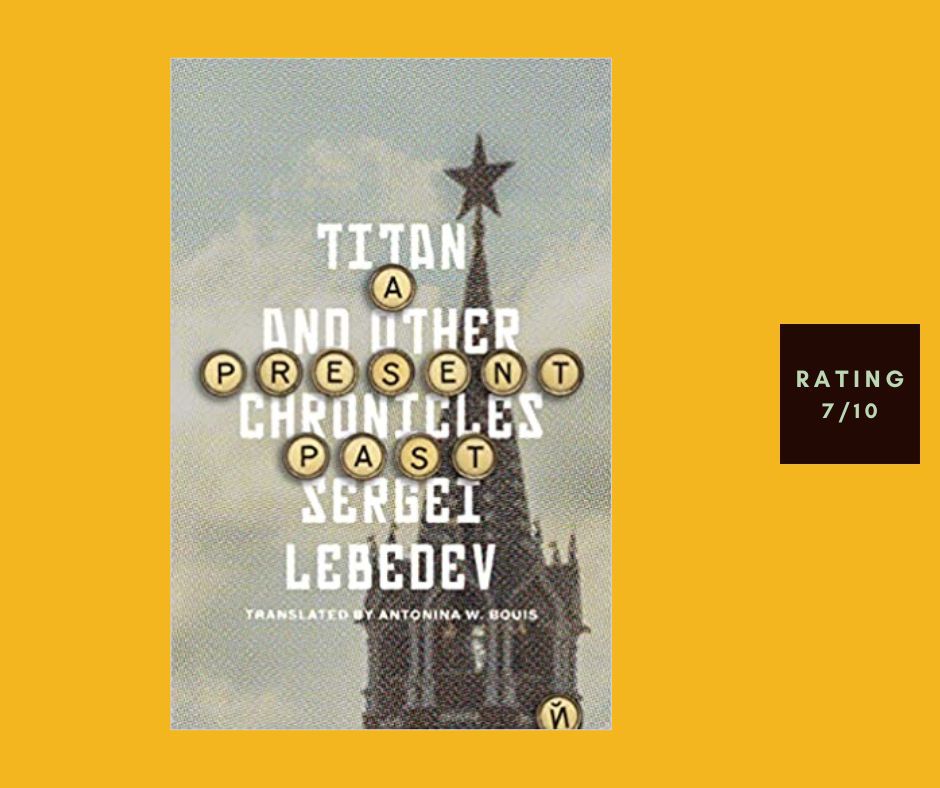
A Present Past: Titan and Other Chronicles by Sergei Lebedev [7/10]
Following on from his brilliant literary thriller, Untraceable, which was also a haunting reflection on Soviet/Russian morality (see my review), “A Present Past: Titan and Other Chronicles” gathers up eleven of Sergei Lebedev’s short stories, each the same wonderful mix of realism and poetic dreaminess that I so enjoyed in the novel. Among my favorite stories is “Judge Stomakov,” which begins with a dissection of a judge’s cold-hearted manipulation of a court hearing for personal advancement, and ends with tormented memories. In a tour de force of imaginative writing, “The Night Is Bright Tonight,” characters in the Kremlin, Lubyanka, and Stalin’s Dacha, face the rise of the ghosts of the Gulag. And the standout story is the title one, “Titan,” about a feared writer who returns from the camps and, under intense scrutiny, writes a second novel the only way he can. All the stories burst into life in the author’s stylish hands, as he wrestles with ghosts of the Soviet past slamming into the Russia of the Putin age. A Present Past is a sterling short story collection.
Fen, Bog and Swamp by Annie Proulx [6/10]
Famed novelist Annie Proulx passionately explores her latest pet subject in ”Fen, Bog and Swamp: A Short History of Peatland Destruction and Its Role in the Climate Crisis.” A rambling plotline explores each of the fen, the bog, and the swamp, that is, moving towards a wetlands environment where trees can grow. This is a complex, nomenclature-driven area of conservation and the author does her best to navigate it, telling tales of different wetlands globally, the people involved in destruction or resurrection. Her passion shines through. I was especially taken with her musings about mangrove swamps, the only type of wetland I really have any familiarity with. She describes these as “a bristling wall that stabilizes land’s edge and protects shorelines from hurricanes and erosion … breeding grounds and protective nurseries for thousands of species…” Like most onlookers or scientists working on wetlands, Proulx offers no solutions, only a howl of anger. Fen, Bog and Swamp is well worth the read.
The Final Verdict by Frank Kennedy [9/10]
The ninth of nine complex, swashbuckling, hard-sci-fi space opera books in the Beyond the Impossible series, at last we can wrap up all the skeins of universe-straddling plotlines. “The Final Verdict” is a fitting finale, commencing just as the heroes in one universe stand ready to repel the Swarm from another universe. And naturally enough, it’s at this point that the most intriguing plot thread from the previous few books, that of Royal the newly created god, comes to life with a thump that reshapes all battles. Familiar characters strive against impossible odds, old characters complete life’s cycles, and universes are reshaped. As ever, author Frank Kennedy is superb in the many action scenes, his dialogue crackles, and the pace never lets up. A triumph of storytelling in a vast setting, The Final Verdict is a roaring climax that must be read in a single sitting.