As a birder, I was immediately drawn to Listers: A Glimpse into Extreme Birdwatching, a seemingly amateurish but actually sophisticated piece of filmmaking on YouTube, put together by two American brothers to document their “big year,” a full-on 365 days of counting bird species across the nation. But the appeal of this brilliant movie should not remain with hardcore birdwatchers for the Reisers prove themselves masters of the art. Perfectly paced across the year, maxed out on humor and chronicling “the moment,” and interspersing beautiful color photos of the most beautiful avian creatures, Listers explores the nature of obsession, the pleasures of nature, the passion of the ambitious, and (less overtly) the horrors of extinction in the Anthropocene Era. The cinematography is simply brilliant, mixing together hand-held reality viewing, filmed interviews, bird beauty, and imaginative graphics. I recommend Listers to anyone still imbued with curiosity; hopefully this gem might attract you to a hobby that might yet save the world.
Zoë Boehm series by Mick Herron [9/10]
Even as Mick Herron modestly basks in his escalating fame arising from his Jackson Lamb/Slow Horses spy thriller novels, the world is beginning to discover his prior thriller series featuring unconventional, stubborn British private investigator Zoë Boehm. Published over 2003-2009, this series is as stylishly, almost poetically written as the Slow Horses one, but it exudes a very different vibe. Where the spy series, now nine books deep, is kinetic, intelligent, and almost comical, the Zoë Boehm books are altogether more serious, if at all times possessing Herron’s dry wit. Down Cemetery Road opens with a cloistered suburban woman investigating the disappearance of a neighboring child, whereupon Zoë enters the tale to steamroll toward a violent finale. The Last Voice You Hear finds Zoë investigating a woman killed in a train accident and discovering a recurring perpetrator. In Why We Die, a psychopathic band of brothers implodes and hunts for a widow while Zoë rocks into action. And in Smoke and Whispers, Zoë’s body is found in a river, summoning the hero of the first book to come looking for answers. All four instalments are impeccably plotted and rich with detail and nuance. A pleasure to imbibe, the entire series comes recommended for any discerning reader of thrillers.
Clown Town by Mick Herron [10/10]
Number nine in the splendid Slow Horses/Jackson Lamb series of spy thriller, Clown Town see brilliant author Mick Herron in full flight. When River Cartwright, the much assailed and endlessly enthusiastic “real” spook amongst Lamb’s misbegotten crew, discovers that a book is missing from his deceased spook grandfather’s library, he cannot imagine that he has unearthed an old buried secret that threatens Diana Taverner, First Desk at the Park. Events escalate until casualties threaten and then Clown Town shifts gear, as Lamb shifts from scurrilous recluse to once-master-spy avenger. A set piece of violence midway through the book is magnificent, as is the shock denouement. Another genre highlight, Clown Town is a must-read in 2025 (but make sure you tackle the previous eight first).
Ludwig [8/10]
Yet another “on the spectrum detective” series? Ludwig certainly seems like that at the start, as we fall under the storyline of a crossword-puzzling recluse coming out of his shell to impersonate his police detective brother in order to help his sister-in-law, and then of course solving murder after murder. But there is a lightness of touch here that is most beguiling, and the gentle tone of the whole shebang, allied to intelligent dialogue, surefooted pacing, great camerawork and music, lift this out of the ordinary. All the actors are fine with the standout being David Mitchell as the geeky hero. Each of the “impossible” murders solved is a decent story (straight out of classic age murder mystery puzzles) in itself and the overall arc of the missing real policeman knits everything together in intriguing fashion. The storyline, implausible as it is, sparkles. Ludwig is a highly satisfying six-episode watching feast.
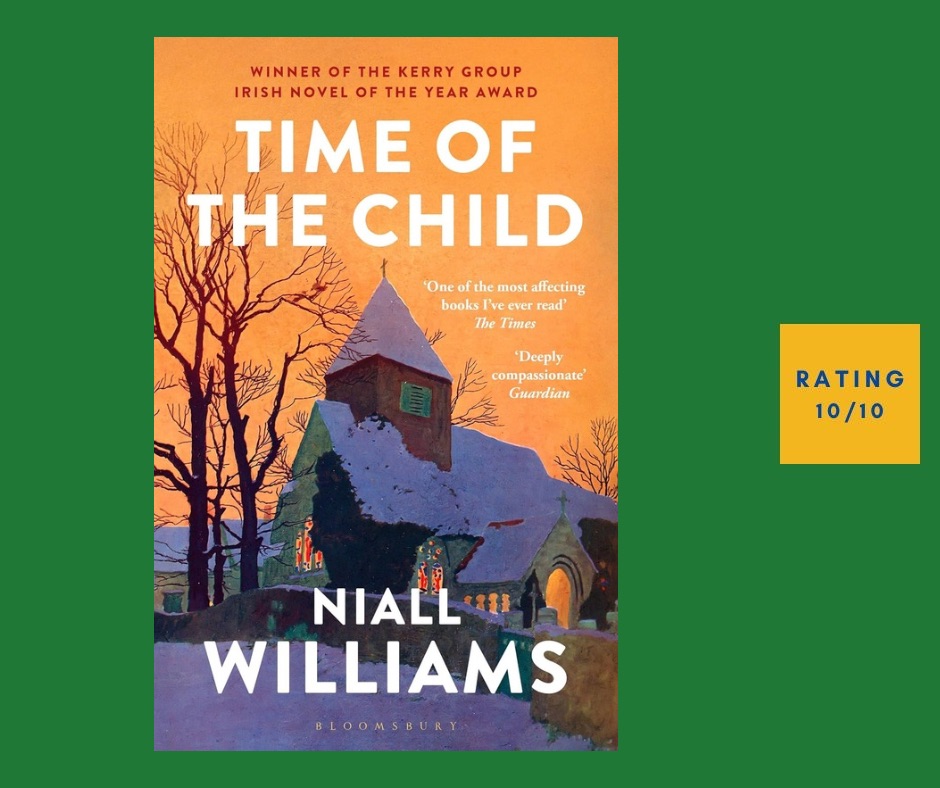
Time of the Child by Niall Williams [10/10]
Why do Irish novelists strike so effectively at the heart, managing to be both unsentimental and timelessly true to heartbreak and joy? Claire Keegan’s 2022 masterpiece, Small Things Like These (see my review), affected me as few recent novels have, and I did not expect, as I began to read Niall Willams’s Time of the Child, to tap into deep emotions as strongly. This is especially true as Williams is a starkly different stylist to Keegan. Time of the Child commences with a seemingly rambling, person-by-person tour of the small town of Faha as Christmas approaches in 1962, the swirling introduction centered around older Doctor Jack Troy and his bookish, stay-at-home daughter Ronnie. And then a baby lands on their doorstep, a baby seemingly inevitably destined to be snapped up into the retrograde Irish orphanage system. The novel takes some time to settle into the tale of Jack, Ronnie, the baby, and yes, Faha (for the town is, yes, a character). Williams’s style is Irish-raconteur, full of sly asides, jammed with affection … the novel becomes a yarn building up with tension as a time of reckoning about the baby approaches. In lesser hands, Time of the Child would be a limping domestic drama; under the grace of Niall Williams’s pen, it is a triumph, surely a 2025 highlight.
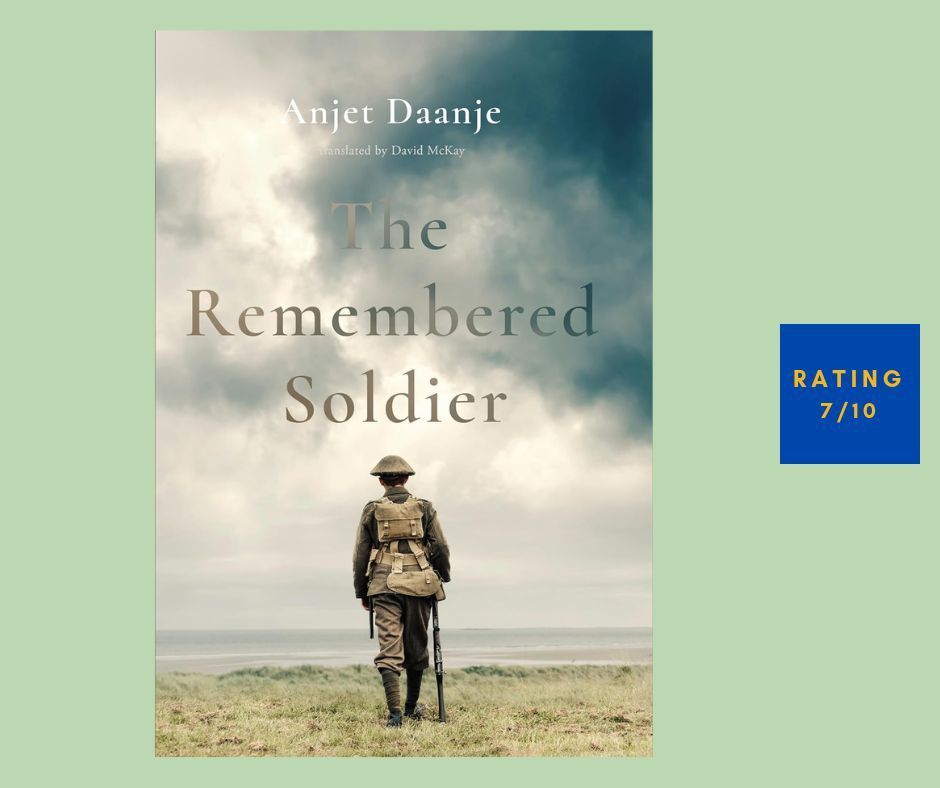
The Remembered Soldier by Anjet Daanje [7/10]
At 700 pages, The Remembered Soldier, by Dutch novelist Anjet Daanje, is an amazing feat of writing, essentially one long piece of sustained third-person-focused, paragraph-by-paragraph momentum (with most paragraphs commencing “and…” intended to propel). It is the tale of an amnesiac soldier after the horrors of World War I. Claimed from an asylum by a Flemish woman (with two children) as her eight-years-lost husband, the unknown soldier gradually gropes his way, amidst nightmare terrors and only the slightest of memories, toward some kind of light, but what kind? Is his wife his wife? Who is he? In describing the book as I read it, I am emphasizing its virtuoso strengths and for some readers, I am sure The Remembered Soldier (ably translated by David McKay) will offer a huge emotional payout, but I regret to say my reading experience felt like over-heavy bludgeoning. A worthwhile reading experience, certainly, but often unenjoyable, overlong, and tedious…
The Studio [9/10]
Seth Rogen was born to play the newly promoted Hollywood studio head in The Studio. With his gravelly voice, tousled appearance, and exuberance, balanced by whimsicality and a deep love of movies, he is also the co-creator and co-director of the ten episodes; it is clearly a labor of love. The conceit of The Studio is much like that of 2024’s The Franchise: each episode blasts, with utter savagery, the excesses and nonsenses of modern filmmaking. Backing up Rogen is a fine cast hamming up studio exec stereotypes, and real-life actors/directors (Zoë Kravitz, Dave Franco, Ron Howard, Martin Scorsese, Ice Cube, and many more) feature regularly and to great effect. The fluid-extended-take cinematography of Adam Newport-Berra is superb, the music works, and the script roars. If you cannot raise a laugh at Rogen trying to justify his chosen career at a conference of pediatric oncologists, or debasing himself to receive a barest “thank you” at the Golden Globes, or disrupting a sensitive sunset scene, or tracking down a missing reel of film … well, you don’t have a funny bone. If everything can feel a bit over the top, the humanity of this first season is rescued, with fine subtlety, by Rogen projecting not only his character’s excesses but also his workaholic loneliness and his abiding love of film. Highly recommended.
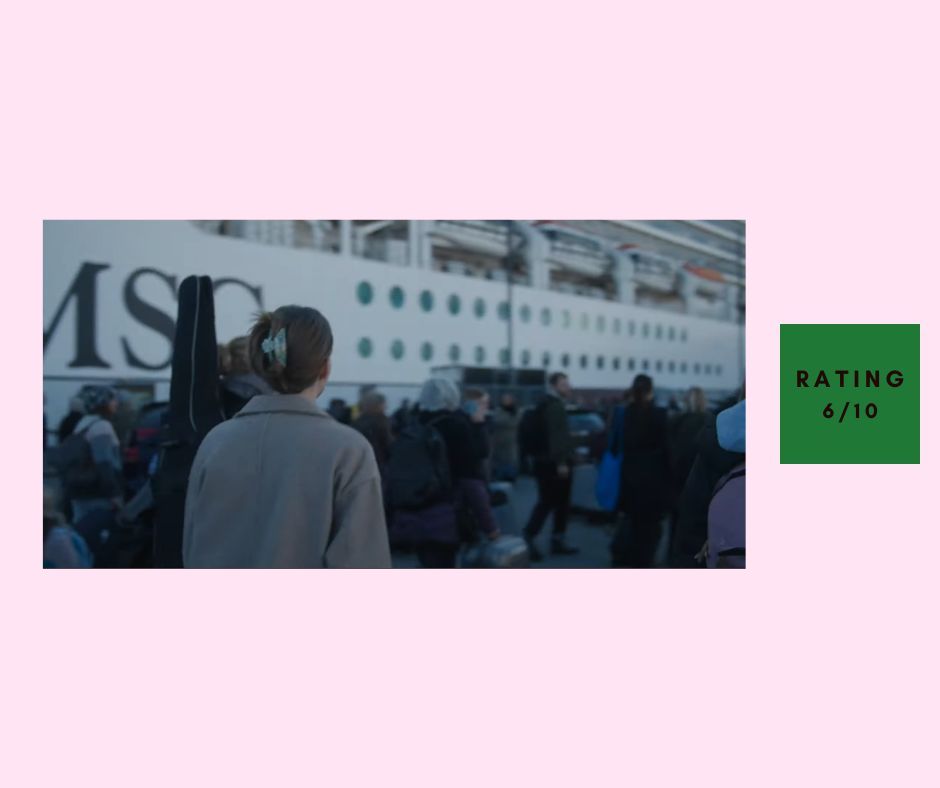
Families Like Ours by Bo Hansen & Thomas Vinterberg [6/10]
A bold and fascinating Danish film, Families Like Ours posits that Denmark, afflicted by rising seas, closes itself down, with the population rapidly fleeing as refugees all over Europe. Especially intriguing because it asks what the refugee experience might be like for upper middle-class Europeans, the movie centers around one extended family. The central male figure and his young family attempts to secure a future in France, his ex-wife ends up in Rumania, the young daughter flees in an illegal private boat, a government official and his husband cope with criminal trauma … it is all an appealing stew of stories that promises, at the outset of the seven episodes, to really test the film’s concept. Regrettably, the acting is make-work, the script, especially the dialogue, lacks crispness and dramatic tension, and key set-piece scenes do not impress, so that the end result of Families Like Ours is modest, beguiling entertainment with little memorable punch.
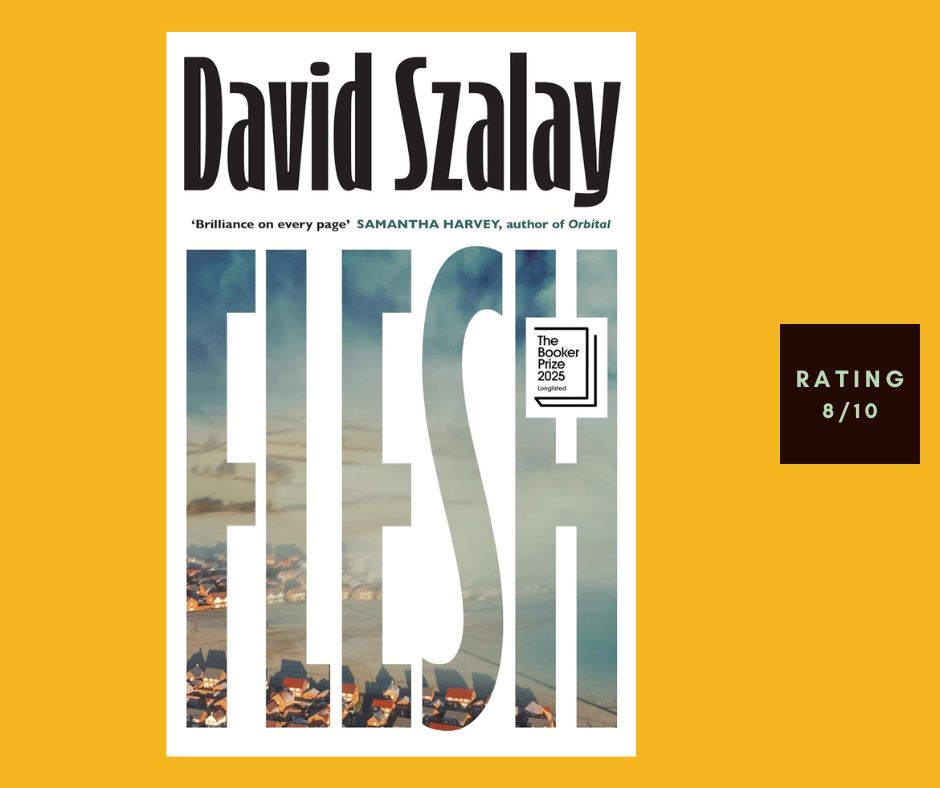
Flesh by David Szalay [8/10]
British novelist David Szalay is carving out his own path with a writing style as gravely denuded as any I have read. Rarely is there any description and when there is, it emerges as austere and beautiful. Much of the action resides in the dialogue between characters, a dialogue replete with much unsaid. Flesh, his sixth, follows a Hungarian naif from poverty through the army, thence to England where blind luck brings him untold riches and the chance for love. Of course what follows, laid out with wonderful ploy dynamics, is a descent. I found the main character tormented me with his blind stumbling through life, and the bare-as-bones writing style often threatens to derail readerly identification, but the unrelenting, grand-scale-yet-intimate plot can read like a thriller. Our antihero wrestles with themes of fate and morality and responsibility, in a world seemingly cold as ice. Overall, Flesh is difficult to recommend to many readers but it possesses a magic I shall remember.
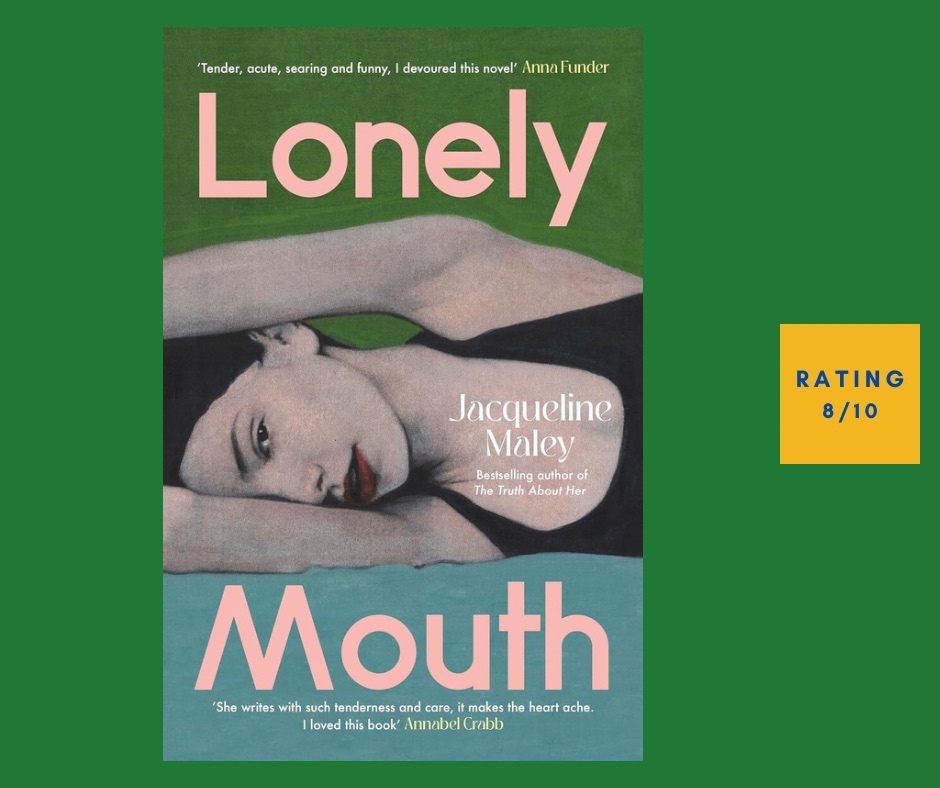
Lonely Mouth by Jacqueline Maley [8/10]
Lonely Mouth, the second novel from Sydney journalist Jacqueline Maley, eschews modern plotting drama with a careful unfolding of the life of Matilda, an orderly worker in a high-end restaurant. As a child, she was abandoned by her mother, as was her much younger half-sister, Lara, now a beautiful model. When Lara and the father who had also abandoned her, even earlier in life, both come to town, Matilda’s life gradually spirals into a new territory, one in which she has to reckon with longing, morality, and love. The book unwinds slowly, with plenty of immersive detail about the circumscribed worlds of Matilda, and is written in a gentle, detailed prose style that captivates. The author treats us with so much tenderness and subtle humor that the reading experience feels warm and quite unlike most literary fare these days. Definitely recommended: watch out for Lonely Mouth in awards.