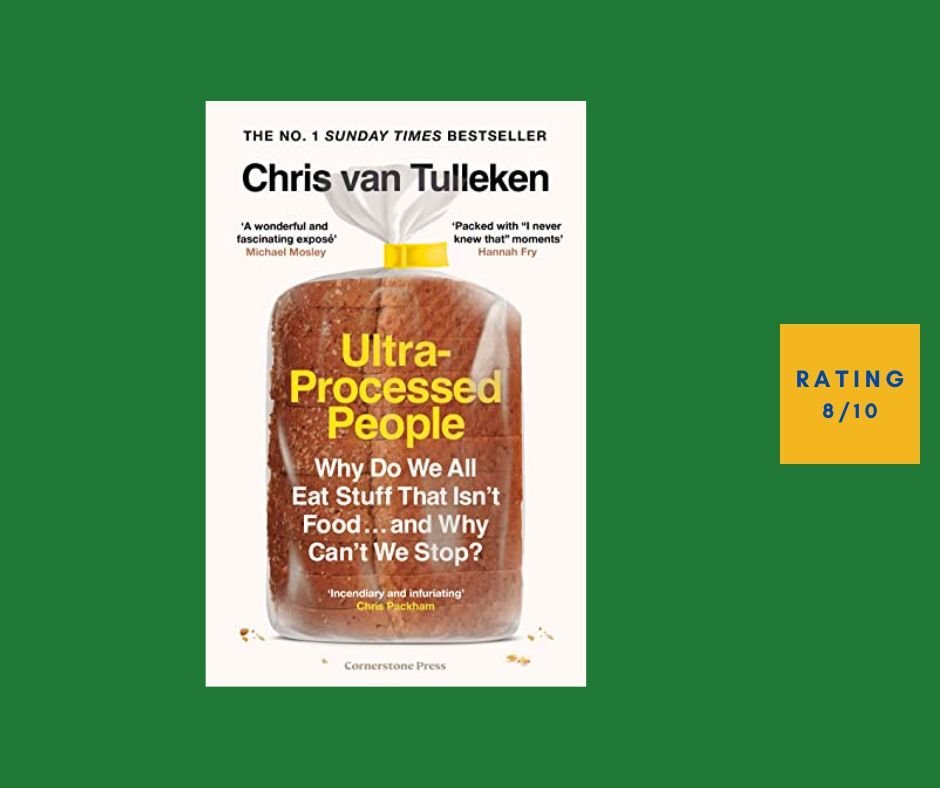
“Ultra-Processed People: Why Do We All Eat Stuff That Isn’t Food … and Why Can’t We Stop?” has a title that hardly welcomes the reader, but this is an important book written with scorching rage and a vivid style. The author, a doctor and TV presenter, tackles the modern obesity and ill-health epidemic through the lens of the super-highly-processed food that many of us eat in huge quantities. It’s a fascinating tale, unwound through the tales of scientists (belatedly) classifying food into four categories, with UPFs (ultra processed foods) being industrial formulations that bear no relationship to real foods but are dressed up as equivalent to real food or (often) improved foods. Scientists then begin to decipher how UPFs underlie many of the dietary, weight, and health ills besetting us. The author excoriates the food industry while admitting the industry, driven by shareholders’ pressures, seems to have little choice. The solution, he writes, must be aggressive, adversarial regulation forcing the industry to reveal what its products really are. The author illuminates the story with anecdotes from his own life, including the weight battles he and his twin brother, Xand (also a doctor and TV presenter), endured (my own enjoyment was greatly enhanced by “bonus” discussions between the two of them on the audiobook). I’m already a disciple of the WFPB (whole foods, plant based) diet, but for those of you still eating what supermarkets mostly sell, this book has the cojones and factual rigor and persuasiveness to change your lives.
Children of Memory by Adrian Tchaikovsky [8/10]
Adrian Tchaikovsky is a celebrated science fiction/fantasy author who had never ended up on my bedside table, until I read 2015’s Children of Time (stimulated by a Ezra Klein podcast), the first fat book in a trilogy of the same name. One could characterize Children of Time as “about super-intelligent spiders”, and the 2019 follow-up, Children of Ruin, as “about super-intelligent octopi,” and the finale, “Children of Memory,” as “about super-intelligent crows,” and one would not be completely askew. But there is far more in the overall storyline of humanity setting off, after apocalypse, in huge spaceship arks to geoengineer new human worlds, aided by AIs, far more even than that. The trilogy is a stunning plotting achievement and Children of Memory is a fitting pinnacle, involving multiple intelligences of different types, plus virtual worlds, plus a classic dystopian tale of hardship. The author is not only a superb plotter, surprising the reader again and again, but the characters compel and the grand settings are deftly and strikingly depicted. The entire trilogy is a genre masterpiece, and Children of Memory is its highlight.
Taking Flight by Lev Parikian [9/10]
2022/2023 seems to be a period of outstanding science-in-nature writing and “Taking Flight: The Evolutionary Story of Life on the Wing,” by classical conductor and nature writer Lev Parikian, is a stellar example. A writer possessed of a breezy, humorous style that somehow manages to retain heft, Parikian is always entertaining, but in this book he rolls up his sleeves and pursues an exploration of the magical phenomenon of flight. I can report that his analytical skills are as strong as his writing chops. Moving forward from the oldest life species to take flight, such as dragonflies, bees, and butterflies, Parikian gives the best coverage of flying dinosaurs (the pterosaurs) and bird precursors (the famed Archaeopteryx) that I have ever read. He then covers birds from non-flying penguins through waterbirds such as geese and the magical hummingbirds, before winding up with pigeons (yes, pigeons, fascinating!) and bats. All the technical explorations of different forms of flight are ballasted by a huge reference list yet come across as precise but chatty pub lectures. Taking Flight is disarmingly, brilliantly educational, a high-flying triumph.
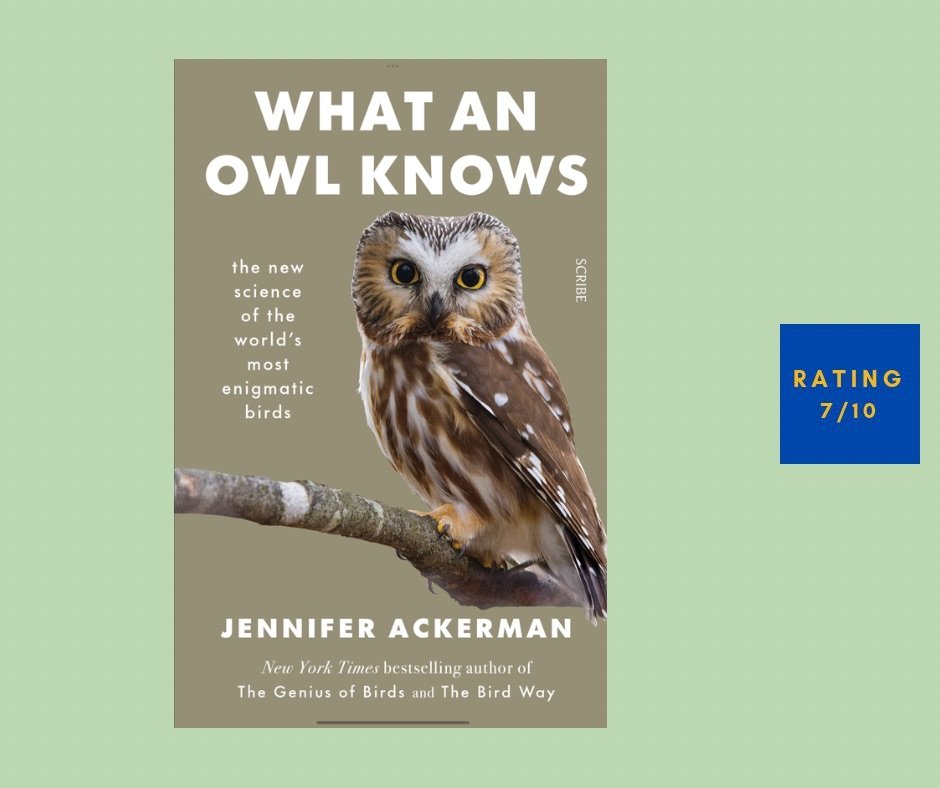
What An Owl Knows by Jennifer Ackerman [7/10]
Jennifer Ackerman is a global treasure, a science writer who has most recently focused on the glory of birds as revealed by the latest scientific findings. The Bird Way (in 2020) and The Genius of Birds (in 2016) were thoroughly enjoyable and dizzyingly revelatory. Now she has turned her wise gaze onto owls, the most enigmatic, mysterious, and unknown (in any real sense) of all birds. “What an Owl Knows: The New Science of the World’s Most Enigmatic Birds,” surveying the 270 owl species. As a mediocre birder, I know how elusive, in a practical sense, they are; I don’t like to venture out at night in pursuit of my hobby, and the few times I have, they have, of course, proven to be hard to see. They possess special feathers that enable them to fly far more silently than other birds, and they’re superbly camouflaged, and they keep out of the way. They’re prodigious hunters. Ackerman documents how varied the various species are, and how wondrous their eyes (the only front-facing eyes among birds) and their ears are. She captures the endless passions of a new generation of scientists finally unraveling how they hunt, how they travel, what their hugely sophisticated calls and cries mean. She documents their place in human cultures throughout history. Above all, she glories in their hitherto unknown intelligence and marvels at how well adapted they are. I fully realize What An Owl Knows might only elicit interest from a limited audience but to anyone scientifically inclined, this is a mind-expanding read that reads like a dream.
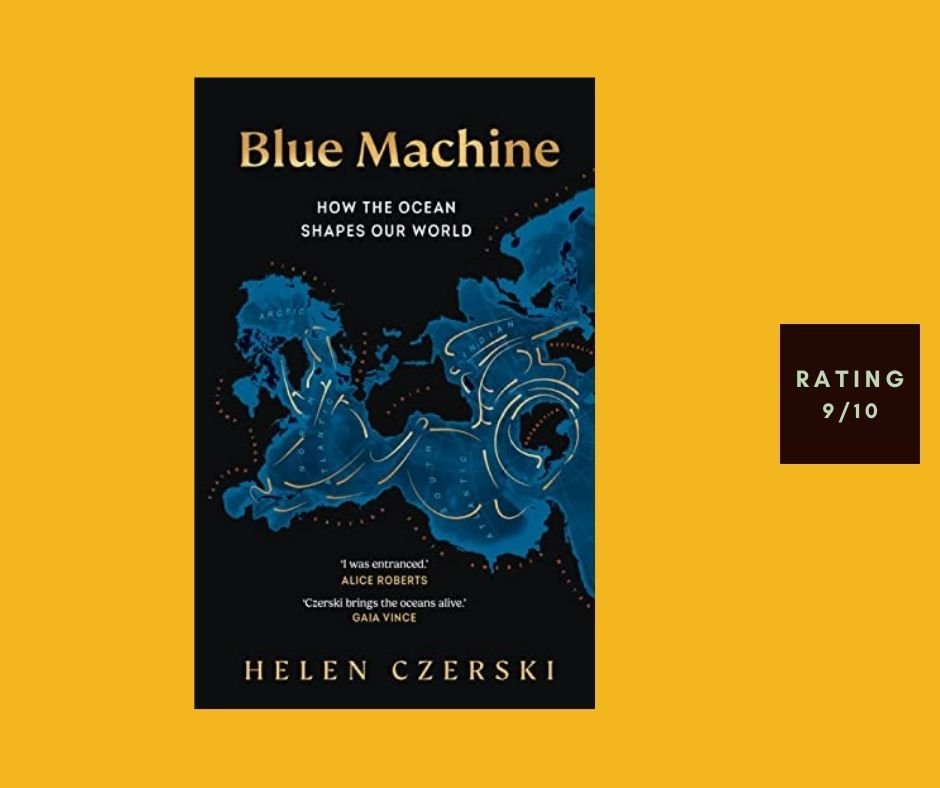
Blue Machine by Helen Czerski [9/10]
Like most of us, my very awareness of the ocean is superficial and random. Only the growing realization that our oceans are crucial for how the global warming crisis pans out in the next decades and beyond, only some sense that “I need to understand,” sent me to “Blue Machine: How the Ocean Shapes Our World.” I am so, so glad I took that step and anyone with a science orientation needs to read it now. Helen Czerski is an oceanographer (and TV presenter) who brings her original occupation of physicist to bear upon her narrative, which constantly reinforces that our oceans (which, startlingly, hold 97-98% of our Earth’s water) are an energy “engine,” a slow-moving-but-dramatic-at-the-periphery liquid artifice driven by temperature, salinity, density, and atmospheric winds. The author is a highly imaginative narrator of enthusiastic stories stitching together her overall explanatory arc, tales that range across the ages, and, of course, all over the globe. Whenever she can, she situates herself into the story, and she never fails to trumpet the incredible glory and subtlety of the “blue machine.” Unlike many science writers, she is not afraid to delve into the technical details, especially of currents and salinity and density, and this led me to at last come to an understanding of those diagrams one sees of gyres swirling on spheres. Above all, Blue Machine is a plea to stop treating the seas as ultimate dumping grounds—of rubbish, of plastic, of fossil-fuel-driven errant heat—and to, instead, celebrate its glory within the precarious web of life.
The New Boy by Warwick Thornton [7/10]
Warwick Thornton is a fascinating writer/director with a grand cinematographic eye, so I came to “The New Boy” with bated breath. A tale of an indigenous boy captured and placed in a remote orphanage, it opens with one of the most spellbinding scenes I have witnessed this year. Indeed the filmic images throughout are stunning, burnished by a brooding, sometimes pounding, score by Nick Cave and Warren Ellis. The debut star turn by young Aswan Reid entrances, and Cate Blanchett is as compelling as ever. The storyline, essentially one of a clash of cultures and the evils of captive education, holds the attention, but in the second half of the movie, the script slackens and often mystifies. The ending, while only slightly ambiguous, fails to round the story, and the overall impression of The New Boy is of an arthouse wonderment only loosely aligned with a strong narrative. Well worth seeing but, as the cliche goes, a missed opportunity.
Olga by Elie Grappe [9/10]
A pity that the trailer for “Olga” is unattractive, suggesting a chaotic Eastern European movie, a pity because the movie is utterly compelling. We follow the strivings of young Ukranian Olga, trying to succeed in the tough world of international gymnastics, at the time of the 2014 Maidan Revolution. Olga’s mother is a fearless journalist on the side of the revolutionaries and Olga flees her home country to join the Swiss time (her divorced father is Swiss), relinquishing her original passport. The cinematography is brilliant, portraying the visceral thuds and squeaks of gymnastics close-up, and the lead actor Anastasia Budiashkina fully inhabits her fifteen-year-old aspirant, coming of age while torn between her ambitions and love of her country. I had feared the movie would lapse into narrative incoherence but director and co-writer Eli Grappe maintains a firm, paced control over the escalating plotline. The juxtaposition of the Euro championships with the bravery and carnage on the streets of Kiev is wonderfully dramatic and, it must be said, most relevant today. Olga is a 2023 must-see.
The Unlikely Pilgrimage of Harold Fry [8/10]
Based on a tear-jerker novel that had the courage to peer into some dark spaces, “The Unlikely Pilgrimage of Harold Fry” turns out to be better than the book, and still very much intrinsically weepy but wrapped in barbed wire. Mousy retiree Harold receives a letter from an ex-colleague recently shoved into a hospice eight hundred kilometers north, and on impulse decides to walk (having never walked before) to sustain her with the power of some intrinsic faith. The movie tracks his painful, then blissful trek up the spine of England, whilst resurrecting the most dire of repressed memories. The book was solipsistic and the movie even more so, and Jim Broadbent puts in the performance of a lifetime as the naively determined every-person who eventually achieves novelty fame and a following of “pilgrims.” Penelope Wilton nails the other key role, that of the even more mousy wife left behind. The Unlikely Pilgrimage of Harold Fry is as gentle a movie as you would expect with the novel’s author penning the script, but superb cinematography, maxing out on scenery end the art of the trudge, means that the plot never flags. The ending almost ends up saccharine but resists, and the film triumphs as a result.
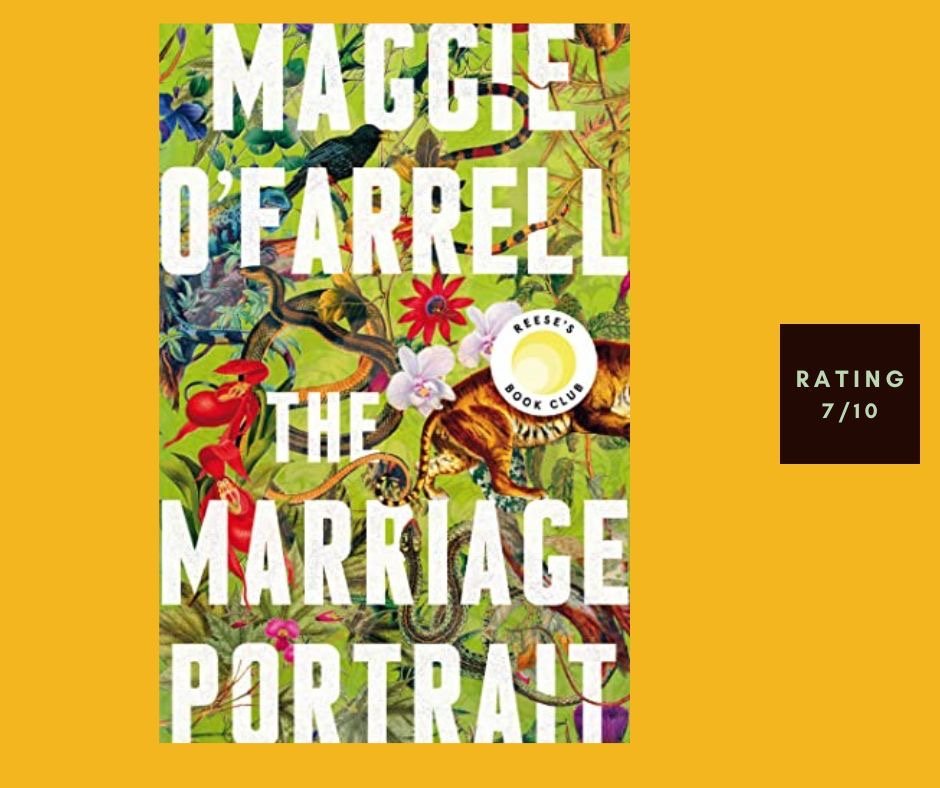
The Marriage Portrait by Maggie O’Farrell [7/10]
An historical novel in the hands of Maggie O’Farrell is always an immersive, controlled experience, and while “The Marriage Portrait” is not quite in the same class as her superb Hamnet, it is a treat. Her time period this time is the middle of the sixteenth century, her locale is northern Italy, and her protagonist is sixteen-year-old Lucrezia, married off by her father, the Duke in Florence, to the new Duke of Ferrara, a manipulative, vulnerable enigma. From the first page, it is clear that Lucrezia is under threat but the threat seems mysterious until it suddenly becomes clear. An independent, artistic young woman, Lucrezia is both naive and resourceful, and the central plot dilemma is: will she survive? The author is a rolling, rhythmic stylist with a wonderful eye for retelling the past, and she brings the Italy of the time of the Medicis to life. The plot is slow but surely spooled, and the build-up to the climax is exciting. If the ending seems too Hollywood, the overall journey of The Marriage Portrait is a splendid one, well worth a read.
Blue Lights [7/10]
A jagged, fierce drama, “Blue Lights” follows three callow probationary cops in Belfast, in bleak suburbs blighted by sectarian troubles. Partnered with a motley lot of experienced mobile officers with varying degrees of cynicism and toughness, the three recruits butt up against ingrained mobsterism, official incompetence, and uncercover interference. The three core actors—Sian Brooke, Katherine Devlin, and Nathan Braniff—are exemplary, but the complete ensemble is equally impressive. A large proportion of the six episodes dwell on the interiors of squad cars or the police station, and both attain solidity with excellent cinematography. A twisty plot knits the episodes together into a truly epic climax that satisfies in so, so many ways. Gritty, uncompromising, yet full of heart, Blue Lights is a cop show with a wonderful difference.