Guy Ritchie is back! Who could forget “Lock, Stock and Two Smoking Barrels” from two decades ago? Entering the cinema, I wondered whether “The Gentlemen” could reprise that whipsaw, amoral swagger. The opening scene, in which a seedy journalist (wonderfully played by Hugh Grant, with a Cockney lilt no less!) sets up the movie’s elaborate framing with the core gangster’s consigliere, requires momentary patience, as does the next sequence of Matthew McConaughey voice-over narration, but from then, wham, bang, pow, it’s vintage Ritchie without letup. Who is double-crossing whom? Who will survive the mayhem? I guffawed with delight during several scenes. McConaughey is in fine form but super acting flows from Charlie Hunnam, Michelle Dockery, Jeremy Strong, Colin Farrell, and Henry Golding, as well as countless bit players. The music is tops, the violence is choreographed without fault, and that special winner-takes-all amorality (with a touch of heart) pervades the entire film. “The Gentlemen” flows as one superb cinematic treat.
Master Amateurs by Kira Asatryan [7/10]
I don’t read as many self-help books as I used to, possibly for the benign reason that I’ve ended up in a relatively happy space in terms of “helping” my “self.” But “Master Amateurs: How Nonprofessionals are Poised to Dominate the Future of Work,” which lauds and talks to those who don’t follow a single line of work or activity, seemed to fit my current situation. I have multiple projects in hand in which I am a complete, total amateur, and I find such a life to be almost unbearably tough and exhilarating. “Master Amateurs” pays less heed to its subtitle (it doesn’t really prognosticate) than to survey a huge, diverse array of amateurs, both current and historical, through a typology of motivations, from a need for imperfection, through greed, through compulsion by personality, to innate curiosity. Astryan’s interviews are fascinating and easily relatable to this or that aspect of oneself, and she writes with an approachable fluency that welcomes involvement. Two of her many observations have lodged with me and altered my work habits, and any book that does that is a most worthwhile read. If you can see the labels brave or amateurish (they go together according to this book) apply to any aspect of your lives, this book is for you.
The Irishman from Martin Scorsese [6/10]
Martin Scorsese has such stellar cred, deservedly so, that “The Irishman” was always going to captivate true fans. Think about it. The gritty tale of a New York mob fixer and hitman, entwined around the famous disappearance of unionist Jimmy Hoffa … De Niro perfectly cast as the American-irish mobster … Pacino as Hoffa … dialogue and violence the drivers … a sinuous assemblage of scenes composed as Scorsese can … how can this not be a late masterpiece of the master? And I admit “The Irishman” is so, so watchable. Time vanishes. The only trouble is, the story is vacuous, offering neither any conclusion nor any reflection. It’s just a life and we know biopics are the dullest of cinematic fare. I sat glued to the screen but then walked off, wishing Scorsese had used his moral compass and imagination to turn this eye-and-ear candy into something imbued with meaning.
Parasite by Bong Joon Ho [8/10]
The only Bong Joon Ho I’d watched was “Snowpiercer,” a dystopian sci-fi extravaganza that left its mark on me, so I approached “Parasite” with respectful caution. Quite rightly, for this is a movie of passions and plots and themes writ large. A scrabbling family of four, residing in a Korean “sub-basement,” worms its way into a wealthy family’s house and existence. Dread builds and then, when you least expect it, the plot spirals in a new lurid direction, and then in another, and then in another, followed by a phantasmagoric Seoul street scene, followed by a sequence of short, telling redux scenes. The direction and cinematography are lockstep precise, the music wonderfully grandiose or menacing. The acting often feels unobtrusive, as if you are watching real people, with Cho Yeo-jeong outstanding as the naif rich wife. “Parasite” is a rush of plot tropes that leaves you scrambling to unpack the strong themes of class and jungle evolution and hopelessness and longing. A stunning film that, for once, offers what literature might not be able to offer.
Ford v Ferrari [8/10]
The sooner we rid the world of petrol-guzzling, carbon-emitting cars, the better. At least that’s my view, so the thought of watching “Ford v Ferrari,” a retelling of Ford tackling Ferrari at a 24-hour Le Mans race in 1966, was repugnant. But it remains a truism that intelligent, heartfelt cinema can render any topic riveting, and I was blown away by this film’s wonderful script, elegant pacing, and immersive scene-making. Christian Bale is stellar in portraying a maverick British racing car driver, and Matt Damon does a terrific job as his partner and foil, as a daring car maker. A slightly mawkish ending threatens to, but never does, upset the narrative tension. The kinetic race scenes, so realistic with jarring, speed, and horrendous noise, reminded me why I’ll never attend a car event, but they worked in spades. Recommended for young and old.
Carnival Row [6/10]
Rummaging through various fantasy tropes, the eight-episode “Carnival Row” evokes a Victorian-era world in which humans coexist with fairies and other non-humans. Set in The Burgue, a claustrophobic, evocatively portrayed city at war, a relentless police detective (played grimly and effectively by Orlando Bloom) investigates a series of hideous murders whilst trying to resurrect a fraught affair with a feisty fairy. Subplots involving the parliament of the city (Jared Harris is magnificent as chancellor) and an aggressive non-human arrival (very much addressing xenophobia and refugees) flesh out the plot. Some episodes ramp up the murder mystery angle, others flex the subplots. Although the climax offers no twist to the alert viewer, the final episode satisfies, and I recommend “Carnival Row” for those keen for rousing dramas in skewed worlds.
The Night Fire by Michael Connelly [7/10]
“The Night Fire” continues the seamless LA crime busting odyssey of Harry Bosch. Now retired and limping, in this outing he lines up, in satisfying constellations, with renegade lawyer Mickey Haller and firebrand night-shift cop Renee Ballard. Three murders – a cold case prompted by an ex-mentor’s murder book passed to Bosch at a funeral, the slaying of a judge, and a homeless man’s fiery tent death – come to vigorous life under Connelly’s brisk, elegant pen. All three characters pulse with life but it’s Bosch who fascinates most, even after all these years. The interweaving plots contain more twists than most crime writers unveil in a decade, and all the outcomes sing of naturalness. If “The Night Fire” reeks a little of comfort rather than explosiveness, this reader, for one, could not care less.
Spread the Feeling by Pernice Brothers [7/10]
Joe Pernice is an energetic wonder, a cult singer-songwriter with melodic chops galore and Elvis-Costello-style cutthroat lyrics. After a number of different forays, he’s back with the eighth offering of Pernice Brothers, featuring his brother and regulars. Nine years after “Goodbye, Killer,” the new one, “Spread the Feeling,” bangs out eleven pithy pop songs. Play it as background to work or let it rip in the car, every track immediately makes sense and can be hummed. Every track is old-fashioned pop magic but check out super-catchy “The Devil and the Jinn,” with backing vocals from Neko Case; the crunchy guitars and wordplay of “Mint Condition”; and bittersweet “Wither on the Vine.”
Waste by Kate O’Neill [6/10]
Australia’s recycling ecosystem has been rocked by China’s withdrawal from mass gleaning. I was disturbed and did some digging, but it’s a tough subject to penetrate. By sheer coincidence, American academic environmentalist Kate O’Neill has just put out a definitive examination of the topic in “Waste.” Covering the mechanics, economics, and politics of a baffling global subject of huge importance, O’Neill somehow manages to juggle myriad perspectives and yet produce a readable and rather concise book. Reading it, I realized my thinking had been shallow. Waste can be a bad or a good, an environmental blight or a vital resource. Anyone with the slightest interest in this accelerating issue would be well served by a keen read of “Waste.”
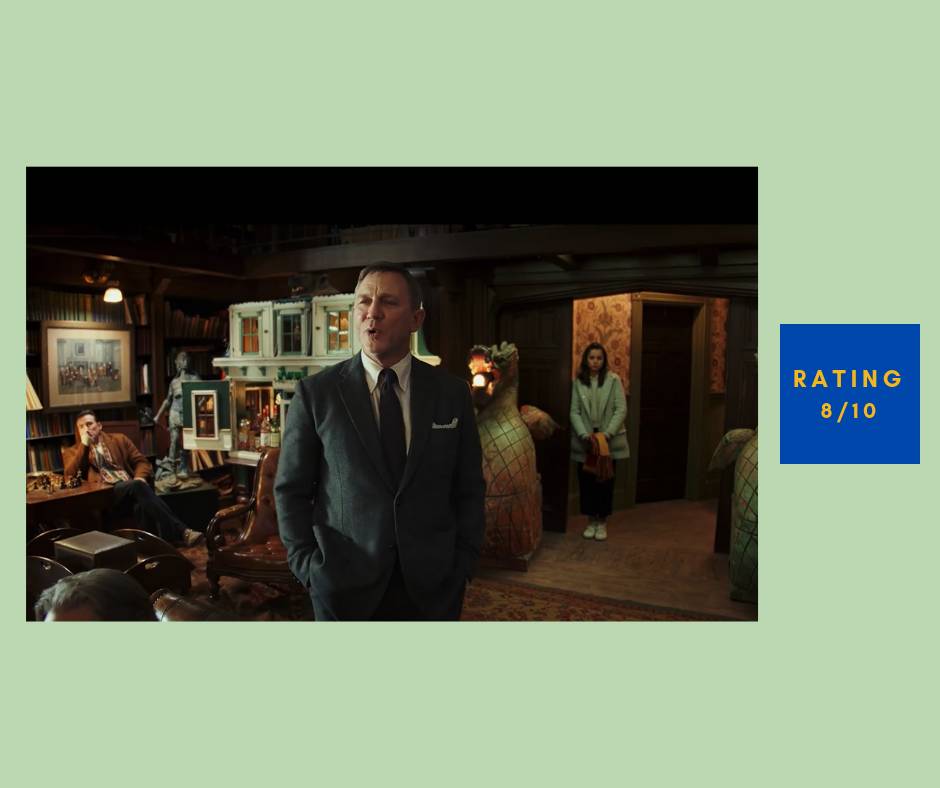
Knives Out by Rian Johnson [8/10]
Who is this Rian Johnson? I’d heard of his “Looper” from 2012 but I’m no Star Wars fan, so his 2017 “The Last Jedi” passed me by. Based on “Knives Out,” his extravagantly Cluedo-meets-Poirot genre outing, I should have kept an eye out, for this is a treat for the senses and the mind alike. The setup is pure Agatha Christie – an aging writer (Christopher Plummer is, as always, spot on) who dies on his birthday, surrounded by a family of rogues, and along comes the cerebral, gimlet-eyed detective to help the police solve what is essentially a locked-room mystery. The locale, a gothic treat of an old mansion, is almost a character in its own right. Plenty of splendid performances here from the likes of Toni Collette, though to be fair, the script is so razor-sharp, the actors can ham things up without concern. And Daniel Craig as the cigar-toting private eye with the languid Southern accent to end them all? Believe it or not, he also rises to the occasion. Lush, kinetic, and brain-tickling, “Knives Out” grabs you from frame one and never lets go.