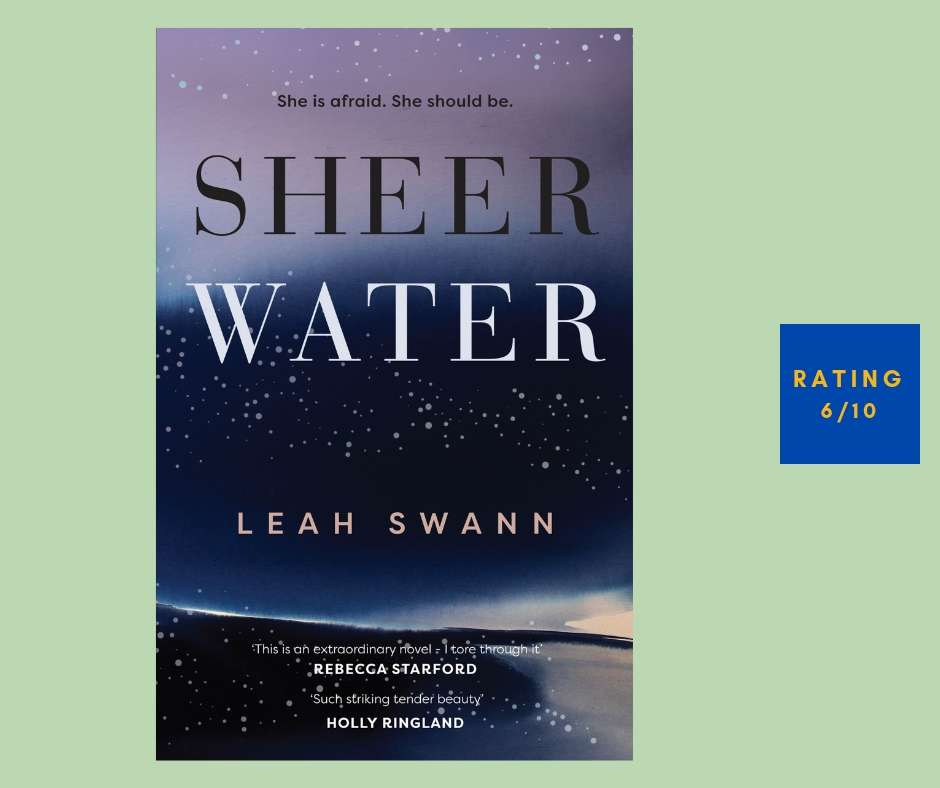
Neither traditional thriller nor standard police procedural, “Sheerwater,” the debut from Leah Swann, piles drama upon drama with calibrated evocation. The book kicks off powerfully: driving to a new life on Victoria’s Great Ocean Road, escaping her fraught relationship with a volatile husband, a mother leaves her two young boys momentarily in the car while helping save the passengers of a crashed light plane, and when she returns to the car … the boys are gone. From there the book spirals in intensity, enmeshing the husband and a troubled local doctor. Each time a formulaic plot twist seems certain, author Swann subverts the genre and takes the story askew. The writing is as ferocious as the plot, bringing the coastline and the characters’ inner lives successively into the spotlight. If I caviled at some plotting confusion between the novel’s aims, I suspect that reflects more upon my faith in existing genre tropes than upon anything else, and the pages of “Sheerwater” turned in a blur of fascination. A fine read.
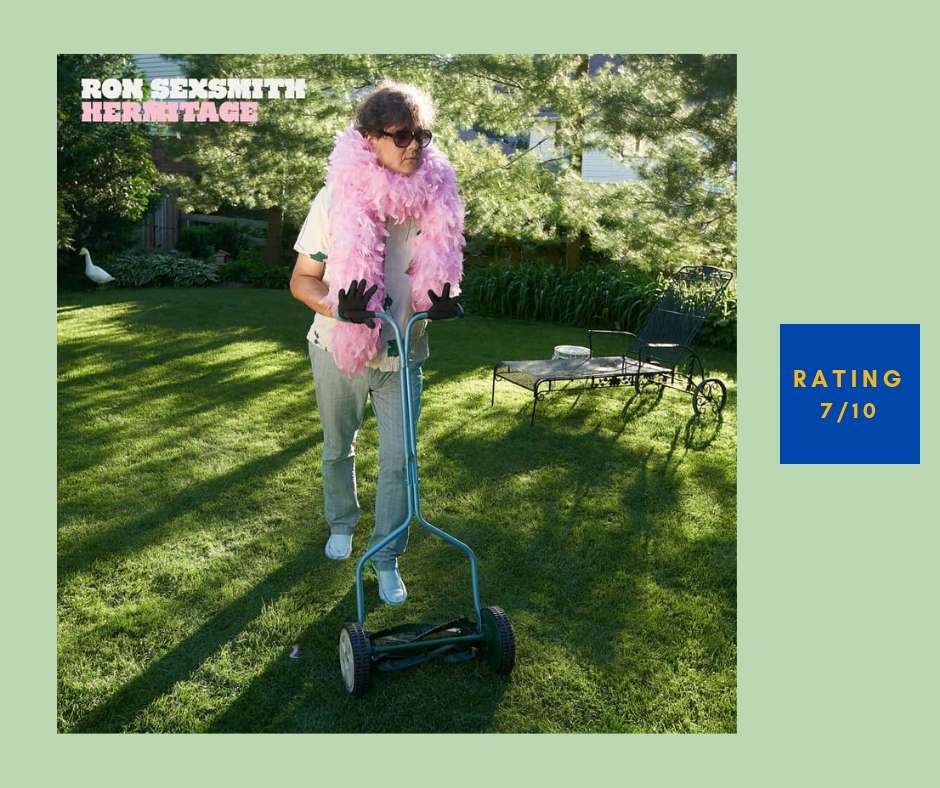
Hermitage by Ron Sexsmith [7/10]
Ron Sexsmith, bard of the velvety, quasi-falsetto crooning voice, has been on my turntable for a decade and a half, but increasingly I’ve found his songs too minor key and saccharine. His trademark simple, evocative singer-songwriter style hovers between steely, melancholic brilliance and sappy pap, and even though every one of his albums contains at least one of the former, the latter had begun to dominate. Thankfully, “Hermitage,” his sixteenth, arrests that trend, and it’s the strongest Sexsmith since the early noughties. Known as a “songwriter’s songwriter,” Sexsmith ensures that each song is finely calibrated, with only a couple upbeat, the instrumentation mostly piano and strings, real music hall stuff. Channeling The Kinks like crazy, time and time again, the songs burrow into the brain after two or three listens. It’s hard to choose highlights but do listen to the unforgettable lilting melody of “Spring of the Following Year”; “Glow in the Dark Stars,” one of his most sublime songs ever, with earworm chorus and melody; and the short, piano-led, world weary “Whatever Shape Your Heart Is In.”
Reunions by Jason Isbell and the 400 Unit [8/10]
Jason Isbell and I haven’t crossed listening paths before and, based on “Reunions,” that’s my bad, for he is a terrific, earnest singer-songwriter in the vein of a Nashville-tilting Tom Petty or The Avett Brothers. His voice rings out true and high, his songs are impassioned slabs of honesty and narrative, and his band rocks hard and smoothly. Isbell’s soaring voice calling “What’ve I Done to Help” high in his register, on the haunting opening track (over six minutes long), is an immediate highlight but there is not a lowball track. Gentler songs, generally nostalgic, like “Dreamsicle” and “Only Children,” hold up the gaps between the stirring anthemic self-examinations such as “Be Afraid” (on which he roars: “Be afraid / be very afraid / but do it anyway / do it anyway”). Apparently Isbell is a recovered alcoholic and on “It Gets Easier,” he hollers the pain of the continuing call of the bottle. What a rousing treat discovering “Reunions” has been!
Climate-Smart Food by Dave Reay [6/10]
A concise examination of the carbon implications of a typical day’s meal, “Climate-Smart Food” is an easily entertaining ride through complex terrain. How does a cup of coffee impact my carbon footprint? My morning toast? How could my evening’s rice portion be better managed, across its lifecycle, to reduce emissions? How will global warming effect chocolate? How much more carbon intensive is chicken than my vegetarian meals? Dave Reay, a UK climate scientist, addresses such aspects of fourteen elements of a day’s three meals. Jammed with illuminations, it’s well worth a read, although some additional context would have helped a neophyte like me understand whether I should eat that banana (100-200g of carbon equivalent). And is “Climate-Smart Food” aiming to educate me about my food choices, or to educate policymakers about cutting food’s emissions, or to inform me about how a given food might suffer under global warming? I suspect the author intends all three but I longed for greater direction. Reay is a smooth, engaging stylist and this is a valuable resource.
Maybe the Horse Will Talk by Elliot Perlman [5/10]
“Three Dollars” made Australian author Elliot Perlman and it was one of my favorite books of that year, but since then I have felt that Perlman’s work has suffered under the weight of serious intentions. “Maybe the Horse Will Talk,” despite being a satire clearly intended to be comedic (and it does have some funny moments), labors over too many pages with a plot of overpowering complexity and characters that often perform roles. The basic story – a rookie lawyer, struggling to save marriage and finances, offers to make a loathsome client’s sexual harassment charges go away – is topical but the story’s machinations paled a bit for me. Perlman writes wonderful dialogue and the corporate world of Melbourne, if a tad over-parodied, rang true. Overall, an odd mixture of lad-lit and serious satire that makes for a slow read.
The Good Ancestor by Roman Krznaric [8/10]
I’m as bedeviled by short-term horizons as most of us, so I turned to “The Good Ancestor: How to Think Long Term in a Short-Term World” with bated breath. With good reason: this book is a panoramic overview of a philosophy/mindset of far-seeking intergenerational morality. Philosopher Krznaric is a superb writer in charge of his material: wonderful, memorable structural organization of the book; comprehensive and fair-minded surveying of the terrain; and just the right amount of detail. He loves a pithy explanatory image and “The Good Ancestor” has a number of brilliant visual aids. I’ve always believed in responsibility towards younger and future humans, and recently I’d set myself a motivational timeframe of 2100, based on when my grandchildren might have grandchildren, but Krznaric has persuaded me to peer much, much further ahead, to expand my moral ambit. I encourage you to read “The Good Ancestor.” Its weighty subject is handled with such unassuming aplomb that I can guarantee at least one of his “six ways to think long” will strike a chord. And the second half of the book covers motivating examples of others acting rather than just thinking long-term. Scintillating.
Permafrost by Alastair Reynolds [5/10]
Wildly inventive time travel always makes for fascinating sci-fi novels, and “Permafrost,” from the pen of renowned Alastair Reynolds, crackles with ingenious plotting. Set in the frigid wilderness of the Arctic in 2080 and 2028, a future Earth, poised on the precipice of doom, sends an elderly teacher back into the past to tweak their present. Valentina Lidova is an engaging heroine and the book’s early pages, chock full of character twists and explanatory time travel science, make for sprightly, intelligent reading. At 176 pages, novella length, I felt the the necessarily complex plot swamps any sense of story, and towards the end, when AIs are introduced, my involvement waned. So … intriguing ideas and a believable protagonist make “Permafrost” a short but perhaps uninspiring futuristic read.
Years and Years [8/10]
“Years and Years,” a kinetic yet character-rich drama from the mind of Russell T. Davies, rockets through its six episodes spanning a decade and a half into Britain’s future from the present day. We follow the Manchester Lyons family, two sons and two daughters, together with their grandmother, plus a constellation of brilliant bit players surrounding them, as the United Kingdom decays in a surreal but oh-so-recognizable extension of the Brexit era. From the first minute, there is no let up; the tightly directed script sprints so fast that viewer attention cannot divert. Each of the core family characters plays a key role, and the acting is superb, especially from Russell Tovey (as Daniel Lyons), Ruth Madeley (sister Rosie), Rory Kinnear (brother Stephen), and Emma Thompson (rampaging across the screen as populist politician Vivienne Rook). The plot plunges England and indeed the world into turmoil, refugees flood borders, technological inventions spring up, the family loves and bickers … what a maelstrom. The cinematography is brilliant and the dialogue crackles. All up, an immersive character study of an absorbing family amidst chaos. Highly recommended.
After Life Season 2 by Ricky Gervais [6/10]
The first season of “After Life” was, I expressed in a review, Ricky Gervais at his best. It somehow married sentimentality to wisdom and side-splitting laughter. What then of Season 2? Well, from the outset the viewer is in no doubt about the storyline, for the first episode quickly establishes that Tony, the sad sack in Season 1 who can’t get over his wife’s death, is still mired in grief. Gervais’s script bestows upon Tony a smidgen of insight and hope from the earlier season, but the routine remains the same: Tony mooches around, berates his acquaintances and wallows in grief. The splendid cast of characters revolving around Tony remains the same, and the acting is terrific, and the rural English town setting is picturesque, and Gervais’s writing and pacing are masterful … but too much sameness is too much sameness. In the first season, I roared with laughter, this time I chuckled appreciatively. In the first season, I often misted with tear, now I chafed at the ickiness. Overall, Season 2 is a pleasant outing over a week of viewing, but is far too unadventurous to be anything but a shadow of Season 1.
The Final Dawn by T. W. M. Ashford [7/10]
Who can resist a fast-paced space opera novel in our current time? “The Final Dawn” kicks off a new series starring Jack Bishop, who volunteers for an experiment on a dystopian Earth, only to find himself careening through space with sentient automata fleeing criminals. Can he survive? Will he be able to return home when no one has even heard of Earth? Ashford is an engaging writer, well in command of his fast-paced plot, and the set-piece scenes in the void of space or in various spacecraft are wonderful. I especially enjoyed Bishop’s growing interrelationship with the eclectic group of automata. Space has never been so enjoyable to read about. Recommended for a fast read in front of a fireplace.