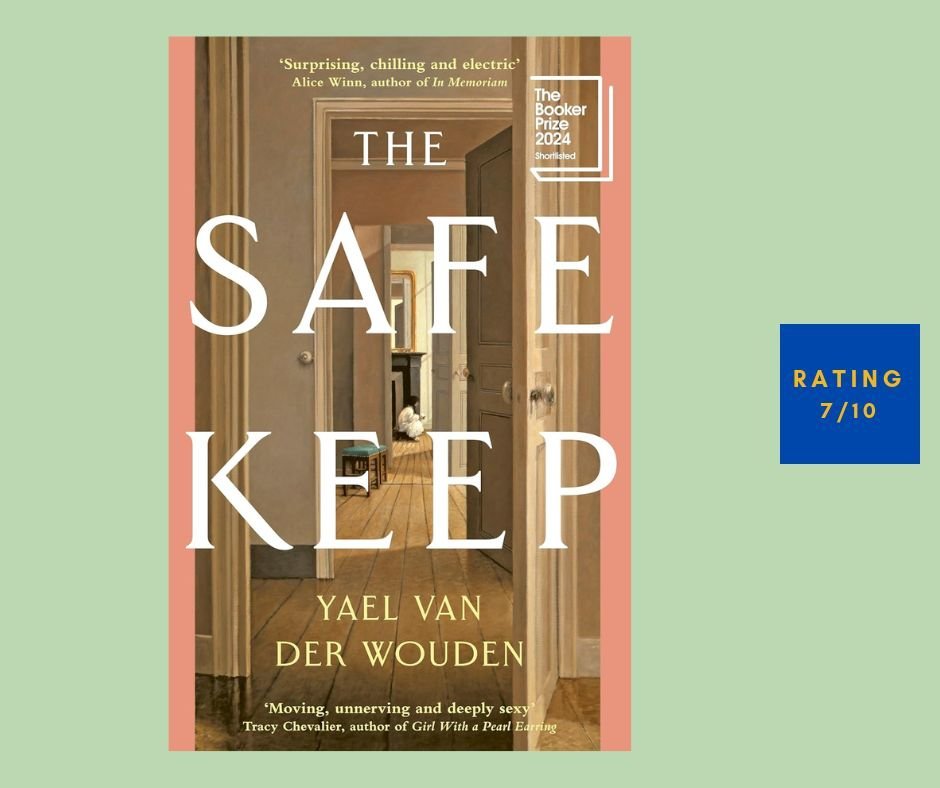
The Safekeep by Yael van der Wouden [7/10]
Yael van der Wouden The Safekeep review

Dutch novelist Yael van der Wouden’s debut, The Safekeep, is a claustrophobic, festering novel set in 1960s’ Netherlands, a country still scorched by Nazi occupation a decade and a half earlier. The story sets out to be an account of an antisocial young woman living in her deceased mother’s house, attended regularly by her two dissimilar brothers. When a brother’s girlfriend is dumped to live temporarily in the house, the story expands to one of lust and longing, and then, unexpectedly, veers into Holocaust reckoning. The author has fashioned a deeply intimate examination of the protagonist, written in dramatic prose, and her plotting is assuredly tight. The florid love affair at the heart of the book slows down the core revelations but overall, The Safekeep is a fiery, poised novel.

Asura by Hirokazu Kore-eda [9/10]

Asura review

Hirokazu Kore-eda makes movies that feel intensely Japanese, uncomfortably different, whilst applying honesty and intelligence to genuinely human stories. Asura is a seven-episode family drama about four wildly dissimilar sisters, their lives swirling around each other with familiar love, resentment, competition, and protectiveness. We have: the happily married wife of a Japanese businessman (who seems to absent himself now and then) and mother of teenage children; the professional flower arranger, a widow ensnarled in a romance with a married man; the insecure girlfriend of a boxing wannabe; and the cloistered librarian seemingly destined to remain a spinster. When their retired father is found to have a mistress and secret son, the drama of the series commences, swirling outwards with unpredictable outcomes. To this viewer, the first two episodes, with the slightly exaggerated Japanese acting, the chintzy music, the plain cinematography, and the matter-of-fact direction, were baffling, but quickly Kore-eda’s magic sets in and we are entranced by the characters and their realism. By season’s end (and I do certainly yearn for Season 2), all the characters are indelibly stamped over their stories and humanity’s messiness is portrayed with rare accuracy. A gem.

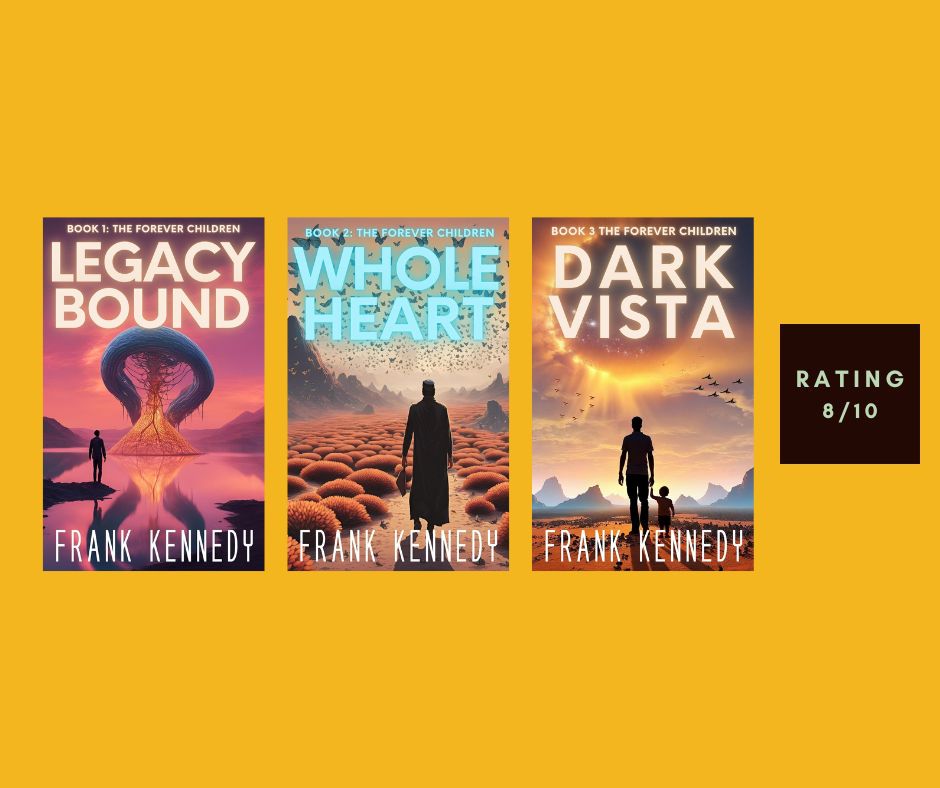
Legacy Bound & Whole Heart & Dark Vista by Frank Kennedy [8/10]

Frank Kennedy series

The first three (short) books in The Forever Children trilogy, Legacy Bound and Whole Heart reprise one of the appealing characters in Frank Kennedy’s Collectorate universe, the principled, immortal soldier Exeter (aka X). In the first book, X seeks peace on the artifical world of Aeterna, home to the immortals, but is sucked back into mortal and high-stakes action when his spouse dives into a lake to find the mythical Jewels and the former super immortal Michael Cooper’s son attempts to bring father back to life. The second book boosts the stakes and increases the mystery and the third escalates external threats, inserts a wonderful character from another of the author’s series, and deepens the Jewel-led weirdness. Throughout, the writing is tight, immersive, and propulsive, and the characters shine. Another winner of a series from this author and I’m hanging out for the remaining instalments of this series.

Apple Cider Vinegar by Samantha Strauss & Jeffrey Walker [9/10]

Apple Cider Vinegar review

The story of fake online wellness guru Belle Gibson is a familiar one: fake, found out, justice. But Apple Cider Vinegar, a six-episode rendition based (howsoever loosely) on a journalistic expose, is turned by Samantha Strauss’s sparky, imaginative script (backed by superbly tight and watchable direction from Jeffrey Walker) into something special. We know the arc but the pleasure is in how the tale unfolds, how the goodies and baddies operate, and indeed in the depth of human understanding shown to all the characters, even the super villainess herself. All the actors are beautifully cast, with Kaitlyn Dever riveting in the Belle role, and Mark Cole Smith and Ashley Zuckerman quietly magnificent in two of the key male roles. Each of the six episodes packs a punch, and the series is bold in its use of time jumps and quirky voiceovers or actor intrusions. The thundering plotline manages to illuminate important themes, such as conventional versus alternative medicines, the ghastly potential for influencers to falsify, and the human desire for connection when unwell. From dramatic start to apt ending, Apple Cider Vinegar is magical.

The Burrow by Melanie Cheng [7/10]

Melanie Cheng The Burrow review

Not quite short enough to be a novella, at 190 pages The Burrow is condensed and freighted with wise emotion on every page. When a grieving couple buy a pet bunny for their teenage daughter, little do they realize that the creature will begin to dominate their slow recovery. When the wife’s mother, herself pivotal in the underlying tragedy, arrives to stay after an injury, the new suburban home of the rabbit becomes a roiling bed of change and crisis. This spare, unsentimental, detailed novel asks: will recovery begin or is this just another crisis? Melanie Cheng is a pinpoint stylist adept at cycling through the four sufferers, adept at manipulating plot in the service of emotional revelations. This reader found the first three quarters of The Burrow to be riveting; if the final quarter lost some intensity, nevertheless the overall journey was a touching, rewarding one.

Carry-On [7/10]

Carry-On review

The disposable-thriller sub-genre is real and one that Netflix excels at. A typical, stalwart example is Carry-On, an airport thriller with a wonderful premise. If a young TSA agent fails to let a catastrophic suitcase through security, his wife (also working in the airport) dies. And it is Christmas Eve. The premise is milked for all it is worth and milked well: the script by T.J. Fishman is contrived but gripping, and Jaume Collett-Serra’s direction is kinetic and immersive. However, what plucks Carry-On from the ruck is the performance of the two stars: Taron Egerton, as the victim, is refreshingly gauche yet smart (and of course physically effective), while Jason Bateman is hatefully indestructible as the genius villain. Anyone casting about for a brief jolt of adrenaline after a bruising day would be well satisfied by Carry-On.

A Complete Unknown by James Mangold [9/10]

A Complete Unknown review

Based on a ten-year-old part-bio, Dylan Goes Electric!, by Elijah Wald, and brilliantly refashioned by eclectic writer/director James Mangold, A Complete Unknown is, of course, about Bob. Dylan. Bob Dylan, the genius singer/songwriter who is the only lyricist to have won the Nobel Prize. Perhaps its greatest strength is that it only relates a segment of Dylan’s life, from when he arrived in New York at the start of the mighty Sixties, penniless, unknown, and a mystery, until he upended the American folk scene by “going electric” at the Newport Folk Festival. Timothée Chalamet stuns as the young Bob, nailing his voice, his singing, his arrogance, his self-certainty, and he is backed up by Ed Norton note-perfect as Bob Seeger, Elle Fanning wonderful as the discarded girlfriend, and Monica Barbero immersive as Joan Baez. The cinematography is excellent, especially in the raucous clubs and on the various stages, the plot zings without concession to the viewer, and the 60s settings are a pleasure in themselves. To my mind, A Complete Unknown remakes the genre of the music bio. Go see it.

Don’t Die by Chris Smith [6/10]

Don't Die review

A documentary definitely not for everyone, but very much in my wheelhouse, Don’t Die: The Man Who Wants to Live Forever profiles Bryan Johnson, the multimillionaire publicly doing a one-on-one experiment on himself with the aim of living forever. If I tell you he finishes eating for the day at 11 AM, eschews alcohol, eschews most social life, eats precisely weighed and planned meals, volunteers for offshore gene therapy, and consumes a hundred pills a day (that number varies every time I read about him) … well, you’d be entitled to dismiss him as a nut. Yet this documentary portrays him (over sympathetically, I must admit) as a likeable, almost vulnerable soul of great obsessiveness. He is, in a word, interesting, and that alone makes Don’t Die quite an intriguing watch. Plot overlays are his love for one of his children (the others are estranged) and his online exhibitionism and business hawking, both of which deepen our appreciation for someone hard to comprehend. Well paced, simply shot, Don’t Die is worth a look, especially if longevity appeals as a topic.

The Remarkable Life of Ibelin by Benjamin Ree [9/10]

The Remarkable Life of Ibelin review

Seemingly unassuming as it starts, The Remarkable Life of Ibelin gently kicks into gear with the documentary tale of a Norwegian sufferer of a muscular degenerative disease, Mats, and his death at age 25. Then the bombshell: his parents discover hidden on his computer (we’ve already seen significant footage of him curled up in a wheelchair, playing video games using special gear allowing him to work the games with just a finger or two, we’ve heard his parents bemoan his wasted time gaming) a community of gamers who swirled around him in a second life on World of Warcraft (I have a friend who spent years on this multiplayer online game, so I know how addictive/rewarding it is). From there writer/director Benjamin Ree plots out a fresh biography (using animated resconstructions of game action plus actual text conversation discovered in Mats’s gaming archives) of Ibelin (Mats’s game name), full of intrigue and emotion and even love. We see some of Ibelin’s closest online friends, face to face in interview, and we begin to marvel at the courage and humanity of Mats/Ibelin. The Remarkable Life of Ibelin is a touching, unsentimental story of the powers of friendship and love in the most difficult of physical circumstances, and the last quarter is truly moving.

Earth by John Boyne [8/10]

John Boyne Earth review

In his quartet of novellas loosely organized geographically around a remote Irish island and organized (it seems) around modern issues of abuse and misogyny, John Boyne’s second instalment is Earth (see my review of the first, Water). At the end of Water, we witnessed a secondary character, a troubled seventeen-year-old youth, fleeing the island, and it is he, Evan, who now stars in Earth. Without preamble, the author deftly inserts us into a court case accusing Evan, now a soccer star, of abetting in a rape, the other accused being his teammate. Then Boyne switches us to and fro, between courtroom scenes and his fraught past since leaving the island. For Evan is damaged, a caring soul plunged into darkness, and the novel soon becomes an examination of his morals under pressure. As always, John Boyne’s writing is free flowing and acute, the dialogue a treat, the ancillary characters all quickly and deeply introduced and then developed. The 168 pages unwind in a pleasing blur, a blur that sinks the reader into the darkness of misogyny and rape, fully up to date in 2025. Not quite as riveting as Water, Earth nonetheless is a sterling, thought-provoking read.