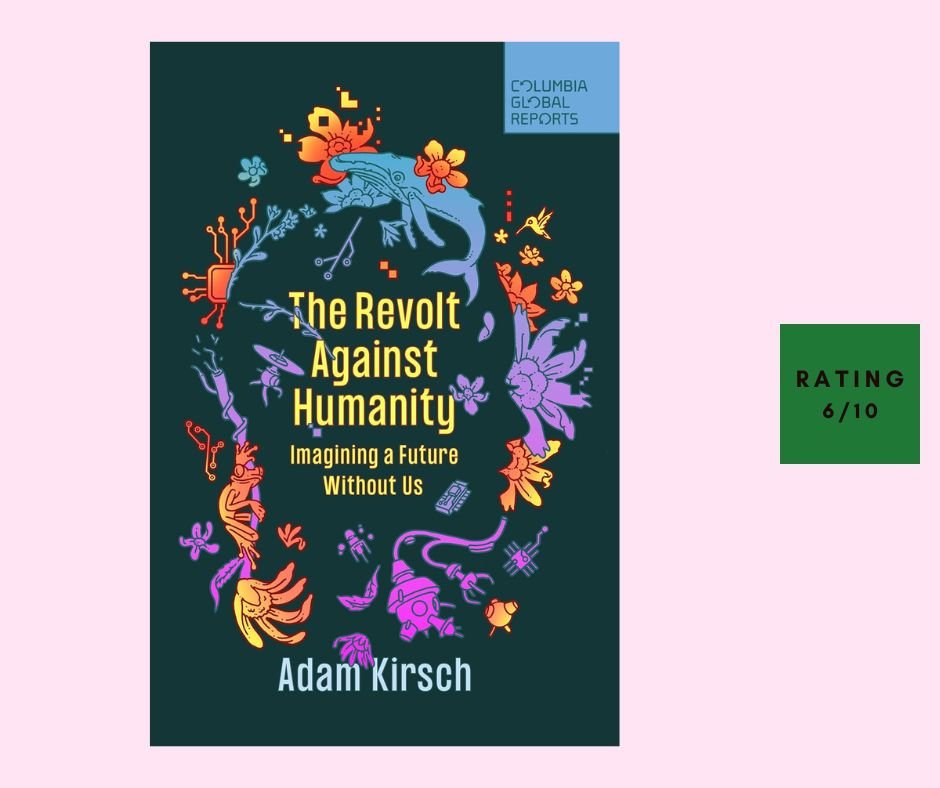
American poet/critic Adam Kirsch is a man of the moment, seizing an insight in his slim book of commentary and philosophy, The Revolt Against Humanity: Imagining a Future Without Us. Once presented, his idea is obvious: many writers and thinkers are imagining a future world without corporeal humans, within two camps at first remote from each other. Anthropocene antihumanists can picture a world where climate change sends humanity extinct (or near enough to). Transhumanists see us transcending our bodies and either “uploading” our brains into digital networks or evolving into artificial intelligences ruling the world. Both strands are, of course, pessimists in one sense, yet both portray futures full of hope (but not human hope). Kirsch steps through six ideas-packed chapters with verve and cool style, offering a heady read. A particular pleasure of this book is the author’s synthesis of recent authors on these subject, ranging from David Wallace-Wells and Vernor Vinge to Toby Ord. For this reader, additional insights arrived from less lauded authors such as Leon Katz, Timothy Morton, David J. Chalmers, Michio Kaku, and Claire Colbrook (her idea of “preliminary mourning” struck me as apt). Another insight was that both of these adversarial streams of thought see the present as “the hinge of history.” Not for everyone, The Revolt Against Humanity will delight those tossing up between doomism and ultra techno-optimism.

Book, movie/show, and album reviews