Hazelwood by Tom Doig [7/10]

Tom Doig Hazelwood review

A decade and a half ago, I joined a tour of the Hazelwood coal-fired power station, two hours east of Melbourne in the coal-smoke-engulfed Latrobe Valley. I was researching renewable energy. Hazelwood impressed me not at all; it was shabby and dirty. Burning the most carboniferous brown coal of all, Hazelwood was an icon of global warming evil. New Zealand writer and journalist Tom Doig has now written a riveting account of the 2014 coal fires, and “Hazelwood” can stand as an eagle-eyed epitaph to that sorry pile of scrap. Assembling a stellar array of local eyewitness, Doig dramatizes the forty-five days of uncontrollable fire, the heroism and inept officialdom, the illness-wracked aftermath, and the eventual taxpayer imposts. He writes with great panache and verve, and by leaving himself out of the story altogether, creates a tense tale that makes for a breathless single-night read. I was especially taken by how venal the plant’s operator, GDF Suez (later rebadged as Engie) was, before, during, and after the horrific blaze. Engie eventually just walked away from the mess by closing Hazelwood down, and if there is any silver lining to that sorry saga, it is that maybe planet Earth was spared a certain amount of emissions. Grab Hazelwood, it’s a must-read.

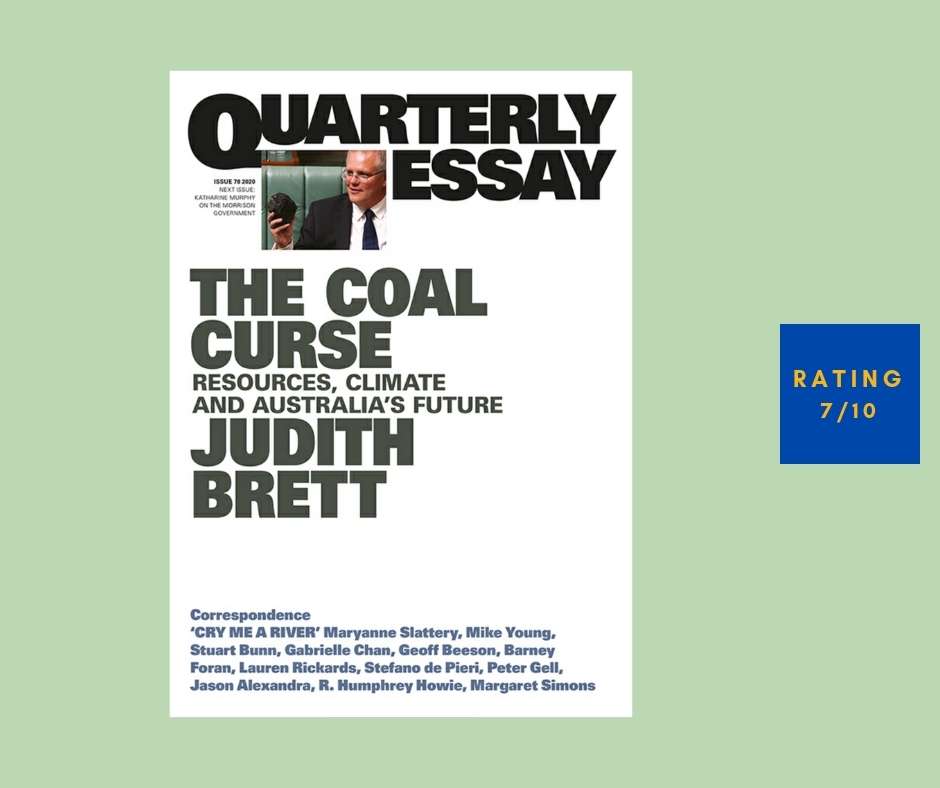
The Coal Curse by Judith Brett [7/10]

Judith Brett The Coal Curse review

Academician and biographer Judith Brett shines a light on one of the most crucial global sectors, at least in terms of Australia, in “The Coal Curse: Resources, Climate and Australia’s Future: Quarterly Essay 78.” An extended essay, it’s what we’ve come to expect from Brett, a readable, coherent, passage through history to our present impasse. She covers the years after the wool trade segued into a growing mining sector; the battle for indigenous rights; the backlash in the 80s as the mining companies organized lobbying and advertising; what Brett calls “state capture” in the 90s and 00s as the Minerals Council seemed to be able to persuade Australians to support mining despite few actual jobs on the ground; the climate change denial campaigns that brought down leaders on both sides. The pernicious influence of the mining industry has been clear for a long time, but Brett is superb at succinctly summing up both history and current status. In the end, The Coal Curse does offer some hope for Australia to shift before the country is assigned a climate action pariah status: “Public concern about climate change is as strong as when Howard was in government, the financial calculations are much more favourable to renewables, and business leaders are more aware of the risks of a heating planet.” The Coal Curse is a masterful insertion into our national debate, and is heartily recommended.

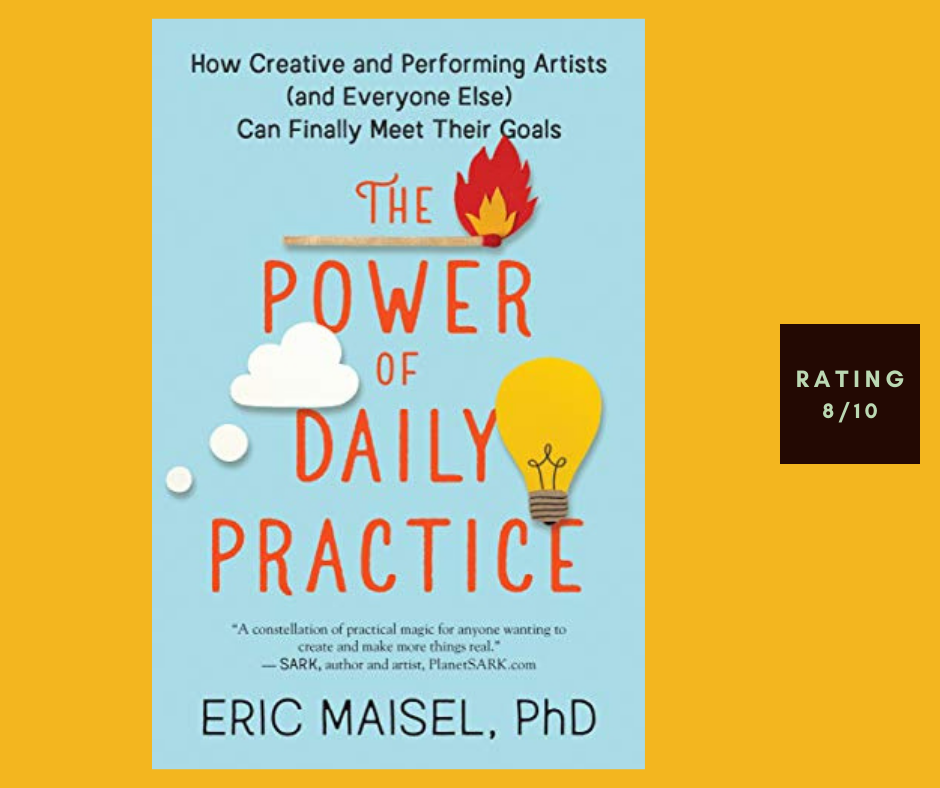
The Power of Daily Practice by Eric Maisel [8/10]

Eric Maisel The Power of Daily Practice review

Steady daily application is one way to achieve something, and a “daily practice” is an approach that I, along with many creatives, focus upon. Now the guru of meaning-making and artistic self-help, Eric Maisel, has turned his wise eyes towards the concept. “The Power of Daily Practice: How Creative and Performing Artists (and Everyone Else) Can Finally Meet Their Goals” is a lively, judicious examination of the complex nature of a daily commitment. I found this heartfelt yet rigorous counsel to speak directly to my current needs and basked in its depths. I suspect those in my shoes – committed but perhaps inefficient workers – will revel in The Power of Daily Practice. An entire chapter drills down into twenty desirable characteristics of a daily program, and anyone attempting discipline will gain something from Maisel’s reflections. I jotted down to brew over my habits – do I “initiate” effectively? How can I add “playfulness”? Do I “invite joy in”? Am I as effective at granting my daily work its “primacy” as I profess to be? At the other extreme, for someone just wrestling with the notion of one or more daily disciplines, The Power of Daily Practice may well be overkill, but I wager Maisel’s lovely prose and sense of magic would make a difference. Overall, a brilliant crucible for striving towards effective creation and work.

Humankind by Rutger Bregman [7/10]

Rutger Bregman Humankind review

Belgian historian Rutger Bregman believes humans are by nature altruistic and kind, and that this is not just his belief but what history documents. “Humankind: A Hopeful History” is his supporting opus and it’s a fizzing romp. Bregman is a captivating stylist with a steady hand at the tiller, and the pages of his exploration of what he believes are the mistaken dogmas about humanity’s intrinsic selfishness and calculated self-interest. The mystery of human’s evil against humans, something that has obsessed me all my life, is, he believes, the exception to the rule, and to demonstrate that he tackles head on the Milgram and Stanford experiments, the Holocaust, The Lord of the Flies. All the classic tropes of rigid selfishness are, he demonstrates, flawed semi-propaganda. Most importantly, Bregman argues in Humankind that this flawed picture of ourselves prevents us from being our best, our most altruistic, our most successful in changing the world. Let this wonderment of a book sweep you up, dear reader.

The Future Earth by Eric Holthaus [6/10]

Eric Holthaus The Future Earth review

Journalist Eric Holthaus, in “The Future Earth: A Radical Vision for What’s Possible in the Age of Warming,” seeks to “encourage all of us to explore possible futures based on the latest science and continue to have faith that the conversations themselves could be transformative.” A talented stylist with an urgent tone, Holthaus sets the scene by surveying the climate emergency, appeals to our common sense of humanity, and then walks the Earth forward three decades, decade by decade, based on the author’s scientific knowledge and interviews with leading thinkers. This “hypothetical” makes narrative momentum difficult to sustain, and sometimes there is a sense of a sci-fi script, but, as the author believes, the very act of telling a story of properly transformative emissions reduction (and some drawdown) is most instructive and encouraging. The author concludes with personal suggestions on how to model change. Overall, “The Future Earth” is an intriguing exhortation.

The Assistant by Kitty Green [5/10]

The Assistant review

The Assistant” should amount to more than it does. Writer/director Kitty Green has devised a smart, oblique peek into the #MeToo world of New York film and television. Julia Garner is stunningly successful in depicting (with few words but great visual aplomb) a single day of a junior assistant (five weeks into the job!) slaving away in the office of a horrific mogul we never see, just hear indistinctly behind a closed door. A strong feature of the film is the beautifully filmed, close-up corporate office world with its banality and hidden dramas (trust me, it rings true). The seemingly never-ending sequences of office-domestic duties carried out by the assistant, all the while increasingly realizing what abuses and ravages are being perpetrated by the Weinstein-modelled person behind the door (we never see him, another deliberate filmic choice), are clearly intended to reek of a Kafka novel, but something in the pacing or atmosphere or framing sucks all the horror out of the buildup. Only a brief foray into the office of a human resources manager (played with panache by Matthew Macfadyen) offers any narrative drive; frankly, boredom sets in readily. Overall, “The Assistant” amounts to an intriguing drama that misfires.

Into the Tangled Bank by Lev Parikian [7/10]

Lev Parikian Into the Tangled Bank review

Conductor Lev Parikian wrote one of my favorite birding books of 2018, revealing in the process a unique voice: jokey, discursive, smart, bustling, compassionate. “Into the Tangled Bank” widens his ambit. Setting out to explore British nature in all its complexity, but also how people experience nature, and in particular what nature means to him, Parikian begins close-up, in his “non-gardener’s” garden, then expands horizons. He strolls his local “patch,” attempts to draw a heron, hikes through rain, examines nature in museums and via documentaries, tours London Zoo and the wetland reserve in Barnes (one of my special places), then journeys to Skye and onto a boat and into a bird banding project. Interspersed are homages to Darwin, Peter Scott, and others. Chuckles abound and Parikian never turns pretentious. Nor does he espouse a platform, though a mid-book “interlude,” a pithy rave about “the state of the planet” moved me greatly. Indeed Into the Tangled Bank weaves a subtle magic over its journey, professing to bumble but artfully suffusing the reader with awe and love of our planet and all its living forms.

The Sunken Land Begins to Rise Again by M. John Harrison [7/10]

M John Harrison The Sunken Land Begins to Rise Again review

M. John Harrison is an immersive, stunning literary stylist who has written several science fiction classics, but “The Sunken Land Begins to Rise Again” is something altogether different. It follows Shaw, a drifter through life who takes on a job on a tumbledown London barge, and Victoria, Shaw’s sometime lover and also a scrambled person, as she settles into the family home in Shropshire. Nothing much happens—the two of them get together, part, and drift onwards, but around them something strange is happening in the waters, in the towns, everywhere … small oddities that build up into a sense of an ancient, menacing otherworld. Harrison cannot write a dull sentence, indeed the sentences overflow with piercing descriptions of a Britain in post-Brexit decline. “The Sunken Land Begins to Rise Again” is a beguiling, aslant tour de force.

Cardinal Season 4 [9/10]

Cardinal Season 4 review

Cardinal” began life based on the spellbinding police procedurals written by Canadian novelist Giles Blunt (the first one and among the best was Forty Words for Sorrow), but quickly established a separate life on the screen. The first two seasons were hypnotic and the third, one of my 2019 highlights, was almost unbearably dark and suspenseful. Season 4 is billed as the finale and I wish it were not so. Set in chilling Canadian snow country, the cinematography and scenic direction are as controlled and beautiful as in the first three seasons. After a harrowing opening murder scene, the plot swirls for the first three episodes, then settles into a duel between evil and the two detective heroes of “Cardinal,” John Cardinal (played as ever more worn-down but indefatigable, by wonderful Billy Campbell) and his junior partner Lise Delorme (Karine Vanasse shines in this role). The embers of the attraction between the two of them glow. As ever, the supporting cast is stellar, and Shawn Doyle exudes tormented evil as the key opponent. The final two episodes, set in the white, white, frigid snow, pound with tension, and the denouement is apt and sweet. A triumph.

The Promised Few by Frank Kennedy [8/10]

Frank Kennedy The Promised Few review

Grandiloquent space opera grounded in the lives of real people flows from the pen of Frank Kennedy. “The Promised Few” is the conclusion of his tetralogy, The Impossible Future, and it delivers as a maximum-octane, intelligent finale. Over the previous three instalments, we followed the lives of three young Americans – awkward Jamie, joshing Michael, and composed Samantha – thrust into the sprawling space empire of the tyrannical Collectorate. At the end of Book 3, James was a rising god overseeing god-human hybrids and immortals, now ravaging the Collectorate; Samantha was Collectorate nobility captured by James; and Michael was a semi-reluctant rebel within the Collectorate. The Promised Few plunges us into frenetic action interspersed with brilliantly conceived and executed space empire diplomacy. Kennedy’s dialogue is whip-smart, his control of the rocketing pace is wonderful, and the many battle scenes thrill. Imaginative plot twists abound. Best of all, the grandiosity of the war and diplomacy sit alongside deeply rooted character studies; this is that rarest type of space opera, one that marries the personal with the vast. And, in the grand tradition of this genre, the entire series of four books is suffused with the mystery of the Jewels, powers that choreograph the fate of all three of our characters, and indeed of the world. The Promised Few is a superb closing volume of a brilliant series. Indulge yourself and sink in!