The Winter Palace by Paul Morgan [8/10]

Paul Morgan The Winter Palace review

Paul Morgan’s beautiful writing bewitched with his first two novels set in the Roman Empire and the world of art. Now, with The Winter Palace, he tackles the horrors of World War II. In 1939 Anton, a Polish army officer, and his wife, Elisabeth, are ripped apart and cast asunder from their beloved Winter Palace in the bucolic countryside of a nation about to be bestially savaged by both Hitler and Stalin. Anton ends up as a prisoner of war in Siberia (this section was especially fascinating to me as an uncle of mine suffered that fate), before battling with a ragtag army in Central Europe, en route to Jerusalem at the dawn of the Jewish state. Elisabeth, in the meantime, suffers equally as a Nazi concubine before working as a nurse in Poland whilst assisting the resistance. The author never flinches from the evils encountered by Anton and Elisabeth; I was, somehow, reminded of Jerzy Kosiński‘s The Painted Bird), and the novel can be harrowing, albeit softened by the slightly saccharine love between the two. As with his other novels, the author’s prose matches his ambition, and he maintains a strong hold on the sweeping plotline, so that The Winter Palace can be recommended as a compelling, bracing read.

Alice in Borderland Season 2 [9/10]

Alice in Borderland Season 2

The two seasons of Alice in Borderland, a tale (based on a manga comic) of Tokyo turned into a grim emptied-out amphitheater for deathly puzzle games (a la The Hunger Games or Squid Game), have been an under-the-radar revelation. Starring Arisu, a disaffected young man whose video game passions turn out to be highly useful for survival, the series alternates incredible sci-fi battle or puzzle sequences and downtime character building. Around Arisu, an eclectic cast of battlers gradually assembles, their back stories detailed in wonderful visual scenes, all of them seeking to win all the games denoted by a pack of cards (with higher ranked cards denoting more difficult contests). The storyline betrays its manga origins—occasional cartoonish dialogue, occasional sentimentality, switches in pacing—but oddly enough, this orientation merely amplifies the show’s myriad pleasures. I was blown away by Season 1 and can report that Season 2 darkens and deepens and magnifies the spectacle and the emotional impact. Alice in Borderland is a cinematic hoot in every episode and deserves to be elevated above its current semi-cult status.

The Mercy Chair by M. W. Craven [8/10]

M. W. Craven The Mercy Chair review

Over the last four years, I’ve read and relished four M. W. Craven mystery novels starring grouchy but brilliant Investigator Washington Poe and his awkward super nerd Tilly Bradshaw (these links are to my four reviews, uniformly rated as 8/10): The Puppet Show, Black Summer, Dead Ground, and The Botanist. There are not many genre series whose instalments I snap up on the day of publication, but this is one, and The Mercy Chair did not disappoint. In this outing, a religious zealot from a cult is found stoned to death and the case soon becomes related, somehow, to the slaughter of a family by a daughter many years ago. By definition, the Poe/Bradshaw cases involve multiple gruesome killings, but The Mercy Chair is perhaps the darkest to date, and the plot twists, superbly cunning as is usual with this author, border on the outrageous (you’ll know what I mean when you read the book), so when I finished it, a couple of days after page one, I felt both refreshed but also unsettled. Longtime series can become pastiches unless the core characters suffer and learn, and I sense that this series has settled down into quirkiness, stylistics, and plot pyrotechnics. This is a minor quibble: I recommend you snap up the six books and clap hands with delight.

My Friends by Hisham Matar [9/10]

Hisham Matar My Friends review

I have only sketchy memories of the April 1984 nightly news images from London of Libyan diplomats opening fire on demonstrating students, which is the initiating event for this stately, probing novel of exile and revolutionary freedom fighting and, yes indeed, friendship, written by Hisham Matar. He imagines two Libyan student friends wounded in the fray, who then become what might end up as permanent exiles from their homeland ruled despotically by Quaddafi. The terrors of that day knit them together and then later, a third, older, ex-author exile joins them. My Friends gently, but forensically, unfolds the next three decades or so until a people’s revolution deposes the dictator, during which the protagonist pursues an unassuming life as a London teacher, forever balancing regrets against the security of certainty. The author provides a filigreed dissection of the many pleasures and hidden grumbles of the trio’s friendships. Matar writes undulating, intelligent prose that could, in most authors’ hands, drag, but here retains solid muscularity. Overall, My Friends is a whispering, deep novel plucked from recent times, one that illuminates as it caresses.

The Beekeeper [8/10]

A Jason Statham film presages a violent thriller, hopefully with scriptwriting nous and a solid cast. Choreographed battle scenes are a given. I’m reminded of Steven Seagal or, God help us, Jean-Claude Van Damme. Statham’s recent vehicles have been ho-hum but The Beekeeper represents a welcome return to form, a kinetic thriller that is not nonsensical and that permits quite some nuance with dialogue and supporting characters. Statham plays a solipsistic beekeeper in the United States, one who is triggered into a nation-shattering vengeance quest when his sole friend is stripped clean by Internet scammers. The script is unfussy and the plot quickly accelerates into a long, drawn out finale that is pleasingly symmetrical and perhaps even weighted with some emotion. The Beekeeper is the kind of thriller one used to watch, something to evoke anticipation and amuse an hour and a half, and as such, was most welcome to this viewer.

Freud’s Last Session [7/10]

Freud's Last Session review

The premise of Freud’s Last Session, directed and co-written by Matt Brown (who doesn’t shy from conceptually challenging ideas, as shown by his movie about a famous Indian mathematician, The Man Who Knew Infinity), might largely predetermine if this should occupy your time. What if Sigmund Freud, just before his London death in September 1939 (with evil occurring real time as Hitler invaded Poland), entertained a visit from C. S. Lewis, then a young academic who had renounced atheism for Christianity? What if the sex-focused atheist debated God with the god-botherer? If you abhor religion but equally decry Freudianism, Freud’s Last Session will annoy rather than entertain, and I had thought, as I entered the cinema, that I would fall into this category, only to find myself rather engrossed in the scorching debate. One reason of course is the acting, Anthony Hopkins in crackling form as the founder of psychoanalysis and Matthew Goode equally fine as the author of the Narnia books, but the script also engages, cleverly building up tension from not much more than two men walking from room to room. The overall impact is blunted by the disjunctive subplots of Anna Freud and Lewis’s war flashbacks, but if movies exploring intellectual matters is your preference, I can commend Freud’s Last Session.

Total Control Season 3 [8/10]

Total Control Season 3 review

The first two seasons of Total Control, a savage examination of Australian politics through the lens of an indigenous politician who grabs the center of power, rocketed along with great brio and intelligence (my review of Season 2), and the second season ended with a corker of a cliffhanger, so I embarked on the six-episode Season 3 expecting more of the same. The first two episodes sagged under the weight of setting the scene, to the extent that I suddenly began to experience disappointment. Deborah Mailman was still superb as Senator Alex Irving, Rachel Griffiths oozed raw, almost honest ambition, and the supporting cast still rocked, but the plot of Senator Irving having acted as kingmaker for Australia’s first indigenous prime minister, initially felt ponderous. But the final four episodes found their feet, the various subplots (Alex’s brother as an adviser to the prime minister while his wife reaches the end of her pregnancy, for example) enriched the central realpolitik drama, and all the story elements cascaded wonderfully into place by the time of a corker of a climax. Total Control is heartily recommended, all three seasons in turn.

Maestro by Brad Cooper [7/10]

Maestro review

If you swoon over Leonard Bernstein’s conducting (clearly inspirational, if Brad Cooper’s portrayal captures it) or composing, then Maestro, which not only stars Cooper but was co-written and directed by him, is likely to captivate you. This is by no means your standard dull biopic but an arty, bold take, from the largely black-and-white cinematography to the demanding scripting (which smacks you into a scene with no preamble, which can skip years in a second) to the Bernstein-music score to the rapid-fire, very upper-class-Manhattan dialogue. This is a film that excites the mind as much as the senses. Brad Cooper’s take on Bernstein’s life, which seems to be so full of action and intrigue and heft, centers on his relationship with his wife, Felicia Montealegre (played brilliantly by Carey Mulligan, who even manages to nudge Cooper out of the limelight), especially the complexities woven by Bernstein’s simultaneous love for her and his unstoppable attraction to male lovers. In the final analysis, this viewer’s emotions failed to be ignited, perhaps due to the seriousness of the overall approach, but Maestro definitely deserves a watch.

Suppose a Sentence by Brian Dillon [7/10]

Brian Dillon Suppose a Sentence review

Not for everyone, Suppose a Sentence sees writer/critic Brian Dillon muse deeply about twenty-eight sentences, long or short, old or recent, that he has “collected” because of a profound effect on him. From Shakespeare to Claire-Louise Bennett, from Virginia Woolf to James Baldwin, from Samuel Beckett to Hilary Mantel … the book is an idiosyncratic but fascinating journey. Some of the sentences hit me hard – cue Annie Dillard, Maeve Brennan, Joan Didion, for example. Others somewhat baffled me but aroused in the author a reflection that I thoroughly enjoyed – cue Gertrude Stein, Elizabeth Hardwick, Susan Sontag. Overall, Suppose a Sentence comes recommended for prose nerds and reflective stylists.

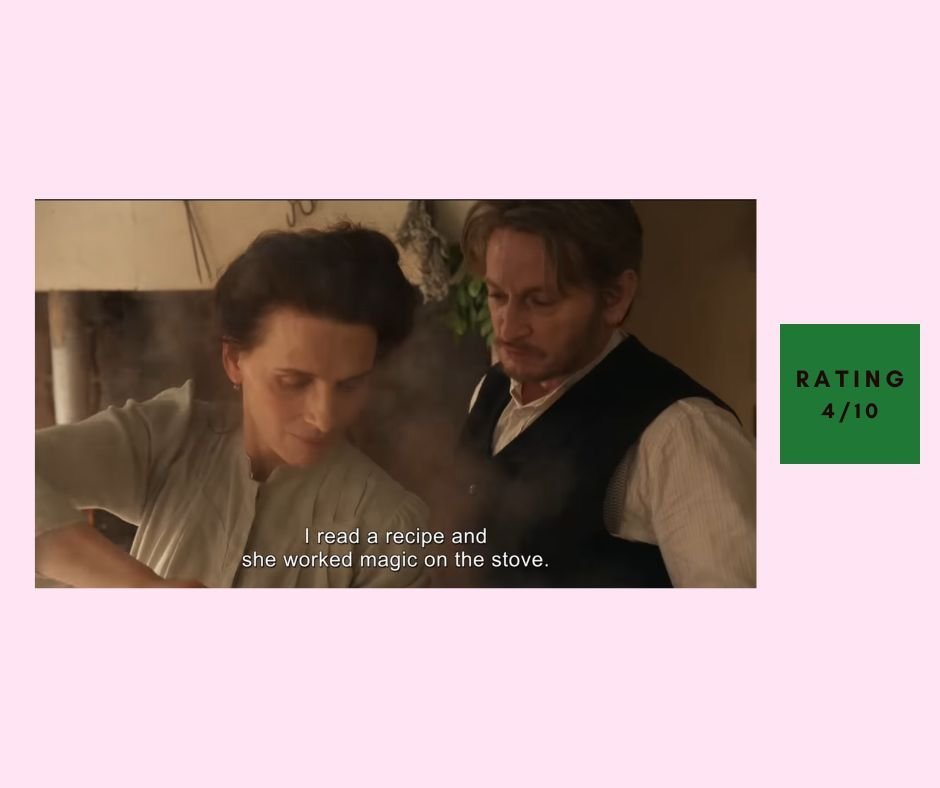
The Taste of Things by Anh Hung Tran [4/10]

The Taste of Things review

French-Vietnamese director Anh Hung Tran’s The Taste of Things is a combination of a luscious love story and a luscious foodie film. Late 19th century gourmand of fame, Dodin, is played with huge passion and intimate physicality (we hear a lot of his breathing) by Benoît Magimel, and his world shifts with a challenge to cook for a local prince but also by his efforts to woo his 20-year kitchen cook, Eugénie, played by audience favorite Juliette Binoche. The film revolves around scene after kitchen scene of luxuriously filmed food preparation sessions, and I have to say there is abundant beauty, very much a treat for the French foodie fan, in these gorgeously filmed gourmand sequences. But the intoxicating ambience is badly served by the glacial script, stilted dialogue throughout, and Binoche’s superficial, beaming performance. The second half, marked as it is by the urgency of tragedy, works better than the first. Mark The Taste of Things as a visually appealing disappointment.