Prolific Ukrainian historian has not only written often about his own country, but he is also author of one of the classic nuclear histories, Chernobyl: The History of a Nuclear Catastrophe, and another nuclear history, so when Russia occupied the Chernobyl plant during the first month or so of its invasion of Ukraine, it naturally fell to him to put out the first book on the troubling event. Chernobyl Roulette: A War Story, short at 240 pages, has the feel of a rushed affair, as many “first on the scene” accounts do. Using Ukrainian interviews, Plokhy describes the 35 days in detailed prose that does the job but perhaps lacks the usual nuance of his other histories. Certainly there was potential for a disaster if the new containment structure locking away the Reactor No. 4 shell were to be blown up or if any of the still highly radioactive areas of the Exclusion Zones were stirred up, spreading radioactive dust, but the threat was less than was the case (and still is) at the huge Zaporizhia nuclear station. Nonetheless, Chernobyl Roulette is a handy and timely historical record that would interest anyone keeping up to date on nuclear energy.
Write Cut Rewrite by Dirk van Hulle & Mark Nixon [5/10]
Write Cut Rewrite: The Cutting Room Floor of Modern Literature is the handsomely laid out and illustrated book accompanying an exhibition of the same name running at the Bodleian until next January, and is written by that exhibition’s curators. Undoubtedly the book would work best if read after viewing the exhibition but it is fascinating and illuminating as a standalone examination of modern works of literature in the process of editing. Numerous Samuel Beckett works feature and the authors analyze how he pruned and changed handwritten drafts at various points in his career. Other famous editing snippets come from Franz Kafka and Jane Austen. I was particularly taken with how books I know and love, by Raymond Chandler, John le Carré, and Philip Pullman metamorphosed, how much repeated effort went into the final works. I have not rated (according to my system) Write Cut Rewrite highly simply because this is a specialized book, but can recommend it to anyone intrigued by literary editing.
Not Built for This by Emmett FitzGerald [8/10]
This reviewing site has never tackled a podcast before but Not Built for This worked so well as the equivalent of a slim six-chapter nonfiction audiobook that I decided to make an exception. Part of the 99% Invisible stable of podcasts, the series sees reporter Emmett FitzGerald investigating America’s built infrastructure in the Anthropocene, and as its title suggests, what he finds is stunningly troubling: the country is struggling right now to cope with the climate crisis’s early impacts. In the “climate haven” state of Vermont, repeated millenial floods drive a town to the brink of abandonment. A Californian town’s repeated firestorm disasters cause cascade effects far and wide. Insurance can no longer cope, turning expensive or becoming unavailable. In a rare case, the government buys out a neighborhood to move to safety. A small community protects itself … after two decades of effort. FitzGerald’s script and delivery (including a couple of other reporters) is flawless; each episode reads like a story from a dystopian drama. If you are wondering when climate change will impact the world, wonder no more. Not Built for This dramatically reveals the crisis is here right now.
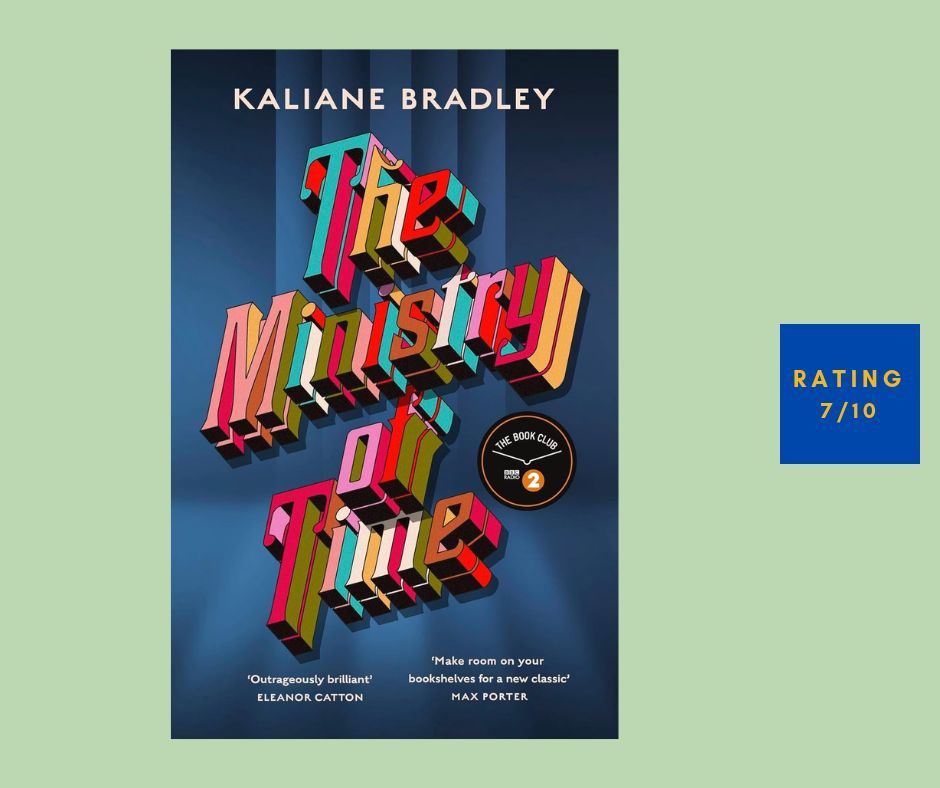
The Ministry of Time by Kaliane Bradley [7/10]
A literary sci-fi novel that reminded me of some of Kazuo Ishiguro, The Ministry of Time is a zany mishmash of classic genre time-travel ideas and modern irony, buttressed by a plot silly enough to fail but one that succeeds through sheer verve. In a near future England, a jaded public servant joins a secret ministry bringing in and examining “expats” from various spans of history. She is labelled as a “bridge,” acclimatizing the shell-shocked expats to the modern world. Her charge turns out to be an explorer from a disastrous attempt to reach the North Pole in 1847. Naturally enough, she discovers there is more to her job than what she knows, and the book’s plot accelerates after the midway point into a fantastical battle across different time eras. The author juggles the plot with high aplomb, while infusing it with the protagonist’s modern-day identity issues, and the 1847 expat is a wonderful secondary character. It all makes for an engaging, fast read of sophistication, and while The Ministry of Time does not quite give our “bridge” enough gravitas to tackle major themes, the read is a splendid one.
The Assembly by Leigh Sales [6/10]
Leigh Sales is not one to shy away from adventurous topics and in The Assembly, fifteen autistic journalism aspirants attend a course and then, over six episodes, prepare and gather to interview top Australian names. The entire process is overseen by Sales and she shines as organizer, coach, and mentor. Each episode is entertaining, each episode casts a light on certain of the fifteen, and there is even a final extra episode in which a handful discuss the experience. The trainees are extremely diverse, ranging from a brilliant woman in a wheelchair to a near-middle-aged man with little to distinguish him from a neurotypical Australian; all are keen as mustard and engaging. The six interviewees range from Anthony Albanese the Prime Minister to pop singer Delta Goodrem. Highlights were Sam Neill, battling health problems and so sweet; ex-footballer Adam Goode, inspiring and welcoming; and warm-heated, open comedian Hamish Blake. The show obliquely challenges society’s prejudices about autism in a refreshing manner. A mild series with a difference, The Assembly is well worth watching.
Gods of Tennis [7/10]
Gods of Tennis, a BBC three-part series, takes a dramatic look back at core Wimbledon match-ups over two decades from the mid-1970s to the early 1990s. Expertly weaving archival footage with an amazing array of present-day interviewees (including Billie Jean King, John McEnroe, Chris Evert, Martina Navratilova, Sue Barker, Pam Shriver, and, most significantly, the traditionally reclusive Bjorn Borg), the focus is mostly on the drama of the big matches. The most thrilling episode is the middle one climaxing with McEnroe’s victory in the 1981 final. This episode includes footage of the 1980 final won by Borg, a match I recall watching in awe. The first episode, focusing on 1975 winner Arthur Ashe and Billie Jean King, offers wider themes; Ashe pioneering race inclusivity, King pioneered equal rights for women. The final episode, building up to the 1991 final between Evert and Navratilova, is less momentous, even with the latter’s outing as gay. Overall, Gods of Tennis is a clever, diversionary documentary that should satisfy tennis fans and others alike.
The Teacher Who Promised the Sea [9/10]
A bravely emotional story from that terrible period of Spain’s history when freedom vanished just before the Spanish Civil War, The Teacher Who Promised the Sea spends most of its screen time showing a principled, modern-thinking teacher inspiring young boys and girls in a small, remote town. Enric Auquer nails the teacher and Laiai Costa rings true as a modern-day, troubled young mother searching for the fate of her great-grandfather, swallowed up by the Civil War, at a mass grave excavation site. The direction by Patricia Font is slow but kinetic, heartrending yet never sentimental; in her hands, the film becomes a search for truth and then moral beauty. There are, as one would expect from a film of this type, scenes of devastating cruelty and loss, but what stays with one after viewing The Teach Who Promised the Sea is the magic of childhood wonderment imbibing fine teaching.
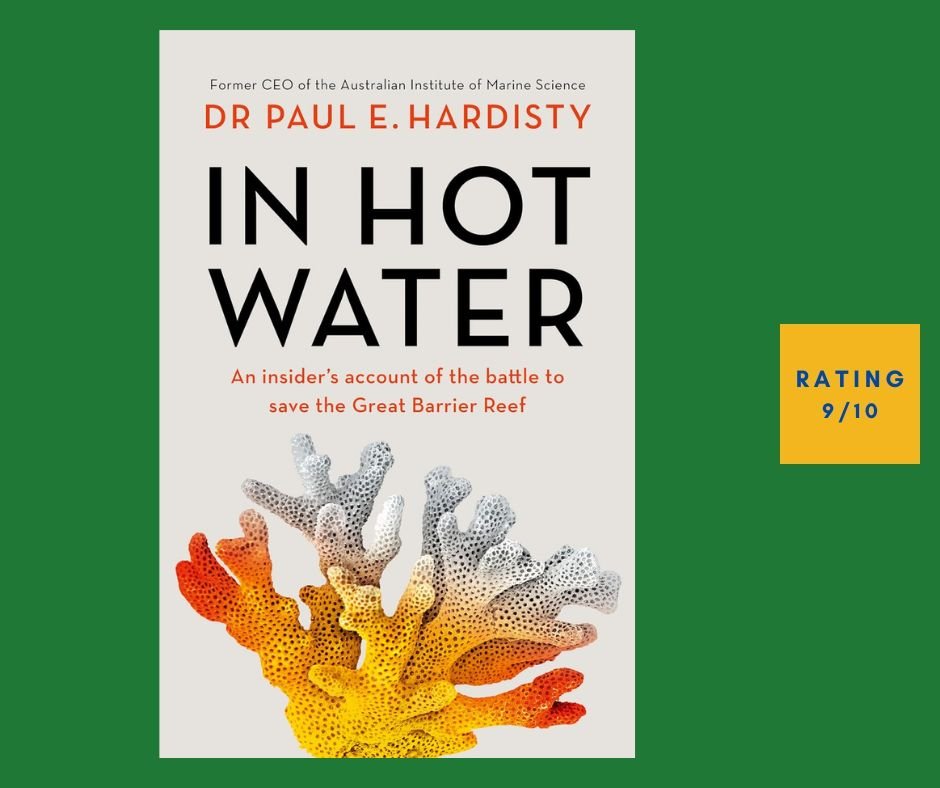
In Hot Water by Paul Hardisty [9/10]
Scientist/engineer was head of the Australian Institute of Marine Science for six years until last year. He is also a novelist and his writing skills shine in his landmark book, In Hot Water: Inside the Battle to Save the Great Barrier Reef. Covering his tenure at the helm of one of the premier science establishments working to save the world’s coral reefs, In Hot Water is a wonderfully choreographed account of what AIMS does, of the beleaguered history of the Reef, of the scarcely believable recent “climate wars” around the Reef, of the desperate straits the Reef is in, and of the last-ditch efforts being expended to save something of them. A raw heartfelt passion blazes forth from the pages, yet the calibrated, honest prose knits together something memorable. This is a hymn to the Great Barrier Reef (and other coral reefs), it is a call to action, and it is a raging funeral service. The coral reefs of the world needed a voice. Now they have one.
Touch by Baltasar Kormákur [6/10]
An Icelandic film about an old man’s quest to track down a fleeting love from sixty years earlier, Touch is constructed as the current day search from Iceland to London to Japan interspersed with the romance’s unfolding as an extended flashback. The core of the film is undoubtedly the latter, as a Finnish university student in sparky 1960s London drops out to learn cooking in a bustling Japanese restaurant. He befriends the restaurant’s owner and gradually falls in love with the owner’s daughter. The flashbacks are filmed in soft, lustrous colors that enhance the idyllic times, and the two key actors, Palmi Kormákur and Kôki are excellent as beautiful young idealists. The present-day plot (actually it is set in 2020, complete with Covid lockdowns) looks more muted and the updated key actors, Egill Ólafsson and Yôko Narahashi, are also muted. A plot twist in the form of a historic tragedy underlying the daughter’s sudden departure provides some dramatic tension in the present-day sequence but it fails to rescue it from mundanity. Overall, Touch offers many lovely, rhapsodic scenes but fails to grab the viewer.
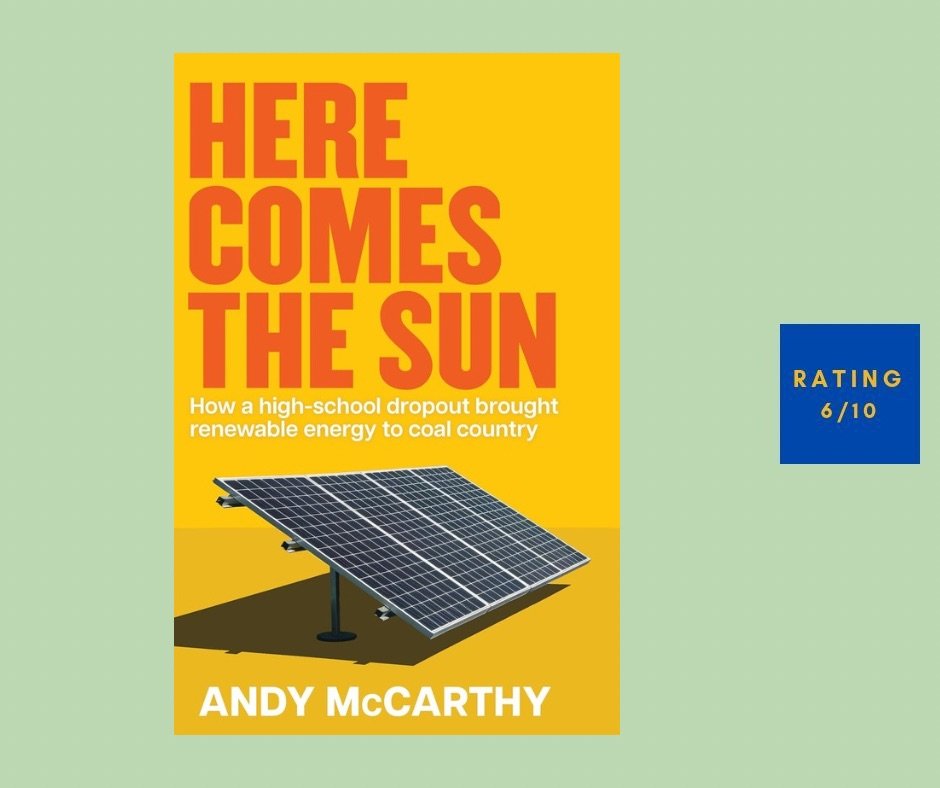
Here Comes the Sun by Andy McCarthy [6/10]
Here Comes the Sun: How a High-School Dropout Brought Renewable Energy to Coal Country is what it sounds like, a heartfelt memoir of a successful entrepreneur, and whether you enjoy it depends on whether you seek insights from such folks and whether the tale intrigues you. The author established Gippsland Solar, a solar panel provider in, as he so aptly puts it, “the heart of coal country.” The book is also the tale of a boy, teenager, and man with nerdy concentration, a dislike of authority, and prodigious energy. In the end, Gippsland Solar prospers, partly due to the author’s leadership (a “learn as you go” style of leading that is portrayed with refreshing honest), but mainly due to the emergence of energy from the sun as the next societal energy source. I found the battle between the inevitable (solar) and the all-domineering (coal) to be fascinating. Less fascinating were the humble “lessons learned,” but that reflects my stage of life. Here Comes the Sun is a refreshing tale of climate crisis success told with candor and spark.