Even though I find some of her books distinctly uncomfortable reading, A.L. Kennedy is one of my favorite stylists. What exactly is her style is hard to describe, for it’s not flashy. Her style is more in the pacing and rhythm than in flowery prose, though her descriptions are wonderful. “The Little Snake” is an oddment within her portfolio, a novella-length fable about a fabulistic snake, Lanmo, who visits humans about to die, and his unexpected friendship with little girl Mary. Told in gentle, evocative prose (“The red jewels blinked like clever, tiny eyes. This was because they were clever, tiny eyes.”), Kennedy’s meditation on death and life and everything in between glides through Mary’s life and Lanmo’s journeys. This is infinitely seductive writing in the service of a handful of basic messages, and I found it powerful indeed. Highly recommended, especially if you can read it to a young child after you’ve wept with it yourself.
Bridge of Clay by Marcus Zusak [3/10]
Much-hyped books rarely fall flat on their faces but the eagerly awaited “Bridge of Clay,” the follow-up to Marcus Zusak’s debut best seller, does just that. It’s a hefty tome classified on the Penguin website as “young adult” yet glossily marketed to the adult mass popular/literary market, with an accompanying narrative of heroic authorly struggle over a decade-plus. I came to it with excitement but quickly settled into the worst kind of reading experience, that of trudging drudgery. An ultra-thin and mawkish plot underpins the novel, that of five brothers rearing themselves after their mother’s death and father’s abandonment, with brother number four, the titled Clay, being the one to build the titled bridge (real and metaphorical) that unites them and their parents’ pasts. That plot should have sustained a novel a third the size. The jumping across timelines jars. Of all the characters, only Clay achieves any presence on the many pages, and I found the other four brothers drawn so cartoonishly that my eyes blurred at their dialogue. Zusak’s writing style is consciously weird and jagged and flowery, with only an occasional glimmer of grace. All in all, “Bridge of Clay” amounts to a lumbering shapeless blergh.
The Circuit by Rowan Ricardo Phillips [8/10]
Book-length sports writing is heroic and tough. A tennis player myself, it saddens me that I had not read an engaging tennis tome for many years. Thankfully the situation is now rectified, for poet Rowan Ricardo Phillips has penned a humdinger: “The Circuit: A Tennis Odyssey.” Phillips spent 2017 immersed in the annual tennis circuit, a sequence of major tournaments bookmarked during each of the seasons by the Grand Slams, commencing with the Australian Open around Australia Day in January, then proceeding with the French Open from the end of May, then resplendent at Wimbledon in July, before exploding with the U.S. Open concluding in early September. Phillips’s electrifying plotting device is that at the start of 2017, Federer and Nadal seem to be has-beens, while Djokovich and Murray reign supreme – will the year pan out that way? Interspersed global rankings narrate the bones of the story, but the drama lies in the author’s bold and stylish take on each tournament. I was swept up by his alternately lyrical or noirish descriptions of key matches. Beyond the top four players, another two dozen or so are beautifully showcased. I don’t know how but Phillips has turned a year of commercial tennis into a grand pageant of grand clashes between the grandest of athletes. Even if you don’t watch tennis, come read “The Circuit“: it’s a tour de force.
Green Book directed by Peter Farrelly [7/10]
Mahershali Ali is brilliant as an African-American jazz musician touring racist southern USA in the early 60s, and Vigo Mortensen is even more brilliant as Tony Lip, his hired Italian-American driver, in the feel-good “Green Book.” The movie quickly transcends the regrettable mantle of “based on a true story” and rattles along at just the perfect pace. The issues of racism are smoothly and sensitively tackled, all the acting is flawless, and the film’s only downside is a huge crest of sentimentality over the final quarter hour. A sweet example of a mismatched duo film that exudes intelligence.
Mary Poppins Returns directed by Rob Marshall [7/10]
Musicals and I don’t mix but for some reason I was attracted to seeing “Mary Poppins Returns” as a window into my childhood memories of the original. I’m pleased to report that Disney and director Marshall have not messed with the vibe of the original, indeed they have faithfully echoed it amidst a narrative shift to the modern day. The conceit is that the original Mary Poppins kids are now adults, the grown-up boy now having three precocious kids. Their mother has died, the dad is in trouble, and Colin Firth plays a malevolent banker. Zing! Down floats the “almost perfect” nanny, played to perfection by Emily Blunt. Moments of sentimentality abound but it all depends on your attachment to the original; we went with older friends who despised this treacly singalong but I channeled my inner boy and enjoyed it from start to finish. A triumph of restrained Disney magic.
The Runaway by Peter J. Thompson [6/10]
An earnest thriller in the vein of Grisham, “The Runaway” kicks off at pace and accelerates without any slack. A simple enough tale – a boy in a family under witness protection runs away and a host of corrupt company heads and killers chase him – is made human by a surprisingly large roster of in-their-heads characters, good and bad, old and young. Thompson writes smoothly and without literary flourish but with an ease that facilitates a fast, enjoyable read.
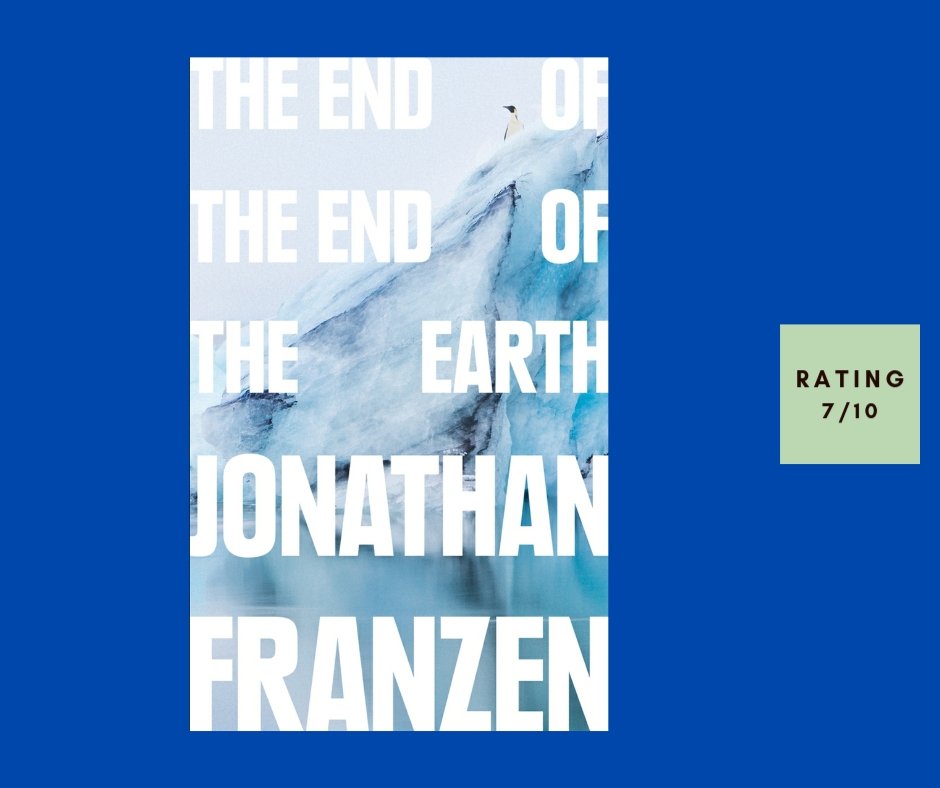
The End of the End of the Earth by Jonathan Franzen [7/10]
Jonathan Franzen is as brilliant an essayist as novelist, and “The End of the End of Earth” collects fifteen essays, mostly, he tells us, from the last half decade. Franzen speaks deepest to me when he describes himself birding, and in “Why birds matter,” he is in full stylistic flight. In that essay, he asks about “our ability to discern right from wrong”: “Doesn’t a unique ability carry with it a unique responsibility?” He slams the bird-decimating “sinkholes” of Albania and Egypt in another essay. The title piece evokes an Antarctic trip conflated with memories of his deceased godfather. Franzen is angry, discerning, and intelligent, and I’d love to say the entire collection is as spellbinding as its peaks. But the major essays sit slightly oddly among odd short essays, book reviews, and appreciations of Edith Wharton and William Vollmann. Overall, this is a deft, if often kinetic collection that readily kills an evening of boredom.
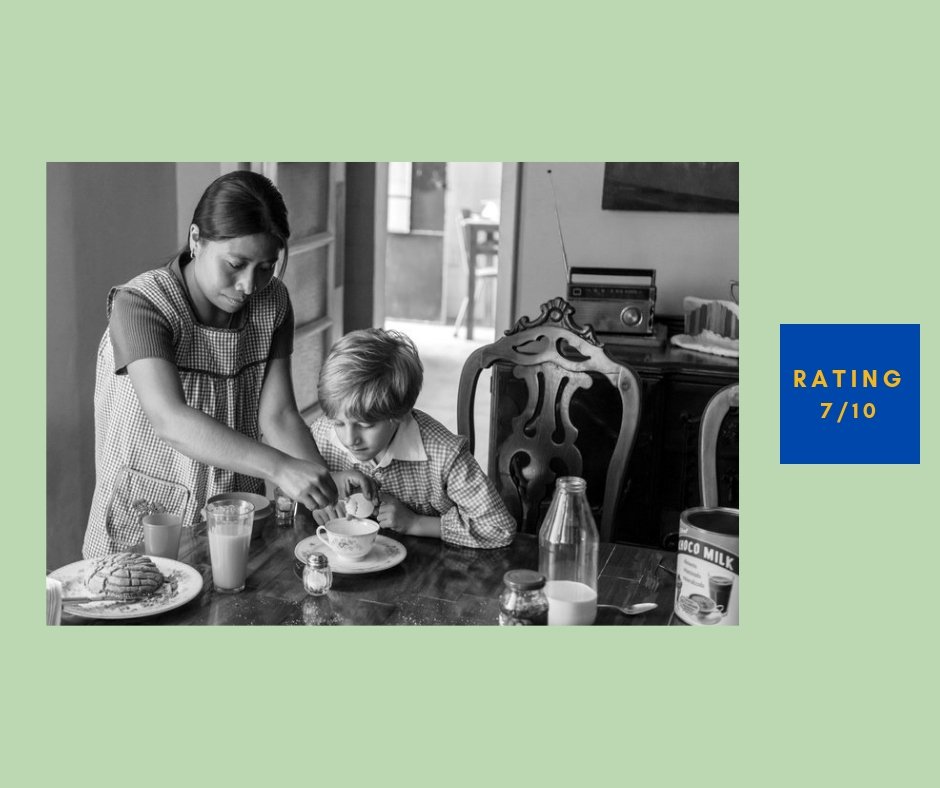
Roma by Alfonso Cuarón [7/10]
“Roma” is subdued yet stark, arty but earthy, an odd film for someone like me, sitting at the askew end of the mainstream movie-going public. The writer/director/ cinematographer has shot the entire two and a quarter hours in a dreamy black and white palette with an expressive range of grays, and he has an instinct for drawing in close or backing out into chroreographed sweeps. The story of a year in the life of the maid of a Mexican middle-class family in the early 1970s is presented with little setup or concession to storytelling ease, so I was forced to concentrate hard, and I found that intoxicating. Yalitza Apiricio, the newbie actor playing the maid, is stunning, especially in her silences. Her relationship with her mistress’s children is rendered subtly and convincingly. The actual storyline – the plot if you like – is the film’s only drawback. Though there are scenes of great drama – the massacre, the surf – the overall narrative lacks punch. Call it verity if you like but parts of the showing dragged. Overall, a most intriguing expression of a vision, but one that needed, in my opinion, additional dramatic depth.
The Eastern Curlew by Harry Saddler [7/10]
A gentle book by seemingly gentle Australian naturalist and writer, Harry Saddler, “The Eastern Curlew: The Extraordinary Life of a Migratory Bird” examines one distinctive species of migratory bird. The Easternn Curlew has a curved bill like an exaggerated scimitar and annually migrates 10,000 kilometers from the Arctic to wintering grounds in Australia, and returns again in time to breed. A few years ago, Saddler traveled to China and Korea, along the Curlew’s flyway, as well as throughout his state of Victoria, to investigate what he already knew, namely the incursions of developers into the shores that are its feeding stops, incursions that are slowly but surely destroying this splendid bird. Saddler writes smoothly and intelligently, with a wonderful air of curiosity, and the slim book is beautifully structured and paced. As he puts it: “And shorebirds can’t exist in the world that we are making. A bird that has long-distance flight so deeply and essentially ingrained in the very fabric of its existence can’t be held in a zoo. Migratory shorebirds will survive in the wild or not at all..” Even if you’re not a birder (and if not, why not?), this is a lovely example of penned naturalism in action.
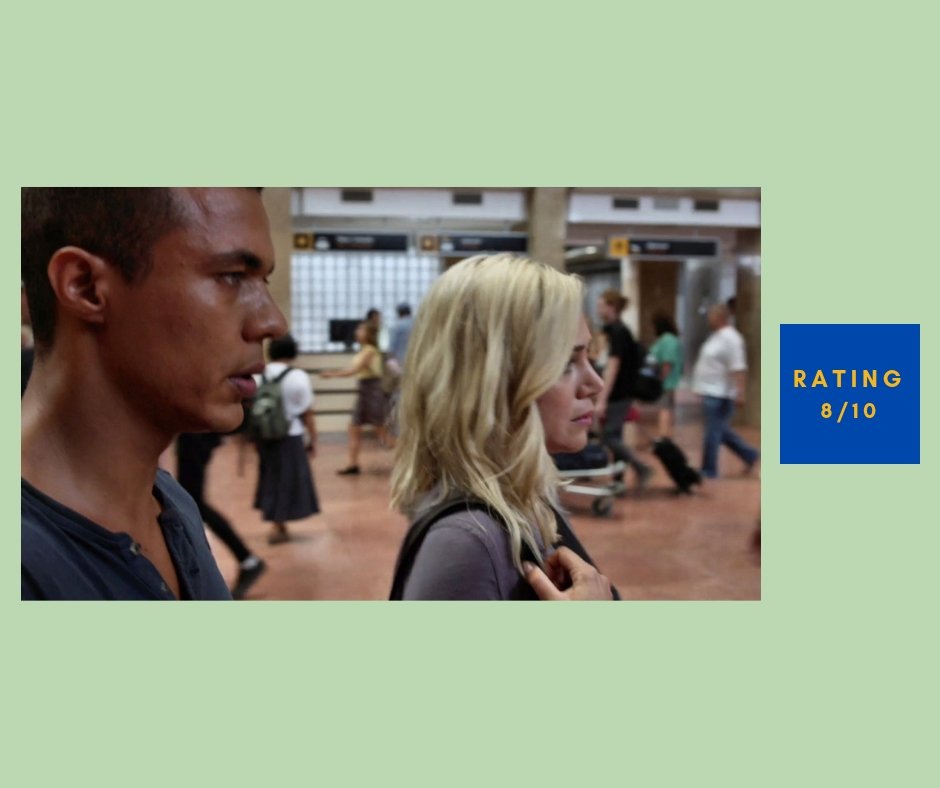
Berlin Station Season 3 Episodes 2-5 [8/10]
There’s no one in this world who can immerse us, as watcher or reader, in the murky world of espionage, in which treachery is committed by allies as often as by. enemies, in which the spies are real people, as ably as can Olen Steinhauer. Episode 1 of “Berlin Station Season 3” threatened to unmoor my enthusiasm because its scene setting in Tallinn, Estonia, was so intricate. I’m happy to report that from Episode 2, the mighty engine of Steinhauer’s plotting chops and imagination roar into life. Richard Armitage is at his best as spy Daniel Miller fleeing the Spetnatz, Leland Orser (as Robert Kirsch, second in charge) is magnificently harried and driven, and station head Valerie (played wonderfully by Michelle Forbes) is the cool, principled leader. I was especially delighted when Ismael Cruz Cordova’s cameo role as action agent Rafael Torres explodes into a major constituent. The camerawork is tight and the locales are splendid and the pace simply rocks. No episode fails to deliver a twist, almost always a disastrous one for our heroes. Motives are more circuitous than ever. Oh, I could carry on, and if espionage thrillers are not your bad, look away, but otherwise, clock on for the ride. How can the final five episodes possibly maintain this standard?